
Everyone told me this sequel was slower than the first book. Everyone was right - and I didn't care.
I was halfway through a stack of sophomore essays on The Great Gatsby (the ones where they all somehow conclude that the green light means "money" and nothing else), when I decided I needed Pip Fitz-Amobi's company more than I needed to write "expand on this" in the margins for the fortieth time. So I put in my earbuds and let Sara Line Møller Olsen's Danish narration pull me into Fairview again.
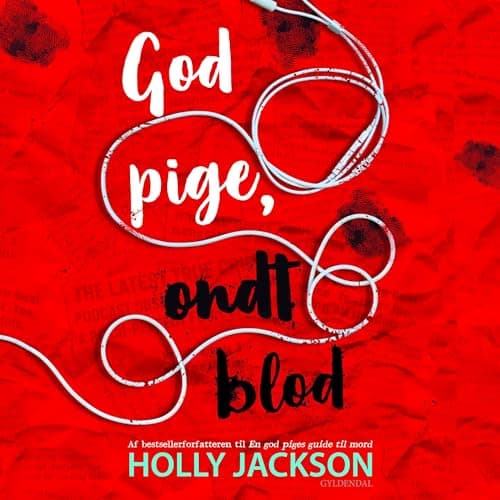
A quick note for the uninitiated: this is the Danish-language audiobook of Holly Jackson's Good Girl, Bad Blood, the second entry in her YA mystery series. I'm reviewing it as someone who teaches English literature but who's been working on his Danish with Denise's family for years. (Her grandmother in Aarhus refuses to speak English to me. Stubborn woman. I love her.)
Pip's Podcast-Within-a-Podcast Trick
What makes this second book structurally interesting - and what the audiobook format rewards more than print - is that Pip is now running her own true-crime podcast. So the audiobook has these moments where Møller Olsen shifts into a slightly different register, a more performative, public-facing voice, mimicking Pip's podcast recordings. It's a small thing, but it creates this layered effect: you're listening to a podcast about a girl who's recording a podcast about a disappearance. The narrator understands that pause is punctuation - she lets those transitions between Pip's private thoughts and her public broadcast voice breathe just enough that you feel the shift without being hit over the head with it.
The mystery itself centers on Jamie Reynolds vanishing on the anniversary of the events from book one, and the police doing approximately nothing about it. That same satisfying slow-burn tension between people who actually give a damn and institutions that don't shows up in Good Omens: A Full Cast Production, though Aziraphale and Crowley are considerably less likely to end up in a police station. If you loved A Good Girl's Guide to Murder, this picks up right where it left off - same town, same protagonist, same instinct to pull at threads until the whole thing unravels. But Jackson raises the stakes by making Pip's investigation public this time, which introduces a moral complexity the first book only hinted at. She's not just solving a puzzle anymore. She's performing the solving, and people are getting hurt by it.
Let's talk about what the author is really saying: there's a thread running through this book about the cost of obsession with truth, about whether the detective is ever really separate from the crime she's investigating. My students would hate this comparison, but it's giving me echoes of Dostoevsky's Raskolnikov - that same question of whether someone pursuing justice can remain just. Jackson writes it for a younger audience, obviously, but the bones of the idea are solid.
Where Møller Olsen Breathes Fire (And Where She Runs Out of Breath)
The narration is genuinely good. Møller Olsen differentiates characters cleanly - she gives Pip this controlled, slightly clipped delivery that loosens into something more frantic as the investigation spirals. The contrast works. When Pip's composure cracks, you hear it crack.
But here's my honest complaint: in the high-tension scenes - the confrontations, the moments of real danger - Møller Olsen goes breathy and rushed in a way that feels physically uncomfortable through earbuds at close range. It's an acting choice I understand (panic sounds panicked, sure), but at 1.0x speed, which is the only civilized speed, those moments made me pull out an earbud more than once. It's like when a student gives a presentation and mistakes volume for emphasis. The emotion is there, but the technique needs a lighter touch.
The first hundred pages or so are genuinely slower than book one. Jackson has to rebuild the investigative engine from scratch - new victim, new suspects, new dynamics - and the Danish narration, which tends to sit in a lower, more measured register than the English version, amplifies that deliberate pacing. I didn't mind. I was grading papers anyway, and the slow build gave me something to anticipate between essay number twelve and essay number thirty-six. But if you're coming straight off the adrenaline of the first book expecting the same immediate hook, you'll notice the deceleration.
The Assignment I'd Give This Book
If I were teaching this (and honestly, I've considered slipping some YA crime into my curriculum just to see if anyone actually does the reading for once), I'd ask my students to track the moments where Pip's podcast audience influences her decisions. That's where Jackson is sharpest - showing how an audience changes the investigator. The audiobook format makes this almost uncomfortably meta. You ARE the audience. You're complicit.
Who Should Listen (And Who Should Skip)
If you finished the first book and want a narrator who mostly nails the emotional architecture of a smart, stubborn girl in over her head, this is worth the credit. Listeners who need a Danish-language YA mystery that rewards close attention to voice and moral gray areas - you're in good hands. Skip it if you need constant pace from page one, or if breathy high-tension narration through earbuds isn't your thing. Just - maybe lower the volume during the last two hours. Your eardrums will thank you.