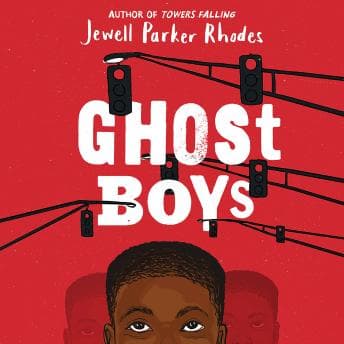

I was halfway through making dal makhani — the kind my mother would disown me for because I use too much cream — when Jerome got shot. Three hours. That's all this book asks of you. I finished it before the lentils were done, standing in my kitchen with a wooden spoon in one hand and tears I wasn't expecting running down my face.
Let me be clear about something: Ghost Boys is written for middle-grade readers. It's short. The prose is simple. And it absolutely wrecked me.
A Dead Boy's Education in His Own Death
Here's what Jewell Parker Rhodes does that's psychologically brilliant — she makes Jerome narrate his own aftermath. Not the event itself, which takes up shockingly little space, but the slow unraveling of understanding that follows. Jerome is twelve. He's dead. And he doesn't fully grasp why.
The protagonist exhibits classic features of what developmental psychologists call "naive realism" — the belief that the world works the way you experience it, that people see what you see. Jerome had a toy gun. He knew it was a toy. So how could anyone think otherwise? Rhodes doesn't rush him past this confusion. She sits in it. And that patience is what makes the book devastating rather than didactic.
Then Emmett Till shows up. Another ghost boy. And this is where Rhodes makes her sharpest move — she doesn't just draw a historical parallel, she forces Jerome (and the reader) to recognize a pattern across decades. The research actually shows that children process systemic injustice differently when they see it as a pattern versus an isolated event. Rhodes seems to understand this intuitively. Jerome's education isn't about his own death. It's about all the deaths.
Sarah and the Psychology of the Perpetrator's Child
The character that got under my skin most wasn't Jerome. It was Sarah — the police officer's daughter. I found myself asking: why does Sarah really reach out? Is it guilt by association? Genuine empathy? Some desperate need to prove her father isn't what the evidence suggests?
Rhodes doesn't give Sarah an easy arc. She's a kid who loves her dad and is slowly realizing her dad did something unforgivable. That's a psychological crisis most adult novels don't handle well, and here it is in a book for ten-year-olds. My therapist would have thoughts about this character — specifically about how children construct identity around their parents' moral frameworks and what happens when those frameworks collapse. The closest I've seen another book sit with that specific psychological unraveling — love and complicity braided together until you can't separate them — is in Getting the Love You Want, which maps how we inherit emotional frameworks from the people who raised us and then spend years trying to untangle the damage.
What I wish Rhodes had done: gone deeper. Sarah's internal conflict gets shorthand treatment. We get her doubt, her tears, her tentative bridge-building with Jerome's ghost. But the messier stuff — the denial, the anger at Jerome for making her father a monster, the part where she probably still wants her dad to tuck her in at night — that's mostly implied. The book's brevity works for Jerome's story but shortchanges Sarah's.
Miles Harvey and the Weight of Simplicity
Miles Harvey narrates with a restraint that matches the prose. Short sentences. Direct questions. The rhythm mimics how a twelve-year-old actually processes trauma — in fragments, not flowing paragraphs. He doesn't oversell the emotional moments, which is exactly right. When Jerome describes watching his mother collapse, Harvey's delivery is almost flat. And that flatness hits harder than any theatrical performance would.
The author herself narrates the afterword, and the tonal shift is noticeable — more measured, more adult, almost professorial. It's a strange transition but an effective one. It breaks the spell of Jerome's voice just enough to remind you: this isn't just a story.
My one note on the audio: at three hours with a single narrator and no sound design, there's not much to evaluate technically. Harvey does solid work differentiating characters through pacing and emotional register rather than distinct voices. It works for this book. I wouldn't call the performance extraordinary, but I'd call it exactly appropriate — and sometimes that's the harder thing to pull off.
Who This Is Really For
Here's where I get honest. If you're an adult listener looking for a complex literary examination of police violence in America, this will feel too simple. The psychological architecture is there, but it's sketched, not painted. Rhodes is writing for kids, and she respects her audience enough not to drown them in ambiguity.
But if you're a parent wondering how to talk to your children about racism and police brutality? This is a fascinating case study in how to make systemic horror child-accessible without sanitizing it. If you're an educator? Essential. If you're someone who thinks three hours of emotional investment is a reasonable ask? You'll be glad you said yes.
The Pattern Repeats Until Someone Breaks It
Ghost Boys isn't trying to be the definitive novel about racial violence in America. It's trying to make a twelve-year-old reader understand that Jerome could be their classmate, their friend, their brother. And that Emmett Till was someone's classmate, friend, brother too. The power isn't in the prose — it's in the structural argument Rhodes builds by placing these boys side by side across time.
Psychologically, that's the most important thing a book like this can do: establish pattern recognition. Because you can't fight what you can't see.
I finished the dal. It was too creamy. My mother would've been right. But I sat at my kitchen table and thought about Jerome for a long time after the last chapter ended, and I think that's the whole point.









