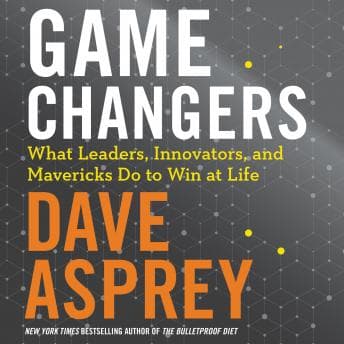

What happens when you interview 450 high performers on a podcast, ask them all the same closing question, and then run a statistical analysis on their answers?
You get 46 "laws" spread across 11 hours. Which, if you're keeping score at home, is roughly 14 minutes per law. Some deserve that time. Most don't.
I was at my desk at midnight, grinding through a client deliverable on organizational health for a Series B startup that's bleeding cash, and I had this playing in the background. The irony wasn't lost on me - listening to a book about "winning at life" while ignoring every principle it preaches about sleep, gratitude, and fear management.
46 Laws, Maybe 12 Worth Your Time
Here's the thing about Dave Asprey's approach: he's essentially crowdsourced a self-help book. The podcast interview format means you get name drops every few minutes - Dr. Daniel Amen on brain imaging, Arianna Huffington on sleep, Esther Perel on relationships, Tim Ferriss on decision-making. It's like attending a conference where every speaker gets 8 minutes and then the MC tells you what they really meant.
Some of it lands. The section on mitochondrial function and how it connects to decision fatigue? That's genuinely useful, and it connects to Asprey's actual area of expertise from the Bulletproof world. He's covered similar mitochondrial territory in Head Strong, honestly, with more depth and less padding. When he talks about gratitude practices backed by specific studies - not just "be grateful" but actual protocols with measurable outcomes - I leaned in. Law 11 on resetting your fear response through neurofeedback is the kind of practical biohacking content that justifies Asprey's brand.
But then you get entire chapters that feel like podcast episode recaps stitched together with transitions. The book is organized into three buckets - Smarter, Faster, Happier - and by the Happier section, the pattern becomes predictable: here's a guest, here's their insight, here's how Dave tried it, here's the science-adjacent justification. Rinse. Repeat. For 11 hours.
My parents didn't need 46 laws. They had maybe three: work harder than everyone, save everything, take care of your family. This is what my parents did instinctively. Now it has a TED talk. Forty-six of them, actually. If you want the shorter version of the same philosophy, it's basically what my parents ran their dry cleaner on - though I'll grant you Asprey articulates it better in Smarter Not Harder.
The Two-Narrator Problem Nobody Talks About
So here's where it gets interesting. Dave Asprey narrates portions himself, and Rick Adamson - an AudioFile Earphones Award winner for other work - handles the rest. You'd think this would be a clean split, maybe Asprey doing personal anecdotes and Adamson handling the science. But the transition between the two feels jarring. Asprey reads with the cadence of a guy who's given 500 podcast interviews - conversational, sometimes too casual, occasionally drifting into what sounds like he's pitching Bulletproof products. Adamson is polished, professional, and... kind of flat? One listener nailed it: "The author has so much more depth in the lines he read." They're both fine individually. Together, the tonal mismatch keeps pulling you out of the content.
At 2.0x, Asprey's sections actually improve - his natural pauses compress into a tighter rhythm. Adamson at 2.0x starts sounding like a GPS navigation voice. I settled on 1.75x as the sweet spot, which is rare for me.
The Elephant in the Biohacking Room
Some critics have called this book an excuse for Asprey to frame personal struggles - including past substance issues - as research material. I think that's harsh but not entirely unfair. There's a fine line between vulnerability in service of the reader and autobiography disguised as advice. Asprey walks that line, and sometimes he stumbles. The sections where he discusses his own journey with weight loss, cognitive enhancement, and relationship challenges feel more like memoir than manual. That's not inherently bad, but when you're promising "science-backed, high performance laws," readers expect the science to lead, not follow.
The supplemental PDF is a nice touch - it includes references and action items that the audio format can't easily deliver. If you're going to listen, download it. Some of the laws only click when you see the protocols written out.
Who Gets ROI Here (And Who Doesn't)
If you're new to the biohacking/self-improvement space and haven't already consumed Tim Ferriss, Ben Greenfield, and Andrew Huberman's entire catalog, this is a decent entry point. It's wide rather than deep, which works for discovery. You'll find at least five or six ideas worth testing.
If you've already read Head Strong or The Bulletproof Diet, or if you've listened to more than 50 episodes of Bulletproof Radio, skip this. The same verdict applies to Fast This Way - competent, but retreading ground for anyone already in the ecosystem. You've heard most of it. The statistical analysis angle is clever marketing but thin on execution - I wanted to see the actual data on which recommendations appeared most frequently, and that analysis gets about three paragraphs.
Skip to chapter 5. Thank me later. That's where the mitochondrial and neurofeedback content lives, and it's the strongest material in the book.
Bottom Line on the P&L
Bottom line: there's a 3-hour book hiding inside this 11-hour listen. The key takeaway is worth the listen. The other 7 hours? Not so much. Asprey is at his best when he stays in his biohacking lane and worst when he tries to be Tony Robbins. At sale price with the PDF supplement, it's a reasonable investment. At full credit price, your money works harder elsewhere. Jenny would say I'm being harsh. Jenny is right. But she'd also agree that 46 laws is about 30 too many.