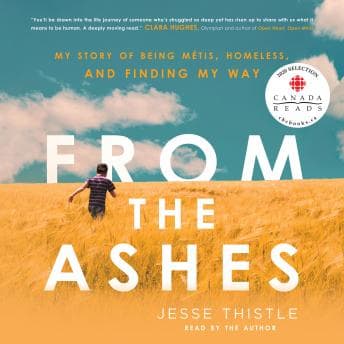

What happens when the person reading you a memoir is the same person who lived through crack addiction, homelessness, and a decade of self-destruction — and somehow came out the other side with a PhD?
I wasn't planning to listen to this one. It's not my usual lane. But I'd been up since 4AM after a pager alert that turned out to be a false positive (thanks, monitoring), couldn't fall back asleep, and needed something that would keep me anchored while I stared at the ceiling in the dark. From the Ashes did that and then some. I finished it across two restless nights and one very quiet Caltrain ride where I forgot to check Slack for forty minutes straight.
The Weight of Someone Telling You Their Worst
Jesse Thistle narrates his own story, and here's the thing — he's not a professional narrator. You can tell. His pacing occasionally stumbles, there are moments where the cadence feels a little flat, and he doesn't do "voices" for different people. But honestly? That's the point. This isn't a performance. It's a confession. When he talks about smoking crack in a Toronto alleyway and calculating whether he'll survive the night, the slight roughness in his delivery hits differently than a polished studio read would. The rawness reminded me of what drew me to Impulse — that same quality of a story that refuses to sand down its own edges for your comfort. You're not listening to an actor interpret suffering. You're listening to the actual person who suffered.
There's a particular quality to his voice when he describes his childhood — being abandoned by his parents as a toddler, landing with his grandparents in Brampton, and the way his father's addiction haunted that house like something physical. He keeps this steady, almost academic tone even when describing things that are genuinely horrifying, and it creates this strange tension. Like he's holding himself together for you. Like he's practiced telling this story to therapists and professors and maybe himself in the mirror enough times that he can get through it without breaking — but you can hear the effort.
A Systems Failure, Not a Personal One
Okay, this is where my engineer brain kicked in. Thistle's story reads like a cascading failure analysis. Remove one safeguard — parental stability — and watch every downstream system degrade. Foster care. Cultural disconnection from his Métis-Cree identity. His grandparents' "tough love" approach that was really just trauma they didn't have tools to process. Each failure compounds the next. He doesn't frame it this way explicitly, but as someone who debugs distributed systems for a living, I kept thinking: this isn't a story about one person's bad choices. This is about what happens when every safety net has holes in it.
The sections about his homelessness in Toronto are brutal and specific in a way that earned my trust. He's not romanticizing it or using it for shock value. He's just... telling you what happened. The petty crime, the shelters, the physical deterioration. And then — slowly, painfully — the recovery. The part where education becomes his lifeline, where he discovers his Indigenous heritage as an adult and it gives him something to build on instead of run from.
I'll be honest: the back third of the book, where things start improving, moves faster and feels slightly less raw. That's maybe inevitable — tragedy is more visceral than recovery. But the pacing wobble that some listeners mention is real. There are stretches in the middle where the chronology gets a bit repetitive, cycling through similar patterns of relapse and regret. At 1.25x it smoothed out for me, but at my usual 1.5x I was losing some of the emotional weight.
Who This Is Actually For
If you only listen to sci-fi and business books like me, this will rewire something in your head. It's not optimized content. It's not a framework you can apply to your morning routine. It's a human being laying out the worst decade of his life and showing you how systemic racism, intergenerational trauma, and the foster care system interact to destroy people — and sometimes, rarely, how someone claws their way back.
Perfect for: late nights when you can't sleep, solo walks, any time you want perspective on how absurdly lucky a stable childhood is. Skip for: background listening, gym sessions, anything where you need to context-switch. This demands your attention.
Not my usual genre. Not my usual narrator style. But the ROI on this audiobook is the kind you don't measure in productivity hacks — it's in understanding something about the world you didn't before.
Commit the Listen
I'm giving this a strong recommendation with one caveat: approach it like you'd approach an important conversation, not entertainment. Jesse Thistle earned the right to tell this story by surviving it, and the least you can do is actually listen.









