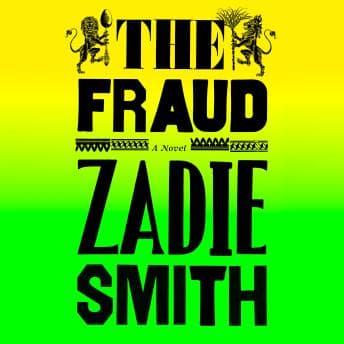

I was up way too late on a Tuesday, tweaking kerning on a mezcal brand's label redesign while Frida sat on my keyboard like she owned the place, and somewhere around hour three of this audiobook I realized I'd stopped designing entirely. Just sitting there in the dark of my apartment, chin in my hand, listening to Zadie Smith talk about sugar plantations and Victorian courtrooms and the slow rot of a man's literary reputation. Diego was asleep on the printer. I was not sleeping. I was completely, embarrassingly riveted.
Here's the thing I didn't expect: this book made me feel like I was eavesdropping on history through a keyhole held by the smartest, most sardonic woman in the room.
Eliza Touchet Lives Rent-Free in My Head Now
Mrs. Touchet — Scottish housekeeper, cousin-by-marriage to a fading novelist named William Ainsworth, and basically the person at every dinner party who sees through everyone's nonsense but is too polite (and too dependent) to say it out loud. Zadie Smith writes her with this perfect mix of intellect and frustration. She suspects her cousin has no real talent. She thinks Dickens is a bully. She watches England perform respectability while people suffer, and she can't quite figure out how to exist inside all that hypocrisy.
And then there's Andrew Bogle. Born enslaved on the Hope Plantation in Jamaica. A man who understands, bone-deep, what it costs to produce sweetness for other people. When he ends up as a witness in the Tichborne Trial — this wild Victorian case where a butcher from Australia claimed to be a missing aristocrat — the book cracks open into something bigger than a courtroom drama. It becomes about who gets believed. Whose story counts. Whose body is evidence and whose body is invisible. The God of Small Things does something similar — bodies that carry the weight of history, stories that the official record refuses to hold.
I didn't ugly-cry at this one, which surprised me. But I felt something maybe harder to name — this slow-building ache, like watching someone you love realize the world isn't going to change for them no matter how right they are.
Zadie Smith Reading Zadie Smith Is a Whole Experience
Okay so. Author-narrated audiobooks are a gamble. Sometimes you get someone who wrote a beautiful book but reads it like they're ordering at a drive-through. Zadie Smith is NOT that. Her voice has this dry, precise quality — she lands jokes with timing that made me actually laugh out loud while adjusting vector paths at 1 AM, which is not easy to do.
The accents. She does Mrs. Touchet's Scottish with this clipped, careful energy, and yes — is it a perfect Scottish accent? Honestly, no. There's a looseness to it that a Scottish listener might clock. But the way she shifts into Bogle's Jamaican cadence, or the pompous bluster of Victorian barristers in the trial scenes, or Ainsworth's particular brand of wounded-ego gentility — it's like watching a one-woman show where she's the entire cast and the stage directions. The "vocal side eye" thing people mention is real. You can HEAR her raising an eyebrow at her own characters.
What got me was the emotional register underneath the wit. During Bogle's sections, especially when he's recounting plantation life, Smith's voice drops into something quieter, more measured. Not performative grief — just... weight. The kind of restraint that hits harder than any dramatic reading would.
This Book Asks You to Sit Still and Think
I need to be honest: this is not a fast listen. At 12 and a half hours, with multiple timelines jumping between 1830s Jamaica and 1870s London, with a huge cast of historical figures weaving in and out — it demands your attention. There were moments in the first few hours where I lost track of which wife Ainsworth was on (the man went through them), and the shifting perspectives took some settling into.
If you're someone who needs plot momentum to stay hooked, you might struggle. The Tichborne Trial doesn't even really take center stage until you're well into the book. Smith is more interested in circling her themes — fraud, authenticity, who gets to claim an identity, who gets to claim a country — than in racing toward a verdict.
But at 1.0x speed? Savoring every sentence? This book felt like sitting in my abuela's kitchen while she told me a story that was really three stories, and you didn't realize they were all the same story until the very end. Abuela would have loved this one — the drama of the trial, the gossip about Dickens, the righteous anger underneath everything. She would've had opinions about EVERY character.
Who This Is For (and Who Should Maybe Read the Print Version)
If you love character-driven historical fiction where the real plot is ideas bumping against each other — yes. If you want to hear an author perform her own work with genuine skill and wicked humor — absolutely yes. If you're interested in how colonialism and class and race tangle together in ways that echo straight into the present — this is your book.
But if complex timelines and large casts in audio make your brain short-circuit, consider the print version. Several people have said the physical book is easier to track. I managed fine, but I was also giving it dedicated attention, not background listening.
The Kerning Can Wait
I finished this book three days ago and I'm still thinking about Andrew Bogle. About what it means to be the most truthful person in a room full of people performing honesty. About how every character in this novel is, in some way, a fraud — and how Smith holds that up to the light without ever getting preachy about it. My heart. Not broken, but... rearranged.