
How many business books do you actually need to tell you that organizational health matters more than strategy? Because Lencioni's been saying it since 2000, your parents' dry cleaner operated on it instinctively, and yet here we are - still buying books about it.
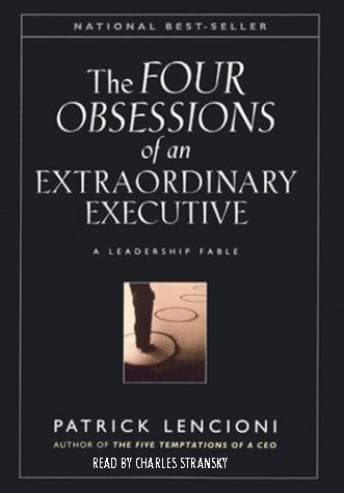
Bottom line: The Four Obsessions of an Extraordinary Executive is a 3-hour audiobook with about 90 minutes of real insight wrapped in a corporate fable that reads like a Harvard Business Review case study got drunk and tried to write a thriller. At 2.0x speed, I was done before my Tuesday morning coffee got cold. And honestly? That's the nicest thing I can say about the format.
The Fable Problem Nobody Wants to Talk About
Lencioni loves his leadership fables. You know the formula by now: two companies, one healthy, one dysfunctional. A protagonist who Gets It faces a rival who doesn't. The rival schemes. Organizational dysfunction ensues. The lesson reveals itself like a slow-motion car crash you saw coming from the parking lot.
Here, we follow Vince Green, CEO of a consulting firm called Greenwich Consulting, who's built a healthy organization through sheer discipline. His foil is Rich O'Connor at a competing firm, who's all flash and politics. The corporate intrigue the description promises? It's more like corporate mild discomfort. Rich undermines Vince's team. People get insecure. Meetings happen. I've literally lived through more dramatic power struggles in a McKinsey elevator.
But here's the thing - and this is where I have to be honest - the four disciplines Lencioni extracts from this fable are genuinely useful. Build a cohesive leadership team. Create organizational clarity. Over-communicate organizational clarity. Reinforce clarity through human systems. That's it. That's the whole book. And it's... right? Like, frustratingly right. I've watched three startups implode because their founders couldn't align on basic questions like "why do we exist" and "what do we actually do better than everyone else." Lencioni nails the diagnosis. The prescription is just thin. The gap between knowing what's wrong and actually fixing yourself — organizationally or personally — is something Emotional First Aid takes more seriously, drilling into the HOW with the clinical specificity Lencioni consistently dodges.
What My Parents Already Knew (Now With a Framework)
This is what my parents did instinctively. Now it has a TED talk.
My dad never read a leadership fable. He ran a dry cleaning business with six employees. But he had total organizational clarity - everyone knew what the shop stood for (quality, speed, Korean ajumma-level standards for shirt collars), everyone knew their role, and he repeated expectations so often my mom would finish his sentences. He reinforced it through hiring, through how he handled complaints, through who he promoted to the front counter.
Lencioni would call that "over-communicating organizational clarity" and "reinforcing through human systems." My dad called it Tuesday.
The gap between Lencioni's framework and real-world execution is where this book falls short. He tells you WHAT to do but barely scratches HOW. The six critical questions framework (Why do we exist? How do we behave? What do we do? How will we succeed? What's most important right now? Who must do what?) - that's genuinely valuable. I've used a version of this with clients. But each of those questions deserves a chapter, not a paragraph and a half after the fable wraps up.
Stransky Does the Job, Nothing More
Charles Stransky narrates this the way a competent consultant delivers a deck - professional, clear, zero surprises. He's done several Lencioni books, and you can tell he's comfortable with the material. The voice is clean. The pacing is fine. But Vince and Rich don't sound meaningfully different, which matters when your entire story depends on contrasting two leadership styles. I wasn't confused about who was speaking, but I also wasn't feeling the tension between them. It's corporate audiobook narration. It does what it needs to do.
At 3 hours, the production is tight and there's no filler audio. No music, no sound effects, just straight narration. For a business fable, that's probably the right call.
Who Gets the ROI
New managers and first-time founders - this is a solid Saturday morning listen. The framework is simple enough to implement Monday. If you're a senior leader who's read Five Dysfunctions and Death by Meeting, you already have 80% of this content through osmosis.
Skip if: you want tactical depth, case studies, or anything beyond conceptual frameworks. The negative reviews calling it "lacking specificity" aren't wrong. It's a 30,000-foot view of organizational health when some of us need the ground-level blueprints.
The Consulting Fee
Three hours. Four disciplines. One fable that won't keep you up at night. The key takeaway is worth the listen. The other 2 hours? Not so much. But at this length, Lencioni at least has the decency not to waste your whole day. Skip to the framework summary after the fable - the last 30 minutes are where the actual value lives. Thank me later.
Jenny would say I'm being harsh. Jenny is right. But she also doesn't sit through client meetings where CEOs quote Lencioni's principles while their organizations burn. The ideas are sound. The book is just... a pamphlet in audiobook clothing.