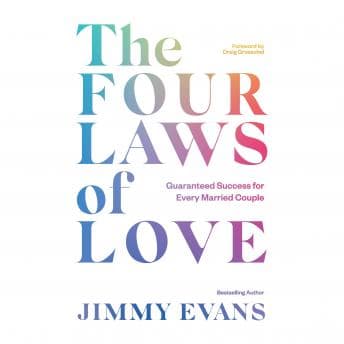

Okay so here's the thing — I'm probably the last person you'd expect to review a Christian marriage book. I'm a systems engineer who spends her waking hours debugging distributed architectures and her commute hours mainlining hard sci-fi. But Kevin and I have been having the "are we actually building something here or just coasting" conversation lately, and when I spotted this on Audible at under 6 hours, I figured: low commitment, potentially high ROI. I downloaded it on a Thursday night after a particularly brutal deploy, couldn't sleep anyway, and finished it by Saturday morning.
Here's where I'll be honest upfront: if you're not Christian or at least open to a faith-based framework for relationships, this book isn't for you. Full stop. Jimmy Evans builds his entire model on the premise that marriage was designed by God with specific intent, and the four laws flow directly from that. There's no secular version of this argument. He's not trying to give you one.
The Part Where He Almost Lost Everything
What actually grabbed me — and I did not expect this — was Evans narrating his own near-divorce story. This isn't some polished pastor-at-the-podium delivery. When he talks about being what he calls a "bad husband," about his marriage careening toward collapse, there's a rawness in his voice that you just can't fake. He's not reading someone else's script. He lived this. You can hear the difference between the sections where he's teaching principles versus the sections where he's confessing how spectacularly he failed at them. That authenticity carried me through the parts that might've otherwise felt like a Sunday sermon outline.
The four laws themselves — the law of priority, the law of pursuit, the law of partnership, and the law of purity — are pretty straightforward. Almost deceptively so. Priority means your spouse comes before everything else (yes, including your career, which made me squirm a little given my relationship with my on-call schedule). Pursuit means you never stop dating each other. Partnership means you operate as equals with distinct roles. Purity means faithfulness in every dimension, not just physical.
Could've Been a Blog Post? Almost, But Not Quite
I'll be real: the framework itself could fit in a long Medium article. Four principles, explained and applied. At 5 hours 52 minutes, there's definitely padding — Evans circles back to the same points multiple ways, uses multiple anecdotes to illustrate what you already understood two examples ago. At 1.5x this was a comfortable 4-hour listen, and I'd argue 1.75x would work fine for the middle chapters where he's layering examples.
But here's why it's not just a blog post: the personal stories give the principles weight. When Evans talks about the law of pursuit, he's not speaking abstractly — he's describing specific moments where he stopped pursuing his wife and what that actually looked like day to day. The gap between "I know I should prioritize my marriage" and "here's how I systematically failed to do that for years" is where the actual value lives.
Who This Is Actually For (And Who Should Hard Pass)
Perfect for: couples who share a Christian faith framework and want a structured, non-academic approach to strengthening their marriage. If you and your partner are the type to listen to something together on a road trip and then actually discuss it — this is built for that. Evans is clearly a pastor first, and the tone reflects that. Warm, direct, occasionally blunt.
Skip for: anyone looking for research-backed relationship psychology (go grab Gottman's Seven Principles instead), anyone not comfortable with scripture-heavy reasoning, or anyone who wants gender role discussions that push beyond traditional complementarian views. The reframe-your-assumptions energy of Think Like a Freak scratches a similar itch for people who want their frameworks challenged but without the faith scaffolding. Evans' law of partnership has a specific theological lens on husband-wife roles that will either feel clarifying or constraining depending on where you sit.
Also skip if you need a dynamic audio performance. Evans narrating his own book means you get sincerity over polish. No vocal gymnastics, no character differentiation — it's one guy talking to you like you're sitting across from him at a coffee shop. Which works for this kind of book, honestly. But if you're used to Ray Porter-level narration (and I am, always), adjust your expectations.
The Commit Message
The ROI on this audiobook is decent if — and this is a big if — you're in its target audience. I sent Kevin the chapter on pursuit and he actually paused his game to listen, which in our household is the equivalent of a standing ovation. It's not going to convert skeptics, and it's not trying to. But for couples already operating within a faith framework who want a clear, personal, no-BS structure for evaluating where their marriage is? It does exactly what it says on the tin. Short enough to not waste your time, honest enough to land a few punches.
I fixed a P0 incident and listened to a marriage book in the same week. Peak adulting.