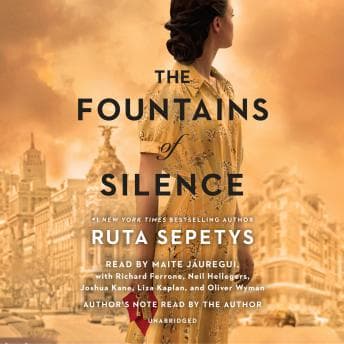

Everyone told me this was a YA book, and I almost let that stop me. Almost. I was walking the lakefront with Denise on a Saturday morning - one of those rare October days where Chicago pretends it's not about to betray you with winter - and I had about forty minutes of Fountains of Silence left. She looked over and saw my face and said, "You okay?" I wasn't, really. But we'll get to that. Chicago fiction has a way of sneaking up on you like that - I had a similar moment with Commonwealth, that quiet gut-punch where you realize the book has been building to something much heavier than the surface suggested.
Ruta Sepetys writes the kind of historical fiction I wish my students would pick up voluntarily instead of the dystopian stuff they inhale. She finds the corners of history that most curricula skip entirely - and Franco's Spain is one of the biggest skipped corners in American education. I've taught for twenty years and I can count on one hand the number of times a textbook mentions the Spanish Civil War's aftermath. The stolen children. The systematic erasure of Republican families. The complicity of the Catholic Church in facilitating adoptions that were, let's be honest, state-sanctioned kidnapping. Sepetys builds her story around all of this, and she does it through Daniel Matheson, an eighteen-year-old American photographer arriving in Madrid with his oil tycoon father and his Spanish-born mother who hasn't been back since before the war.
The Camera Sees What Silence Won't Say
What Sepetys does brilliantly here is use Daniel's camera as a metaphor that never feels forced. He's shooting photographs of a country that has been performing normalcy for two decades. The tourist brochures say sunshine and wine. The reality is informants on every block and families who've learned that grief itself is dangerous. Ana, the young woman Daniel falls for, works at the Castellana Hilton alongside her family, and her storyline peels back layer after layer of what it means to survive under fascism - not the dramatic resistance-fighter version, but the grinding daily compromise version. The quiet violence of keeping your mouth shut because speaking means your family disappears.
This reminds me of what Hemingway said about writing - the dignity of movement of an iceberg is due to only one-eighth of it being above water. Sepetys gives you the surface story of young love in 1957 Madrid, but the seven-eighths underneath is a horror story about institutional cruelty. And the thing is, she never lets the romance overwhelm the history. Daniel and Ana's relationship matters because it's the vehicle through which an outsider - and by extension, the listener - discovers what Spain has been hiding.
Seven Narrators and One Pronunciation Problem
The full cast production is ambitious. Seven narrators for a YA novel. Maite Jáuregui carries the bulk of the work, and her pacing is - I want to say deliberate, in the best sense. She doesn't rush. The prose deserves to be savored, and she seems to know that. Her Spanish is excellent, which matters enormously when you're dealing with a book where the language itself carries political weight. Names, places, the small cultural details - she handles them with the confidence of someone who actually knows the sounds.
But here's the thing nobody wants to say: her English pronunciation occasionally wobbles outside the dialogue sections. Small stuff - word stress landing in unexpected places, vowels that drift. For most of the twelve hours, it's barely noticeable. But there were a few narrative passages where I caught myself rewinding because the emphasis shifted my understanding of a sentence. It's not a dealbreaker. It's a speed bump on an otherwise smooth road. And honestly, there's something almost appropriate about a narrator whose voice lives between languages telling a story about people trapped between identities.
Richard Ferrone and Oliver Wyman are reliable presences - if you've listened to audiobooks for any length of time, you know their work. They bring weight to the adult male characters without chewing scenery. And Sepetys herself reads the Author's Note at the end, which I always appreciate. When the person who spent years researching stolen children in Franco's Spain tells you directly why this story needed to exist, it hits different than a printed afterword.
What My Students Would Actually Feel
My students would hate the pacing for the first three hours. I love it. Sepetys is building a world where tension lives in what people don't say - in the gaps between polite conversation and the fear underneath. She's teaching you to read silence the way Daniel learns to read photographs: what's in the frame matters, but what's been cropped out matters more.
By the midpoint, when the full scope of what's happening to certain families becomes clear, the slow build pays off with compound interest. I won't spoil the specific revelations, but I will say this: the sections dealing with the inclusa - the foundling home - are genuinely difficult to listen to. Not because of graphic content, but because of the bureaucratic normalcy with which terrible things are described. The narrator understands that pause is punctuation, and Jáuregui uses silence in those sections like a knife.
If you loved Between Shades of Gray, this is its spiritual successor - same empathy, different corner of the twentieth century. If you've read Orwell's Homage to Catalonia and wondered what happened to Spain after the cameras left, this fills in the picture from the ground level.
Worth Pausing the Faculty Meeting For
This is why we still read the classics - or in this case, the books that are becoming classics. Sepetys has written a novel that my sophomore students could access but that made a forty-seven-year-old English teacher stop walking on the lakefront because he needed a minute. The audiobook production mostly serves the material well, with Jáuregui's unhurried approach being the right call for a story about what happens when an entire country is forced to forget. A few pronunciation hiccups keep this from being a perfect audio experience, but the emotional architecture is sound.
Principal Martinez, if you're somehow reading audiobook reviews: this is the kind of book we should be teaching. Budget that.