
Look, I need to get something off my chest: why does Andy Weir insist on making me feel like I'm back in a statistics lecture every time he writes a short story? I love the guy's work, but "Randomize" had me staring at the dashboard of my car like a student who forgot there was a quiz today. The math-heavy heist setup is clever, sure, but in a collection where every other story is punching you in the gut emotionally, it felt like someone swapped out the dessert course for a textbook.
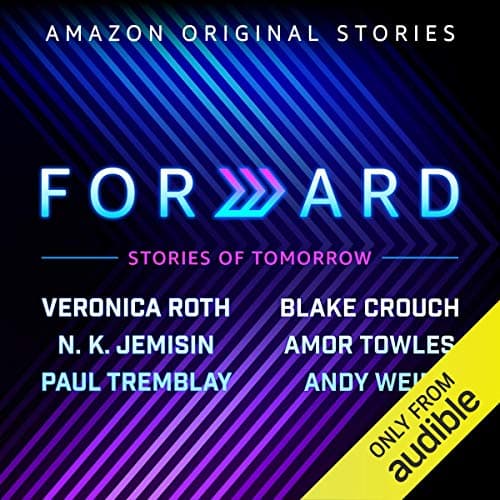
Now that I've gotten that out of my system — Forward is a genuinely impressive anthology that does something rare for short fiction collections: it justifies its own existence as an audiobook. Six authors, six narrators, six visions of the future, and the whole thing clocks in at just over eight hours. It's tight, it's varied, and the narrator pairings are so well matched to their respective stories that each entry feels like a standalone audio production.
Let me break down what works. Blake Crouch's "Summer Frost" is the centerpiece for me, and Rosa Salazar's narration is the reason. She voices an AI character named Maxine who evolves from a glitchy NPC into something disturbingly human, and Salazar tracks that evolution with her performance — her voice literally cracks at key moments, shifting from passive and mechanical to direct and emotionally loaded. It's the kind of narration that makes you pull into a parking lot and just sit there because you refuse to pause it.
Jason Isaacs reading N.K. Jemisin's "Emergency Skin" is another standout, though I should warn you: the story is structured in a way that some listeners find disorienting. You're essentially hearing one side of a conversation — the AI voice guiding an explorer back to a ruined Earth. Isaacs delivers it with this insistent, almost scornful British tone that shifts into other accents when needed, and it's technically brilliant. But if you're half-listening while cooking dinner, you'll get lost fast. This one demands your full attention.
Paul Tremblay's "The Last Conversation" is where the collection gets genuinely unsettling. Steven Strait narrates with this measured, hypnotic cadence that perfectly captures the disorientation of waking up with no memory, no identity, nothing but a disembodied voice telling you who you are. The final reveal hit harder than I expected, and Strait's delivery is a huge part of why.
Amor Towles brings the most grounded story with "You Have Arrived at Your Destination," and David Harbour — yes, Hopper from Stranger Things — reads it with this gruff warmth that suits the material perfectly. It's a near-future tale about a fertility lab that lets you preview your child's potential life paths, and Harbour finds just the right balance between humor and existential dread. It earned an AudioFile Earphones Award, and honestly, I'd listen to Harbour narrate a phone book.
Veronica Roth's "Ark" opens the collection with quiet devastation. Evan Rachel Wood reads it with a soft, resigned tone that fits the story's end-of-the-world premise — a scientist cataloging plant samples before an asteroid impact. It's beautiful and sad and doesn't overstay its welcome.
Where the collection stumbles is in consistency. Not every story lands with the same force. "Randomize" is fun but feels slight compared to the emotional weight of the other entries. And a couple of the stories — I won't name names — wrap up in ways that feel more like they were abandoned than concluded. When you've got six different authors with six different approaches to pacing and resolution, that's going to happen. It's just the nature of anthologies.
But here's what sets Forward apart from most short story collections in audio: the casting. These aren't just celebrity narrators reading words — each performer was clearly chosen because their voice matches the story's emotional frequency. That level of intentionality elevates the whole project. No music, no sound effects, no production gimmicks. Just voice and story, matched well.
Compared to something like The Very Best of the Best, which throws a wider net across sci-fi short fiction, Forward is more focused and more accessible. It's not trying to represent the entire genre — it's asking six specific writers to look forward and tell us what they see. The genre has no shortage of ambitious visions, though — I stumbled into Alas de sangre around the same time and found it scratching a similar itch for high-concept storytelling with actual emotional stakes. Some of those visions are terrifying, some are funny, and one involves a casino heist with quantum computing. The range is the point.
Who Should Listen (And Who Should Skip)
If you've burned through Crouch's Recursion or Dark Matter and want more of his sensibility without committing to another full novel, this is a perfect palette cleanser. And if you've never tried any of these authors, it's a low-risk sampler platter with genuinely excellent narration across the board. Skip it if you need your sci-fi stories to wrap up with neat, tidy bows — a couple of these endings will frustrate you — or if you can't handle math-heavy prose without zoning out at a red light like I did.









