
When's the last time you butchered a chicken? Grew a tomato? Composted anything that wasn't a corporate strategy deck?
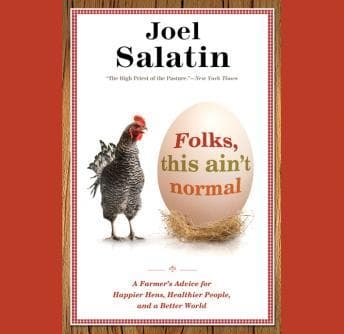
I was prepping banchan at 10 PM on a Tuesday - Jenny's mom's kimchi recipe, the one that takes three days - when Joel Salatin started telling me through my earbuds that my grocery store eggs are basically edible lies. And the thing is, he's not wrong. But man, does he take his time getting there.
The Dry Cleaner's Son Meets the Farmer-Philosopher
Here's what got me: Salatin's core argument - that industrial food systems have severed us from the natural rhythms that sustained humanity for millennia - is essentially what my parents lived every day in Koreatown without ever writing a book about it. My mom knew which vendors at the Korean market had the freshest produce. She could tell you the season by what was on the table. She didn't need a TED talk or a documentary appearance to figure out that food should come from somewhere you can actually point to on a map.
This is what my parents did instinctively. Now it has a TED talk.
But I'll give Salatin this: he backs it up. The man runs Polyface Farm in Virginia's Shenandoah Valley, and when he talks about stacking enterprises - chickens following cows following grass rotation - there's a systems-thinking elegance that would make any McKinsey partner nod approvingly. His comparison between industrial monoculture and his multi-species pasture model is basically a case study in vertical integration, except the product is actual life instead of quarterly earnings.
15 Hours Is About 9 Hours Too Many
Bottom line: this book has maybe 6 hours of genuinely sharp insight buried in 15 hours of folksy tangents, political asides, and repetition. My 2.0x speed couldn't save this one. At 2.0x it's still seven and a half hours, and by hour five I was mentally editing chapters while dicing garlic.
Salatin narrates his own book, and this is both the strength and the liability. When he's on - telling you about how his grandmother's kitchen was the original farm-to-table restaurant, or breaking down why the USDA's food safety regulations actually make food less safe - his Virginia drawl carries genuine authority. You can hear decades of dirt-under-the-fingernails credibility. "Joel narrates his own writing so you hear exactly what he intended" - and that's true. The passion is real. The irascible humor lands when he's skewering bureaucratic absurdity.
But there's a patronizing streak that creeps in. Salatin has a habit of assuming his audience is completely ignorant AND personally responsible for everything wrong with modern agriculture. By chapter 8 or 9, the folksy "well, folks" framing starts to feel less like a neighbor chatting over the fence and more like a lecture from someone who's decided you're part of the problem. Jenny would say I'm being harsh. Jenny is right. But also - I've sat through enough keynotes to know when a speaker mistakes volume for persuasion.
Where the ROI Actually Lives
The chapters on children and food are genuinely good. Salatin's argument that we've raised a generation of kids who've never seen where their food comes from - never killed, plucked, or planted anything - lands hard. His point about how food safety paranoia has made us afraid of the very processes that feed us is sharp and specific. The historical comparisons between how colonial Americans processed meat versus our current industrial system are the kind of data-rich storytelling that justifies the listen.
The economics chapters are weaker. Salatin romanticizes small farming economics in ways that anyone who's watched a family business struggle - say, a dry cleaning shop in LA working 14-hour days - will find a little naive. "Passive income" is fiction my parents never got to read, and "just start a small farm" carries similar energy. The real costs, the margins, the labor reality - he glosses past these to get to the philosophical point.
Compared to Michael Pollan's work in The Omnivore's Dilemma (where Salatin actually appears as a character), this book is rawer, less edited, more personal - but also less disciplined. Pollan is a journalist who knows when to cut. Salatin is a preacher who doesn't. The same tension between raw personal conviction and disciplined storytelling is something J.D. Vance wrestles with in Hillbilly Elegy - another book where the author's lived credibility is both the whole point and occasionally the problem.
Who Gets Value Here (and Who Doesn't)
If you're already in the sustainable food world, skip to the middle third - that's where the operational wisdom lives. If you're a suburban parent who's never thought about where your chicken nuggets originate, this might genuinely shift your perspective. If you're a business-minded listener looking for operational frameworks? There's maybe 90 minutes of applicable thinking about local supply chains and direct-to-consumer models scattered throughout.
The key takeaway is worth the listen. The other 7 hours? Not so much.
The Consulting Fee
I respect Salatin. The man practices what he preaches, literally, and that's rarer than a business author who's actually run a business. But 15 hours at his own narration pace is a commitment that the content doesn't fully justify. Speed it up, skip the repetitive political tangents, and there's a solid 5-6 hour book in here about reconnecting with food systems that actually sustained communities for centuries. My parents would've liked this guy. They also would've told him to get to the point.