
Here's my one complaint about First-Time Caller: E.J. Bingham has no business sounding that good as a radio host and then not being available on my actual commute home. I spent three weeks listening to this man narrate Aiden Valentine's buttery late-night voice and now actual Baltimore radio feels like a downgrade. Someone get this man a syndicated show.
Okay, now that I've gotten that out of my system.
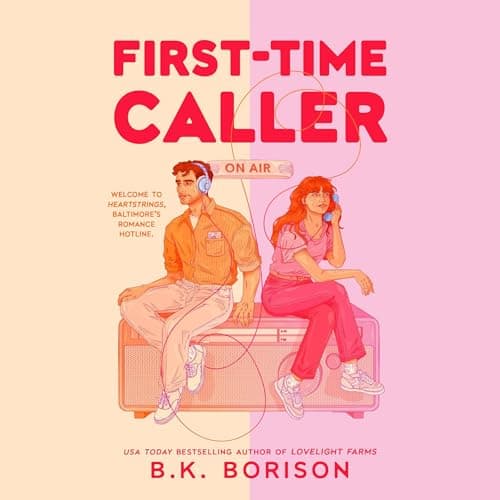
I picked this up during a week of long evening drives and made the mistake of starting it on a Monday, because by Wednesday I was actively hoping for traffic so I could keep listening. The setup hooks you fast: a little girl calls into her city's romance advice hotline, Heartstrings, to ask the host to help find her mom a boyfriend. The call goes viral. The station smells ratings gold and turns single mom Lucie Stone's love life into a public project. And the guy running the whole thing—Aiden Valentine, the voice of romantic hope for all of Baltimore—secretly doesn't believe in any of it anymore.
That tension between what Aiden sells on-air and what he actually feels is where Borison does her best work, and it's where E.J. Bingham earns every bit of the praise listeners have been throwing at him. He gives Aiden this warm, knowing radio cadence that sounds totally natural behind a microphone, but underneath it there's a tiredness, a guy going through the motions of being charming because he's forgotten how to stop. When Aiden starts cracking around Lucie—dropping the host persona, getting flustered, saying things he didn't plan to say—Bingham makes those shifts feel real rather than performed. One listener nailed it: "He was a 10/10 for me." I don't argue with that.
Hathaway Lee matches him beat for beat as Lucie. She's bright and quick without tipping into manic pixie territory, and she lets Lucie's stubbornness come through in ways that feel protective rather than bratty. Lucie doesn't want to be Baltimore's charity case, and Lee voices that resistance with enough edge that you understand it's not cute reluctance—it's a woman who built her life on her own terms pushing back against a city that suddenly thinks it knows better. The moments where Lucie's guard drops, especially around her daughter and eventually around Aiden, land because Lee has been holding that tension the whole time.
The dual narration is the reason to go audio here. These two don't record together, but you'd swear they're in the same booth during the banter scenes. There's a rhythm to the back-and-forth that Borison writes well on the page but that hits different with two voices trading lines. I caught myself grinning in a grocery store parking lot during a scene where Aiden and Lucie are arguing about dating criteria while technically on the clock at the station. That sneaky warmth—where you're smiling before you've registered why—is the book's signature move.
What keeps this from being just another cute premise is the emotional baggage both leads carry. Aiden's disillusionment with romance isn't played for laughs; it's rooted in something specific and painful that the book takes its time revealing. Lucie's past includes a parent's cancer diagnosis (now in remission) and the kind of parental abandonment that leaves marks you organize your whole life around. Borison doesn't wallow in either thread, but she doesn't wave them away either. They sit underneath the rom-com surface and give the funny moments actual weight.
Lucie's daughter deserves a mention because kid characters in romance novels are usually either invisible or unbearable, and this one is neither. She's sharp and a little scheming—she did call a radio show to matchmake her mother—but she reads as an actual child rather than a tiny adult delivering precocious one-liners. The fact that her call sets the whole plot in motion and the epilogue circles back to it gives the story a satisfying shape.
I do wish the audio production had leaned harder into the radio show setting. A few sound effects—a jingle, some on-air static, the click of a soundboard—would have made the Heartstrings scenes pop even more. The narrators carry the atmosphere on vocal performance alone, and they do it well, but a little production design would have pushed this from great to truly something special.
If you've listened to Borison's Lovelight Farms books, this is a step up in emotional complexity while keeping that same cozy, hopeful DNA. I had a similar but slightly more mixed reaction to In the Weeds, which has all that same warmth but didn't quite stick the emotional landing the way this one does. The Sleepless in Seattle comparison on the cover is accurate: there's a public love story everyone's watching and a private one happening behind the scenes that turns out to be the real thing. At nearly twelve hours, it earns every minute. The ending doesn't cheat with a manufactured third-act blowup—just two people recognizing that the connection they've been building off-mic matters more than the show.
Who should listen: If you love slow-burn romances with dual narration, found-family warmth, and a premise that's got that nostalgic nineties rom-com glow, this is your next listen. Who should skip: If kid characters in romance make you cringe no matter what, or you need high-heat scenes to stay engaged, this one probably isn't for you.