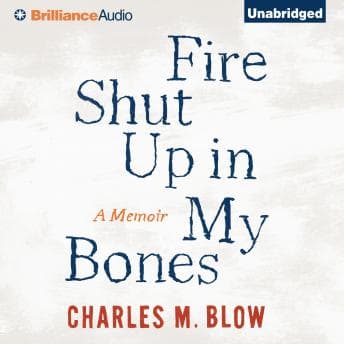

"I drove south on old highways, a gun on the seat beside me, tears streaming, screaming at a God I wasn't sure existed."
That's how Charles M. Blow opens this memoir. Not with a preamble, not with context, not with the kind of gentle throat-clearing most memoirists use to ease you in. He drops you into a car with a loaded weapon and a man unraveling, and then — only then — does he take you back to Gibsland, Louisiana, to show you how he got there.
I was walking the lakefront with Denise on a Saturday morning when that opening hit me. She asked why I'd stopped mid-stride. I didn't have a good answer. I just stood there with the wind off Lake Michigan and Charles Blow's voice in my ears, that deep, unhurried baritone telling me about the worst moment of his life like he was reading scripture at a funeral.
The Kind of Silence That Speaks
Let's talk about what the author is really saying when he narrates his own memoir at this pace. Because yes — Blow reads slowly. Some listeners find it monotone. I understand that criticism. His pitch doesn't dance around. He doesn't do voices for his mother or his brothers or the cousin who abused him. He delivers the whole thing in this steady, low register that some people will mistake for flatness.
But here's what I think they're missing: the prose deserves to be savored. Blow writes with a poet's instinct — short declarative sentences that land like closed fists, then these gorgeous, winding passages about the Louisiana landscape that open up like somebody cracking a window in a stuffy room. When he reads lines about his mother — this woman with brass knuckles in the glove compartment and a job plucking chickens and a ferocious love of newspapers — he doesn't need vocal fireworks. The material carries itself. The narrator understands that pause is punctuation.
That said, I'll be honest. Around hour six, during some of the fraternity passages, I did find myself wishing for just a touch more vocal energy. The hazing sequences are brutal and surreal, and Blow's even delivery sometimes flattens moments that should hit harder. It's a trade-off. You get authenticity and dignity, but you occasionally lose urgency.
Gibsland Is a Character, and Blow Knows It
What struck me most — what I kept thinking about while grading a stack of sophomore essays at 11 PM with this playing in my headphones — is how Blow writes place. Gibsland isn't just a setting. It's an argument. This is a town where slavery's echo isn't metaphorical. The elders remember things their grandparents told them firsthand. Violence isn't an aberration; it's weather. And Blow renders all of this with the kind of specificity that makes you smell the red dirt and hear the screen doors.
This reminds me of what Hemingway said about writing one true sentence and then going from there. Blow's truest sentences are about his mother — her five sons, her collapsing marriage, her refusal to let poverty define her boys. The scenes of her working the poultry line and then coming home to push her children toward books? My students would hate this. I love it. That particular dynamic — a mother's fierce, unglamorous love reshaping what a son believes he's worth — is something Mother and Son: The Respect Effect circles around from a completely different angle, and reading them in proximity to each other did something to me I'm still working out. It's the kind of quiet heroism that doesn't fit neatly into a movie trailer but sits in your chest for days.
And then there's the abuse. Blow writes about being molested by an older cousin with a restraint that is somehow more devastating than graphic detail would be. He shows you what it does to a boy's understanding of himself — the anger, the confusion about sexuality and masculinity, the years of self-interrogation. When he reads these passages in his own voice, you understand why this had to be author-narrated. No hired voice could carry that particular weight of memory without it feeling performed. Blow isn't performing. He's testifying.
The Fraternity Chapters Will Test You
I'll warn you: the section about pledging his fraternity at Grambling State is hard to listen to. The hazing is extreme, and Blow doesn't flinch from it. But what makes it genuinely unsettling is the pivot — when he's asked to become the one inflicting pain. That moment is where the memoir earns its title. The fire shut up in his bones isn't just the abuse he suffered. It's the question of whether trauma reproduces itself, whether the abused inevitably becomes the abuser. Blow's answer is complicated and honest, which is the only kind of answer worth giving.
Who Needs to Hear This (And Who Might Struggle)
If you loved James McBride's The Color of Water or Kiese Laymon's Heavy, this is their spiritual successor — Southern Black memoir that refuses easy redemption arcs. If you need fast pacing or vocal variety from your narrator, you might want to bump the speed to 1.15x or 1.25x. (I listened at 1.0x because the author chose those words, but I understand I'm in the minority on this one.)
This is not a background listen. Not for the gym. Not for half-attention while cooking. This book asks you to sit with discomfort, and Blow's deliberate pacing won't let you skip past the hard parts.
Worth Pausing the Faculty Meeting For
A Lambda Literary Award winner narrated by the man who lived it. The voice is imperfect — too slow for some, too steady for others. But the story is fierce and true, and there are passages about motherhood and manhood and the strange geography of shame that I haven't stopped thinking about in a week. This is why we still read the classics, and why some memoirs become them.