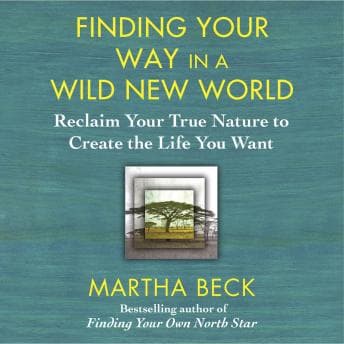

"Drop into wordlessness."
That's the instruction Martha Beck gives you about forty minutes in, and I remember exactly where I was when I heard it — standing in my kitchen at 11:30 PM, post-incident review finally done, trying to make chamomile tea with hands still buzzing from four hours of debugging a cascading failure in our logging pipeline. And this audiobook just... told me to stop thinking in words.
Reader, I tried it. I stood there holding a mug and attempted to be wordless. My brain immediately generated the sentence "I am being wordless right now." So.
The Four Steps Are Basically a Framework, and I'm a Sucker for Frameworks
TL;DR: Worth your commute if you're the type who needs your woo-woo wrapped in structure.
Beck's core thesis is that some people are natural "wayfinders" — healers, creatives, people who feel pulled to help others but can't figure out how to monetize or even operationalize that impulse. She lays out four steps: Wordlessness (meditation-adjacent), Oneness (connection with nature and others), Imagination (creative visualization), and Creation (actually doing the thing). It's basically a spiritual practice disguised as a self-help methodology. Or maybe the reverse. That tension between the mystical and the structured reminded me a lot of Witch of Blackbird Pond — totally different genre, but the same pull between intuition and the community telling you to sit down and be normal.
Here's what surprised me: the science actually holds up. Partially. Beck cites real neuroscience around default mode networks and flow states, and she's a Harvard-trained sociologist, so she's not just pulling from a crystal shop. But she also spends real time talking about communicating with animals through telepathy and sensing energy fields, and — look, I debug distributed systems for a living. My tolerance for unfalsifiable claims is calibrated pretty tight. About 30% of this book triggered my BS detector hard.
But the other 70%? Genuinely useful. Her framework for getting out of your analytical mind and into creative problem-solving is something I've accidentally used during 2 AM outages — that state where you stop reading the logs line by line and just see the pattern. Beck would call that dropping into wordlessness. I'd call it sleep deprivation plus caffeine reaching a specific equilibrium. Potato, potahto.
Heather Henderson Carries This Book on Her Warm Alto Shoulders
The narration is genuinely good. Henderson has this warm, grounded voice that keeps the more mystical passages from floating off into space. When Beck tells stories about her clients — and there are many, including a memorable character referred to as "The Rhino" who is exactly the kind of bulldozer personality you'd expect — Henderson shifts into distinct character voices. She does a Scots nanny at one point, and a Fargo-esque housewife, and both are specific enough that you can track who's talking without the "wait, who said that?" rewind tax.
She reads it like it's her own work, which for a self-help book is the sweet spot. You don't want detached NPR voice for this kind of material. You want someone who sounds like they believe it. Henderson does.
That said — 12 hours. Twelve. Hours. For a self-help book. Could've been a blog post is too harsh here because there's genuine depth, but could've been 7 hours? Absolutely. The guided reflection exercises are fine if you're sitting in a quiet room with a journal, but I was on the 6:47 AM Caltrain pressed against a guy eating a breakfast burrito. I was not dropping into oneness with the universe. I was dropping into oneness with his hot sauce.
Who This Is For (And Who Should Bail by Hour 2)
Perfect for: long walks, housework, weekend mornings when you're already in a reflective headspace. Also genuinely good if you're in a career transition and need permission to pursue something less conventionally optimized.
Skip for: the commute (too meditative, you'll zone out at the wrong parts), deep work, or anyone who needs their self-help books fully evidence-based. If you eyeroll at the phrase "the universe is conspiring to help you," you'll have a rough middle third.
Kevin listened to about twenty minutes, said "this is like if your meditation app became sentient and wrote a memoir," and went back to his Bobiverse re-listen. He's not wrong, but he's also missing something real in here.
The ROI on this audiobook is weird — it's not a productivity book, it's not a business book, it's a "who are you and what are you actually supposed to be doing" book. And at 1.5x speed (my default), it clocked in at about 8 hours, which is still long, but I finished it across maybe five commutes plus that late-night tea session. Some of it stuck. The wordlessness exercises are actually useful before high-stress meetings. The animal telepathy stuff, less so.
Worth a Credit? Only If Your Spirit Animal Has a Budget
Honest assessment: this is a good book wrapped in 30% too much content and about 25% too much mysticism for my taste. Henderson's narration elevates it significantly. If you're already Beck-curious, go for it. If you want something tighter with similar "find your purpose" energy, I'd point you elsewhere first. But if it catches you in the right headspace — exhausted, questioning your trajectory, making tea at midnight — it hits different than you'd expect.