
What happens when a fantasy series built on illusion has to finally pull back the curtain?
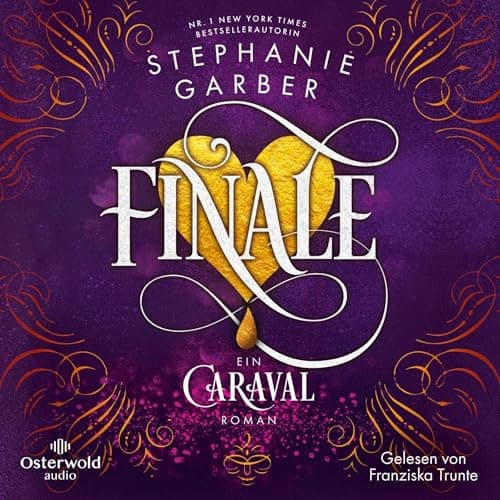
I was shelving returns at the library — late shift, nobody around but the hum of fluorescent lights and Shirley Jackson's namesake glaring at me from the staff break room webcam — when I decided to put Finale on. German-language audiobook, Franziska Trunte narrating, the conclusion to Stephanie Garber's Caraval trilogy. I figured a YA fantasy romance wouldn't exactly scratch my horror itch, but I've been on a kick lately of exploring how other genres handle dread and suspense. And Garber, to her credit, plays in that space more than people give her credit for.
The Illusion Finally Has to Mean Something
Here's the thing about the Caraval series: the first two books get to hide behind the conceit that nothing is real, everything might be a trick, and you should trust no one. It's a great gimmick. But by book three, Garber has to cash the checks she's been writing. Legend's true nature, the Fates breaking free, Tella and Scarlett's fates (lowercase and uppercase) — all of it has to land.
And... it mostly does? The shift to alternating perspectives between Donatella and Scarlett works better here than in Legendary because both sisters actually have stakes that feel distinct. Tella's tangled feelings for Legend carry real tension — not just "will they or won't they" tension, but the genuine uncertainty of loving someone whose entire identity might be a performance. That's actually kind of terrifying if you sit with it. The horror of loving someone whose face might be a mask is something R.F. Kuang excavates from a completely different angle in Babel, where the performance of identity carries genuinely violent consequences. Scarlett's arc is quieter, more about agency and breaking free from the patterns of control that defined her in book one. The emotional throughlines are the strongest part of this finale.
But — and this is a significant but — the plotting gets wobbly in the middle act. The Fates as antagonists never quite achieve the menace Garber seems to want from them. They're described as impossibly powerful, ancient, dangerous, and yet the resolution to their threat feels rushed, almost convenient. For a book called Finale, the actual climax needed about thirty more minutes of breathing room.
Trunte Carries the Weight in German
Listening in German adds an interesting layer. Franziska Trunte has a clear, warm delivery that suits the romantic fantasy register well. She differentiates Tella's impulsive energy from Scarlett's more measured voice, which is crucial when chapters alternate between them. Where she really earns it is in the scenes where Legend drops his masks — there's a shift in her tone that communicates vulnerability without overselling it.
That said, I don't have a ton of specific performance data to work with here, and I want to be honest about that. Trunte isn't a narrator I've spent dozens of hours with, and the German-language audiobook market doesn't get the same granular critical coverage as English releases. What I can say is that at nearly thirteen hours, she maintains consistency, and the production is clean — no weird edits, no volume drops, nothing that pulled me out of the story. For a single-narrator fantasy with this many characters and emotional registers, that's not nothing.
Who Should Listen (And Who Should Skip)
If you've read (or listened to) Caraval and Legendary, obviously you're here for the ending. And you should be — Garber delivers on the emotional promises even when the plot mechanics get shaky. If you're coming to this cold, don't. This is emphatically a book three experience; the payoffs depend entirely on investment built across the first two installments.
Pick this up if you want a fantasy that prioritizes feeling over fight choreography. Skip it if you need your magic systems to make rigorous logical sense — Garber's magic has always been more aesthetic than architectural, and Finale leans into that fully. The rules of the Fates, the mechanics of Legend's power, the costs of the various deals — it all operates on emotional logic rather than systematic logic. That's either going to charm you or drive you up a wall.
Closing the Book on Caraval
I finished Finale at the end of my shift, locking up the library in the dark — and okay, I'll admit, a YA fantasy romance shouldn't have made me feel things at midnight in an empty building, but Tella's final choice got me. Not scared, obviously. (Shirley Jackson walked so Stephanie Garber could... stroll briskly, let's say.) But genuinely moved by the idea that the scariest thing in this series was never the magic or the Fates — it was choosing to be honest with someone who's built their entire existence on deception.
My podcast listeners who've been asking me to cover more fantasy-adjacent work: this is a good entry point into understanding how dread and romance use the same toolkit. Garber understands that uncertainty — not knowing who to trust, not knowing what's real — is the engine of both love stories and horror. She just picks a different destination. That same toolkit — dread dressed up as something else entirely — is exactly what King and Chizmar were working with in Gwendy's Button Box, where a seemingly innocuous object carries weight that the reader feels long before the characters do.