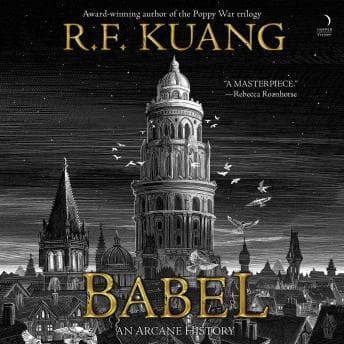

I finished this at 11 PM on a Tuesday, grading papers completely forgotten, and I just sat there in my kitchen staring at the wall. My wife Denise came in, saw my face, and asked if someone died. And I said, "Several people, actually. In 1839. And I'm not okay about it."
Look, I've been teaching literature for twenty years. I've read the colonial critique novels. I've assigned them. I've listened to seventeen-year-olds fumble through discussions about imperialism while checking their phones under their desks. But R.F. Kuang? She wrote the book I wish I'd had in grad school. The one that makes you understand - really understand - how language itself becomes a weapon of empire.
The Magic System That Made Me Stop Walking
I usually listen while doing my lakefront walks with Denise. This one made me stop. Multiple times. Because Kuang built a magic system around translation - around the untranslatable gaps between languages - and it's the most intellectually satisfying fantasy concept I've encountered since I first read Le Guin. That same intellectual satisfaction - fantasy that trusts your brain - is what I loved about Last Wish: Introducing the Witcher, though Kuang operates on a whole different level of academic rigor.
Silver-working. The idea that you can capture the meaning lost between languages and manifest it as power. It's brilliant. And it's a metaphor that doesn't feel like a metaphor. It IS the thing it's describing. The British Empire didn't just take resources - it took languages, flattened them, weaponized them. Kuang makes you feel that theft in your bones.
The footnotes - and yes, this book has footnotes, and yes, they work in audio - are where the academic in me got absolutely fed. Etymology breakdowns. Translation theory. Historical context. Billie Fulford-Brown narrates these separately from the main text, and honestly? It's genius. Like having a brilliant professor whispering context in your ear while the story unfolds.
Chris Lew Kum Hoi Understands the Assignment
Here's the thing about narrating a book obsessed with language: you better be able to handle multiple languages. Chris Lew Kum Hoi doesn't just handle them - he inhabits them. The Mandarin, the Latin, the Greek. The way he shifts between Robin's internal voice and his performed Britishness. This is what I mean when I tell my students that narration is interpretation.
There's this moment - I won't spoil it - where Robin has to choose between two versions of himself. Two languages. Two loyalties. And the way Kum Hoi voices that fracture? I had to pause. Just... pause. Stand on the lakefront and feel the Chicago wind and process what I'd just heard.
(My students would absolutely hate this book, by the way. Too long. Too many ideas. Not enough action until the end. I love it.)
Fulford-Brown's handling of the footnotes deserves its own praise. She's warm but precise. Academic but accessible. The separation between narrators creates this layered experience - story and scholarship woven together. It's how I wish I could teach.
Where It Gets Complicated
I'm not going to pretend this is a perfect listen. The second half shifts. The cozy Oxford academia - the friendships, the linguistic puzzles, the dark academia vibes - gives way to something harder. More explicitly political. Some listeners bounce off this. The pacing changes. The lectures on imperialism get more direct.
But here's my take, and maybe this is the teacher in me: the shift IS the point. You can't stay in the ivory tower. Knowledge serves power. And when Robin finally understands that - when the reader finally understands that - the book becomes something else entirely.
There are some minor editing hiccups with Kum Hoi's sections. Nothing that broke immersion for me, but I noticed. And at nearly 22 hours, this is a commitment. This is not a faculty-meeting-background listen. This demands attention.
The Question That Haunts
"Can powerful institutions be changed from within, or does revolution always require violence?"
Kuang doesn't give you an easy answer. She gives you Robin - brilliant, conflicted, colonized and colonizer both - and she makes you sit with his impossible choice. This reminds me of what Fanon wrote about violence and decolonization, but Kuang makes it personal. Makes it hurt.
I've added this to my podcast queue. Episode coming soon. (Mom, please stay awake for this one.)
Who Should Listen (And Who Should Skip)
Anyone who loved Jonathan Strange & Mr. Norrell but wanted it to actually grapple with empire. Anyone who thinks magic systems should mean something. Anyone who's ever felt like an outsider in an institution that claims to want them. Their Eyes Were Watching God explores that outsider experience too, though through a completely different lens - Hurston writing in a voice that refused to flatten itself for white audiences. Students who think classics are boring - this might change your mind.
Skip it if you want fast-paced fantasy. If you don't want to think about colonialism for 22 hours, fair enough. If you need your protagonists to win cleanly, look elsewhere.
Me? I'm going to listen again. At 1.0x, obviously. The author chose those words. And Kuang chose every single one with devastating precision.









