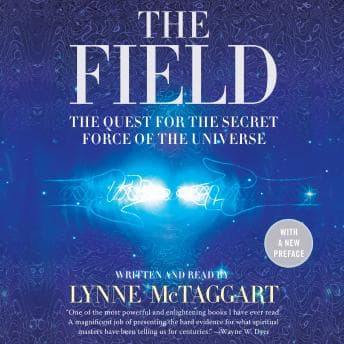

Look, I need to get something off my chest before we go any further: if you're going to claim that consciousness shapes physical reality, you'd better bring receipts. And Lynne McTaggart does bring receipts - sort of. The problem is that some of those receipts are from stores that mainstream science isn't sure actually exist.
I was halfway through a chicken tikka masala - the onions at that crucial caramelization stage where you can't walk away - when McTaggart started describing the zero point field experiments, and I genuinely stopped stirring. Not because I was convinced. Because I was fascinated by the structure of her argument. This is a fascinating case study in how investigative journalism techniques get applied to fringe science, and the result is something that reads (or listens) like a mystery novel where the detective is maybe a little too eager to declare the case solved.
The Scientific Detective Who Already Knows The Answer
Here's what McTaggart does well: she profiles real researchers. Fritz-Albert Popp and his biophoton work. Karl Pribram's holographic brain theory. She treats these scientists like characters in a thriller, tracking their eureka moments and professional struggles, building narrative tension around each discovery. As someone who literally studies narrative psychology, I can tell you - the storytelling architecture here is effective. You feel like you're watching a conspiracy unravel, breadcrumb by breadcrumb.
But - and this is a significant but - the research actually shows that good storytelling can make weak evidence feel stronger than it is. It's called the narrative bias, and McTaggart's book is practically a textbook example. She presents each study as another piece of a grand puzzle, but she rarely lingers on replication problems, sample sizes, or the fact that many of these experiments haven't been accepted by the broader scientific community. I found myself asking: why does she skip from one experiment to the next so quickly? Psychologically, the answer tracks perfectly - she's maintaining momentum so you don't stop to question the last claim before she's already stacking another one on top.
The duplication issue that other listeners have flagged is real. By hour six, I'd heard certain concepts restated three or four different ways. It felt less like reinforcement and more like the book didn't trust me to get it the first time. Which is ironic for a book that asks you to accept some pretty extraordinary leaps of logic on relatively thin evidence.
McTaggart Narrating McTaggart
She reads her own work, and honestly? It's fine. Her delivery is clear, her pacing is measured, and she handles the scientific terminology without stumbling. But there's a flatness to author-narrated nonfiction that a trained voice actor might have avoided. When she's describing, say, the emotional journey of a researcher who spent decades being ridiculed by peers, it lands more like a news report than a human story. The information comes through. The feeling doesn't always.
At ten hours, this is a commitment. And at normal speed - which I'd recommend, because the science vocabulary demands it - you're going to need dedicated listening time. This is not a background-while-doing-dishes book. I tried. I missed an entire section on quantum coherence while draining rice.
The Psychology Researcher's Problem With This Book
Here's where I get genuinely conflicted. McTaggart interviews researchers who are doing interesting, sometimes genuinely innovative work at the edges of established science. Some of it is worth knowing about. The problem is the frame she puts around it. She doesn't present this as "here are some intriguing hypotheses that need more investigation." She presents it as "here is the secret force of the universe that They don't want you to know about." The protagonist exhibits classic confirmation bias - every study confirms the thesis, every skeptic is just not seeing the bigger picture. I saw the same narrative pattern in her follow-up, Intention Experiment—it's as if she's workshopping the same thesis on slightly different material.
And that framing matters. Because if you're someone dealing with health issues or existential questions (and let's be honest, that's a lot of the audience for books like this), the implication that your consciousness can heal you is not a neutral claim. My therapist would have thoughts about telling struggling people that their minds are failing to properly interact with the universal energy field.
That said - I'm not dismissing everything here. The sections on Popp's biophoton research are genuinely interesting. The overview of zero point energy as a physics concept is accessible and well-explained. If you can separate "here's some cool frontier science" from "this proves we're all connected by a mystical field," there's value in this listen.
Who Gets The Most Out Of This (And Who Should Run)
If you're already interested in consciousness studies, alternative medicine frameworks, or the intersection of quantum physics and philosophy, this is a solid primer on the arguments that camp makes. You'll find it energizing.
If you're a skeptic looking for rigorous methodology? But if you'd rather not wrestle with quantum mysticism, a dose of ancient wisdom might be a refreshing palette cleanser—Of Peace of Mind by Seneca tackles similar inner-work questions with far fewer logical leaps.You will spend ten hours arguing with your earbuds. If you're somewhere in the middle - curious but critical - you might actually get the most out of it, because the tension between "that's interesting" and "wait, that doesn't follow" keeps your brain engaged.
Just don't mistake engaging storytelling for scientific consensus. The human mind has patterns. One of the biggest? We believe things that feel like good stories.