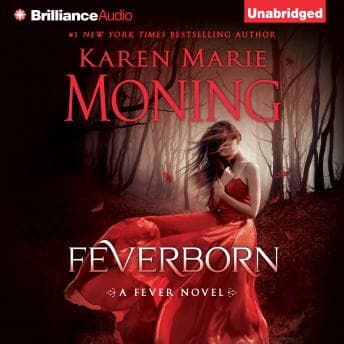

Look, I need to rant about something before we get into this: why does the Fever series keep switching narrators? This is book 8. EIGHT. I've been listening to these characters for dozens of hours at this point, and swapping out the voices is like someone replacing your coworker's Slack avatar mid-conversation - technically functional, but deeply unsettling in ways you can't fully articulate at 6:15 AM on a Tuesday.
Okay. Deep breath. Let me back up.
The Narrator Swap Nobody Asked For
I started Feverborn on a Sunday night when Kevin was out and I was stress-cooking my way through a particularly annoying on-call weekend (no pages, but the anxiety was doing its thing). Twelve hours and thirty-nine minutes later - spread across about four days of commutes plus that one late night where I couldn't stop - I have... feelings.
Luke Daniels and Jill Redfield are objectively talented narrators. Daniels has genuine range - he cycles through a roster of Fae princes, ancient warriors, and Dublin lowlifes with impressive differentiation. His side characters? Sharp. Distinct. You can tell who's talking without the "said" tags. But here's where it falls apart for me: Barrons and Ryodan. These are supposed to be dangerously magnetic, centuries-old immortals dripping with barely-contained power. Daniels gives them voices that land somewhere between "confident middle manager" and "your friend's cool older brother." Not bad voices. Just... not those characters. If Barrons walked into a room sounding like that, Mac would not be having the reactions she's having. The chemistry runs on tension, and the voice needs weight behind it.
Redfield handles Mac competently - the internal monologue sections flow well, she nails the sarcasm, and her emotional range during the darker self-confrontation scenes actually hit. But then there's the accent situation. Dani/Jada is Irish. Very Irish. It's a core identity marker for the character. And what we get instead is something that drifts into what I can only describe as Georgia-by-way-of-nowhere. It's not constant, which almost makes it worse - you'll get a solid line delivery and then the next sentence sounds like a different character entirely. For a series this deep into its run, that inconsistency is hard to forgive.
Dublin's Runtime Exception
The story itself is doing a LOT. Moning is juggling the Keltar conflict, the nine immortals running Dublin, the Seelie queen's disappearance, the Unseelie prince power grab, Mac and Jada being hunted, the Song of Making quest, AND Mac's internal reckoning with her darker self. It's like watching someone try to resolve a massive merge conflict across twelve branches simultaneously - impressive when it works, chaotic when it doesn't.
The Mac-versus-herself thread is genuinely the strongest part. There's a rawness to how Moning writes Mac confronting what she's become after eight books of escalating supernatural trauma. It's not neat, it's not pretty, and Redfield actually earns her keep in these passages. The quieter moments where Mac is trying to figure out if she's still human enough to trust herself - that's where the book breathes.
The romance and tension between Mac and Barrons still runs hot. Like, content-warning-level hot. If you're listening on public transit, maybe don't have your volume up when those scenes hit. I learned this the hard way when the guy next to me on the Caltrain definitely heard something he shouldn't have through my earbuds. At 1.5x speed, the spicier scenes hit fast and without warning.
But the pacing is uneven. The political machinations with the Keltar and the immortals drag in the middle third - lots of exposition about who controls what and ancient power structures that could've been trimmed by a good two hours. I bumped up to 1.75x for those stretches and lost nothing.
Who Should Deploy This
If you've been with the Fever series since Darkfever, you're going to listen regardless of what I say. And you should - the Mac storyline pays off in ways that matter, and the world is genuinely in crisis mode here. The stakes feel real even when the pacing stumbles.
If you haven't read the earlier books? Hard skip. This is not a standalone. You will understand approximately nothing. It's like jumping into a codebase with zero documentation at commit #4,000. The disorientation of mid-series entry is something I ran into with Sabotage in Space too — dropped into a world mid-momentum with no onboarding, and it showed.
If you're deeply attached to the previous narrators (Natale Naudé, Phil Gigante), brace yourself. The transition is rough. Not deal-breaking, but rough. Give it about two hours to recalibrate your expectations.
Worth the Commute Hours?
TL;DR: Worth your commute if you're already invested in the series. The narrator swap is a downgrade for key characters but not a disaster. Mac's internal arc carries the book through its slower stretches. Bump the speed during the political exposition, slow back down for the character moments. The ROI on this audiobook is decent but not great - you're paying a premium in patience for the narrator adjustment period, and the middle sags. But that ending? Sets up the next book in a way that had me downloading Feversong before I got off the train.