
I expected this to be one of those niche business books that's basically a glorified LinkedIn post stretched to 10 hours. The kind where someone with a recruiting firm writes a book that's really just a business card with chapters. And honestly? The first hour or so had me bracing for exactly that.
I was wrong. Mostly.
The Dry Cleaning Shop That Became a Dynasty (Just Kidding, But Also Not)
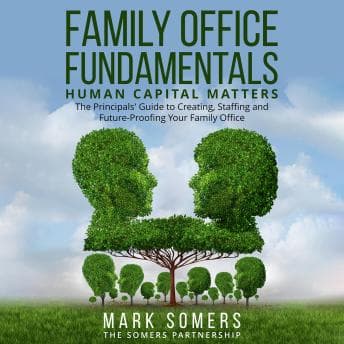
Here's the thing about family offices that most people don't realize: they're basically my parents' dry cleaning business scaled up by a factor of a billion. Same family dynamics, same succession headaches, same "Uncle won't stop meddling" problems. The difference is the zeros on the balance sheet and the fact that someone like Mark Somers gets paid handsomely to sort it out.
Somers has spent 20+ years recruiting for billionaire family offices, and he's pulled insights from 50 principals, consultants, and practitioners who actually operate in this space. What surprised me - and I was listening at 1.75x on a Saturday morning while Jenny was at yoga - is how much of this applies outside the ultra-high-net-worth bubble. The human capital frameworks here, particularly around hiring for cultural fit versus technical competence in family-governed structures, are problems I've seen at three different startups where founders couldn't let go of hiring decisions. The psychological piece underneath all of that - why high achievers resist delegating, why founders micromanage hiring - gets a sharper treatment in Motivation Myth, and it reframes some of what Somers is describing in useful ways.
The case studies are where the real value lives. Somers walks through specific scenarios of family offices that got staffing wrong - brought in a CIO who was technically brilliant but couldn't navigate the family politics, or hired a family member into a role they weren't qualified for because, well, family. If you've ever watched a founder's kid get installed as VP of Something at a company you're consulting for, you know this pain. I've lived it.
When the Recruiter Reads His Own Resume
Somers narrates his own book, which is always a gamble. He's not a professional narrator, and you can tell. But here's the counterintuitive take: for this specific book, author-narration actually works. He's essentially talking you through the way he'd brief a client, and his delivery has that consultative cadence - measured, clear, case-study-driven. It's not going to win any Audie Awards, but it doesn't need to. The illustrative examples land better because you can hear the guy who actually placed these candidates telling you why the placement worked or didn't.
The downside? Ten hours and thirty-eight minutes is too long. This is what my parents did instinctively - they knew who to hire, who to trust, who was family-loyal versus just loyal-to-a-paycheck - and they figured it out without a 10-hour audiobook. Somers could've delivered 80% of the value in 6 hours. There's repetition in the middle sections, particularly around governance structures, where the same principles get repackaged with slightly different framing. Skip to chapter 5. Thank me later. That's where he gets into the actual hiring frameworks and succession planning mechanics.
Who Needs This (And Who Really Doesn't)
Let me be specific because the target audience here is narrow. If you're advising or operating within a family office - or building a family business that's approaching the complexity where you need dedicated staff beyond the family itself - this is genuinely useful. The section on how to structure compensation for non-family executives who'll never have ownership stakes is worth the listen alone. That's a problem I've seen destroy three consulting engagements because nobody wanted to have the honest conversation about equity versus loyalty.
If you're a startup founder or general business reader looking for broad management insights? You'll extract maybe 2-3 hours of applicable material. The family office-specific governance stuff (trust structures, multi-generational wealth transfer protocols) won't apply unless you're swimming in those waters.
Somers clearly knows his world. The guy was twice named one of the top 100 most influential people in the family office sector, and won an Outstanding Contribution to Wealth Management award in 2021. That credibility shows - he's not theorizing, he's reporting from the field. But the book reads like it was written for conference keynotes first and edited into a book second, which means some sections feel more like panel discussion prep than structured argument.
The Bottom Line on Your 10-Hour Investment
Bottom line: this is a solid reference guide disguised as a narrative business book. The key takeaway is worth the listen - human capital decisions in family offices require a fundamentally different framework than corporate hiring, and most families learn this the expensive way. The other 7 hours? Not so much. But for the specific audience that needs this, there's nothing else like it on Audible. Somers owns this niche, and he's earned it.
Jenny would say I'm being harsh. Jenny is right. But she also doesn't have to sit through governance chapter three saying what governance chapter one already said.