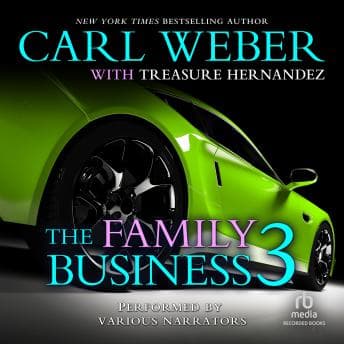

Look, I need to get something off my chest: I am a snob. I know this. My podcast is literally about annotating classic literature for an audience smaller than my homeroom class. So when I tell you I picked up Family Business 3 — the third installment of Carl Weber's Duncan family saga — it wasn't because I was browsing the literary fiction shelf at Powell's. It was because Denise left it playing on the Bluetooth speaker while she was cooking Sunday dinner, and by the time the jollof rice was done, I was hooked. And a little mad about it.
Here's my complaint: Carl Weber writes cliffhangers like a man who wants you to suffer. I hadn't even listened to books one and two, and I still felt the pull of that ending yanking me forward like a fish on a line. That's annoying. That's also craft.
The Duncans Are the Corleones of Queens — and They Know It
The setup here is soap opera with a body count, and I mean that with genuine respect. LC Duncan is in a coma. Vegas, fresh out of prison, is trying to reassert himself in the family hierarchy. Junior's romantic entanglements have somehow provoked Brother X and an army of Muslim hit men — and yes, I typed that sentence knowing how wild it sounds. But Weber and Hernandez play it straight, and the stakes feel real because the family dynamics feel real. The Duncans fight like a family that actually loves each other, which is to say viciously and with zero boundaries.
What surprised me is how much attention gets paid to Rio's development. Listeners keep coming back to that character, and I get it now. There's a slow-burning arc there — someone finding their place in a family where your place might get you killed — that carries real emotional weight. This reminds me of what Hemingway said about prose being an iceberg: most of the meaning sits below the surface. Weber isn't Hemingway, obviously, but he understands that the best drama comes from what characters don't say to each other. That subterranean emotional architecture — the thing unsaid doing more work than the thing said — is something I noticed in a completely different register when I reviewed Cuentos de Amor de Locura y de Muerte, where Quiroga wrings entire tragedies out of what his narrators refuse to name. The Duncans talk around their grief, around LC's condition, around the power vacuum his coma creates. And that silence is louder than the gunfire.
Two Narrators, One Family War
Jules Williamson and Kevin R. Free split narrator duties, and the dual-narrator approach is smart for a book with this many competing perspectives. The drama and intrigue come through — you can feel the temperature rise in certain scenes just from vocal shifts. I wish I could give you more granular detail on exactly how they divide characters, but honestly, my research came up thin on specifics, and I'm not going to fake it.
What I can tell you is that the emotional delivery works. When Vegas comes back into the fold and the family has to decide whether to trust him or fear him, the narration lands those beats. The pacing moves — at 8 hours and 36 minutes, this is a lean book that doesn't waste your time with filler. Weber's a "leave you wanting more" writer, and at 1.0x speed (yes, I'm that guy), it clipped along without dragging. Though I'll admit: for a book this plot-driven, 1.25x wouldn't hurt if you're the type. I won't judge you. Much.
Who's Going to Love This (and Who Should Keep Walking)
If you're deep into urban fiction — the Wahida Clarks, the Sistah Souljahs, the Ashley & JaQuevis crowd — this is a no-brainer. Weber's been doing this for years and he knows exactly what his readers want: family loyalty tested by violence, romance complicated by power, and enough twists to keep you pressing play at 11 PM when you should be grading sophomore essays on The Great Gatsby. (Not that I would know anything about that.)
If you're coming in cold to the series, you can follow this — I did — but you'll feel the gaps. Characters reference events from books one and two with the assumption you were there. It's like walking into a family reunion where everyone's mid-argument. You'll figure out the sides eventually, but you'll miss some context.
And if you need your fiction to come with a Pulitzer pedigree? This isn't for you. But I'd gently suggest that's your loss. My students would actually read this. They'd pass it around and argue about who's loyal and who's a snake. And honestly? That's more than I can say for half the books on my curriculum.
Mr. Williams's Grade: B, With a Note Home
This is a page-turner — or, more accurately, an "I-missed-my-exit-on-Lake-Shore-Drive" turner. It's not going to change your understanding of the human condition. But it's going to make your commute disappear, your treadmill session feel short, and your Sunday cooking soundtrack infinitely more dramatic. Weber leaves you wanting more, and I hate that I'm now looking at book four. Denise is going to be insufferable about this.