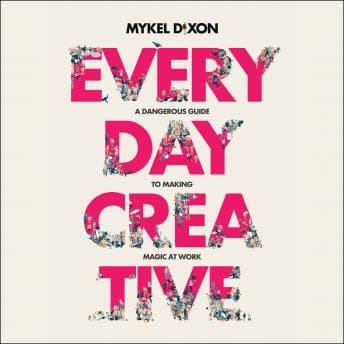

"Creativity doesn't belong in the boardroom" — that's the unconscious belief Mykel Dixon identifies early on, and I nearly dropped the onion I was dicing when he said it. Not because it was shocking, but because I recognized it immediately. I've spent years studying why people construct identities that actively work against their own interests, and here was Dixon, a musician-turned-corporate-creativity-consultant, diagnosing the exact same phenomenon in organizational psychology. The human mind builds prisons and then forgets it holds the key. Same pattern whether you're looking at a protagonist in a thriller or a middle manager at a Fortune 500 company.
I was making my mother's rajma recipe — the long version, the one that takes three hours and requires you to stand there stirring and thinking about your life choices — and Dixon's narration kept me company through every stage. At under six hours, this is a tight listen. Which matters, because self-help books that overstay their welcome are basically the audiobook equivalent of that colleague who could've sent an email.
The Psychology Dixon Gets Right (And Where He Loses Me)
What makes this book interesting from a research perspective is that Dixon isn't just recycling the tired "unlock your inner artist" framework. He frames creativity as an identity problem — we've internalized the idea that creative people are other people, not us. The protagonist of your work life exhibits classic learned helplessness when it comes to original thinking. You've been conditioned out of it. Dixon argues this convincingly, drawing from his background as a musician and learning designer who works with senior leadership teams. The accountability angle — who owns your own creative stagnation — is something QBQ! The Question Behind the Question also circles, though from a much more procedural angle that honestly made me appreciate Dixon's identity-first framing even more by comparison.
The research actually shows he's onto something real here. There's solid work in narrative psychology about how professional identity constrains behavior — we perform the role we think we're supposed to play. Dixon doesn't cite the academic literature (this isn't that kind of book), but his instincts track. He understands that the barrier to workplace creativity isn't a skills gap. It's a self-concept gap.
Where I found myself pushing back: the book occasionally tips into motivational-speaker territory, and the practical frameworks feel lighter than I wanted. Dixon is clearly a dynamic speaker — you can hear it in how he narrates, with an energy that suggests he's more comfortable on a stage than behind a desk — but some sections felt like they were building toward an insight that never quite crystallized into something I could use on Monday morning. I kept waiting for the dangerous part of the "Dangerous Guide" subtitle to hit harder. It's provocative framing for what is, structurally, a fairly conventional business creativity book.
Author-Narrated: The Double-Edged Sword
Dixon narrates his own work, and this is a fascinating case study in what author-narration buys you versus what it costs. On the plus side: he believes every word he's saying. You can hear it. There's a conviction and rhythm to his delivery that a hired narrator probably couldn't replicate — the pauses land where they should because he wrote them to land there. His background as an award-winning speaker shows. The man knows how to hold attention.
The cost? Author-narrators sometimes lack the technical range of professional voice actors, and at nearly six hours, there are moments where the inspirational tone becomes a bit monochromatic. I found myself craving tonal shifts — some quiet, reflective passages to balance the energetic delivery. But honestly, for a business-self-help hybrid, this is a minor complaint. You're not here for character voices. You're here for ideas delivered with genuine passion, and on that front, Dixon delivers.
Who This Is Actually For (Be Honest With Yourself)
If you're someone who already reads creativity research — Csikszentmihalyi, Ed Catmull, even the more accessible stuff like Austin Kleon — this might feel like ground you've covered, just from a different angle. Dixon's contribution is the corporate application lens and his particular energy as a communicator.
But if you're the person who secretly thinks "I'm not the creative one on this team"? If you've built an entire professional identity around being the analytical one, the operations person, the one who executes but doesn't ideate? This book is basically a psychology intervention aimed directly at that belief system. And Dixon — part musician, part corporate consultant, part provocateur — is a surprisingly effective therapist for that particular wound.
My therapist would have thoughts about how many of us construct work identities that systematically exclude the parts of ourselves we most need. Dixon clearly has thoughts about it too.
The Prescription
I'd recommend this at 1.25x speed for the sections that lean heavily inspirational, and normal speed for the framework-heavy chapters where you actually want to sit with the ideas. It's a good commute or workout listen — not quite dense enough to demand dedicated focus throughout, but engaging enough that you'll want to be paying attention for the moments that land. And some of them do land. Hard.
Is it the most rigorous book on creativity I've encountered? No. Psychologically, some claims could use more scaffolding. But Dixon understands something important about human nature: we don't change because someone gives us a better process. We change because someone gives us permission to see ourselves differently. That's not nothing. That's actually — if you study identity formation like I do — kind of everything. What a Time to be Alone operates in a completely different register — more personal, less corporate — but it does the same essential psychological work: handing the reader a reframe about who they're allowed to be.