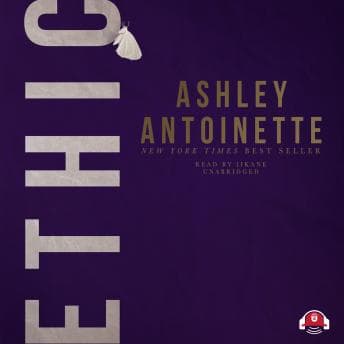

Look, I need to be honest about something upfront: I am not Ashley Antoinette's target audience. I'm a fifty-something English teacher whose idea of street literature is Dickens's London. But here's the thing about being a reader - a real one, not just someone who curates a shelf - you have to leave your lane sometimes. And Ethic pulled me out of mine at 11 PM on a Tuesday while I was pretending to grade sophomore essays on The Great Gatsby. The irony of moving from Fitzgerald's old money to Ezra Okafor's streets was not lost on me.
So here's my complaint: why did nobody tell me about Ashley Antoinette sooner? Forty-plus novels. A whole universe built on Moth to a Flame that I've never touched. I walked into this spin-off cold, and while I could follow the story - Ethic as the reformed street king haunted by ordering the hit that killed the woman he loved, now raising three kids including the wonderfully defiant Morgan - I kept getting the nagging sense I was missing layers. Like reading King Lear without knowing about Gloucester. The book functions on its own, but there's connective tissue here that rewards the faithful reader. That same feeling of walking into someone else's world mid-story hit me with Then She Was Gone, where Cara Hunter builds on a history you sense but never fully see - and somehow it deepens rather than frustrates.
What Hemingway Would've Called "The Iceberg" Problem
Antoinette does something genuinely interesting with Ethic as a character. He's built on contradictions - powerful enough to have once controlled the game, broken enough that guilt has hollowed him out from the inside. The premise of a man who ordered a hit that accidentally killed his own love? That's Greek tragedy dressed in contemporary clothes. Sophocles would recognize this man. The weight Ethic carries isn't just backstory decoration; it shapes every decision he makes as a father, every wall he puts up against intimacy. When Morgan keeps pushing toward the streets he's trying to leave behind, there's a generational tension that feels earned, not manufactured.
But - and this is where I have to put on my teacher hat - the character work occasionally stumbles over itself. There are moments where Morgan's characterization feels inconsistent, where her motivations shift in ways that seem driven more by plot necessity than organic growth. My students would call this "the author needed something to happen so they made it happen." I've read enough Dostoevsky to know that characters can contain contradictions, but there's a difference between complexity and inconsistency. This book sometimes blurs that line.
IiKane and the Narrator Divide
Here's where things get complicated. IiKane's performance is genuinely polarizing, and I understand both sides. When she's locked in emotionally - and she is locked in for most of the eight-and-a-half hours - you feel like you're sitting in the room with these characters. There's a rawness to her delivery during the heavy emotional sequences that made me stop pretending to grade and just listen. One listener I came across said IiKane made them "feel every emotion the character felt," and yeah, I get that. The narrator understands that pause is punctuation, and she uses silence the way Antoinette uses short sentences - for impact.
But I also get why some people bounced after two hours. There's an adjustment period. IiKane's style is performative in a way that asks you to meet her halfway, and if you're not willing to settle into her rhythm, it can feel like too much. I'd compare it to listening to a jazz vocalist who bends notes - if you're expecting clean studio pop, you're going to be frustrated. I wasn't frustrated. But I was aware of the performance in a way that occasionally pulled me out of the story rather than deeper into it. At 1.0x speed (because the author chose those words and I choose to hear them properly), there were stretches where I wished for just a touch more restraint.
Who Gets the Assignment and Who Gets Excused
If you're already in Ashley Antoinette's world - if Moth to a Flame meant something to you - this is required reading. Full stop. The emotional architecture is built for readers who care about these characters, and the street-lit elements are grounded in real consequence rather than glamorization. The prose deserves to be savored, especially when Antoinette writes about Ethic's guilt. Those passages carry genuine weight.
If you're like me, coming in cold from the literary fiction side, there's still plenty to appreciate here. But know that you're walking into book one of a six-book series, and this is very much a setup novel. The ending doesn't so much conclude as pivot.
Skip this one if: you need tight plotting over character atmosphere, or if you're sensitive to violence, abuse, and explicit content. The content warnings are real.
The Red Pen Says
Ethic isn't the kind of book I'd normally reach for, and that's exactly why I'm glad I listened to it. Antoinette writes with a directness that most literary fiction authors - myself included, on my little podcast that exactly 47 people listen to - could learn from. She's not trying to impress you with the sentence. She's trying to hit you with it. And when IiKane matches that energy, the combination works. Not perfectly. Not without stumbles. But with enough raw emotional honesty that I kept listening past midnight, Gatsby essays be damned. My students would probably love this. And for once, they might not be wrong.