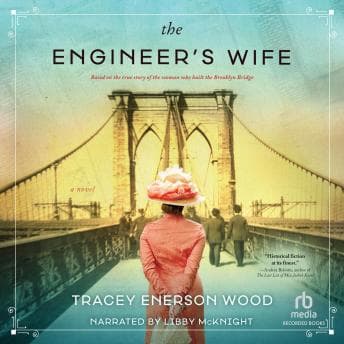

"The bridge is my husband's dream. But whose hands are building it?"
That line hit me somewhere around hour six, walking the lakefront with Denise while the November wind off Lake Michigan tried to freeze my earbuds into my skull. Emily Warren Roebling is asking herself the question every ambitious woman married to an ambitious man eventually confronts—and Tracey Enerson Wood doesn't let her off easy with a simple answer.
This is why we still read the classics. Or in this case, why we listen to historical fiction that understands what the classics were doing.
The Weight of Someone Else's Monument
Wood's debut novel does something I rarely see pulled off well: it takes a woman who history remembers as a footnote ("the engineer's wife who helped finish the Brooklyn Bridge") and digs out the full human being underneath. Emily isn't just supporting her husband Wash—she's sacrificing her own suffragist work, her own identity, her own ambitions. And the novel is honest enough to show that she resents it. That she loves him anyway. That both things are true.
The prose deserves to be savored. Wood writes with the kind of period-appropriate restraint that never feels like costume drama—Emily's internal voice has a sharpness that feels modern without being anachronistic. There's a scene where Emily descends into the caisson beneath the East River, into the pressurized nightmare where workers are dying of what they don't yet understand is the bends, and the claustrophobia is palpable. I actually stopped walking and stood there on the path like an idiot, completely transported to 1870s New York.
The P.T. Barnum subplot adds a strange, almost carnivalesque energy that shouldn't work but absolutely does. It's a reminder that Emily moved through a world of spectacle and showmanship, not just engineering drawings and suffragette meetings.
Now About That Narration Problem
Libby McKnight's performance is—and I say this with genuine frustration because I wanted to love this audiobook—a mixed bag that occasionally tips toward a real problem. Her emotional range is solid. She captures Emily's determination, her exhaustion, her complicated love for Wash. The pacing works.
But the mispronunciations. Lord, the mispronunciations.
"Emphasize" instead of "empathize." "Secrete" instead of "secret." "Lopped" instead of "loped." These aren't obscure technical terms—they're common vocabulary, and every time one landed wrong, it yanked me right out of 1870s Brooklyn and back to grading papers at 11 PM wondering if my students would catch the error. (They wouldn't. But I did.)
I've seen other listeners call the narration "very well done," and I genuinely don't understand how we heard the same audiobook. Maybe some people's brains autocorrect more generously than mine. After twenty years of teaching English, my internal editor has no off switch.
Who This Bridge Was Built For
If you loved "The Paris Wife" or Melanie Benjamin's work on women in famous men's shadows, this is its spiritual successor. That same excavation of hidden lives happens in Public Secrets, though Nora Roberts takes it in a darker direction. If you're fascinated by the Brooklyn Bridge and want to understand the human cost of building something that ambitious—not just the workers who died, but the marriages that bent under the weight—this delivers.
My students would hate this. Too slow, too much internal conflict, not enough explosions. I love it. The pacing is deliberate in the best sense—you feel the fourteen years this project consumed, the way it ate Emily's life one decision at a time.
Skip if: You have zero tolerance for narration errors. They're not constant, but they're frequent enough that if that sort of thing ruins your immersion, you'll be miserable. Maybe try the print version instead.
Listen if: You can forgive technical stumbles for the sake of a genuinely moving story about ambition, marriage, and the question of whose name goes on the monument when two people built it together.
Worth Pausing the Faculty Meeting For
Here's what stays with me: Emily Roebling actually walked an elephant across the Brooklyn Bridge on opening day, proving it was safe. Wood includes this detail, and it's such a perfect metaphor for everything Emily did—the grand gesture that history remembers, while the fourteen years of daily work that made it possible fades into footnotes.
The narration issues genuinely hurt this audiobook. A story this good deserved a narrator who'd looked up every word beforehand. But the story itself? The story is worth your time. Just maybe at 0.9x speed, so you can catch the errors before they catch you.
Denise asked me what I was listening to when I got home that night. I tried to explain Emily Roebling for twenty minutes. She fell asleep around minute fifteen. But she said the bridge sounded beautiful.