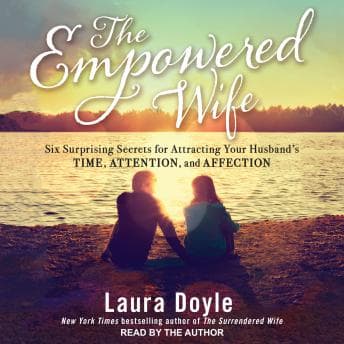

Look, I need to get something off my chest before we go any further: if one more self-help book tells me the secret to a happy marriage is that women need to stop being so... much, I'm going to throw my phone into the Charles River. And yet. AND YET. Here I am, having listened to all seven and a half hours of Laura Doyle's The Empowered Wife, and my feelings are more complicated than I expected them to be.
I started this one while making chana masala on a Sunday afternoon — the kind of elaborate solo cooking project where you're toasting whole spices and pretending you're on a cooking show nobody's watching. The kitchen smelled incredible. My mood was good. And then Laura Doyle told me that if I wanted my hypothetical husband to pay more attention to me, I should stop telling him what to do and start saying "I hear you" more often. Reader, my wooden spoon almost went through the ceiling.
The Part Where I Wanted to Argue With My Earbuds
Here's what's genuinely frustrating about this book: Doyle frames her Six Intimacy Skills as "empowerment," but the core thesis is that women should relinquish control, stop criticizing, and focus on their own happiness rather than trying to change their partner's behavior. On the surface? That sounds like warmed-over 1950s advice with a Instagram-wellness rebrand. And some of it genuinely made me bristle — like when she suggests that expressing preferences ("I would love it if...") works better than direct requests, or when she uses anecdotes of women who stopped managing household logistics and watched their husbands magically step up.
Psychologically, this doesn't track — at least not universally. The research actually shows that demand-withdraw patterns in relationships are harmful regardless of gender, and reducing one partner's assertiveness isn't a fix; it's an avoidance strategy. Doyle treats "controlling behavior" as almost exclusively a female problem, which is a pretty selective reading of couples dynamics literature.
But — and this is the complicated part — she's not entirely wrong about everything.
What the Research Actually Supports (Grudgingly)
Stripped of the gendered framing, some of Doyle's principles map onto legitimate psychological concepts. Her emphasis on self-care and pursuing personal desires echoes differentiation theory in couples therapy — the idea that maintaining a strong sense of self actually strengthens relationships. Her skill around "receiving gracefully" (accepting compliments, help, and gifts without deflecting) connects to attachment research on vulnerability and responsiveness. When she talks about dropping the "control" and letting your partner handle things their way, there's a kernel of autonomy support in there — a well-documented predictor of relationship satisfaction.
The problem is she packages all of this in a framework that puts the entire burden of change on women. I found myself asking: why does Doyle really avoid addressing what happens when the husband is the one who needs to change? She mentions abuse briefly — and to her credit, she does say these skills aren't for abusive situations — but the line between "controlling" and "having reasonable expectations" gets blurry fast in her examples.
This is a fascinating case study in how useful behavioral strategies can get undermined by the ideology they're wrapped in.
Laura Reading Laura
Doyle narrates her own book, and honestly? It works better than I expected. She has this warm, slightly conspiratorial tone — like she's leaning across a coffee table telling you what she learned the hard way. There's genuine conviction there, not polished performance. You can hear the moments where she's drawing from real memory versus reciting principles, and the personal stories land harder because of it. She's not a professional voice actor and you can tell — the pacing is occasionally uneven, and she doesn't vary her delivery much between her own voice and the stories of other women she quotes. But the authenticity carries it. When she talks about her own marriage nearly falling apart, you believe her.
At 7 hours 33 minutes, it's a manageable listen, though I'd recommend 1.25x speed because some sections — especially the repeated "here's another woman who tried this and it worked" testimonials — start to feel formulaic by hour five.
Who This Lands For (And Who Should Run)
If you're in a relationship where YOU tend to be the manager, the planner, the one who handles everything and resents it — some of this will hit uncomfortably close to home. The self-reflection pieces are genuinely useful. If you're someone who already tends to suppress your needs and accommodate your partner? This book could actively make things worse. That's not a minor caveat.
My therapist would have thoughts about this book. Many thoughts. Specifically about the difference between surrendering control as a growth move versus surrendering control as a trauma response dressed up in self-help language. Doyle doesn't distinguish between these nearly enough.
My Professional Diagnosis
I'm giving this a split verdict. There are real, applicable behavioral strategies buried in here. But the framework asks women to do all the emotional labor of changing the relationship while calling it "empowerment," and that contradiction never gets resolved. If you can extract the useful bits and leave the ideology — treat it like a buffet, not a prescription — there's value. But approach with your critical thinking fully engaged. That same "here are the secrets, now go execute them" energy is something I kept bumping into in Financial Freedom: A Proven Path to All the Money You Will Ever Need — another book where the framework is genuinely useful but the ideology wrapped around it deserves a raised eyebrow.