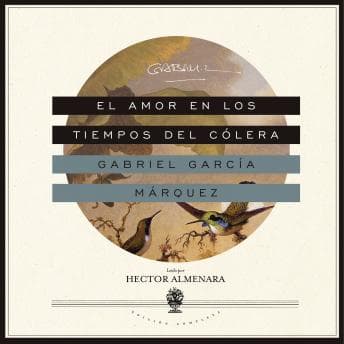

García Márquez wrote a love story that spans fifty-one years, nine months, and four days, and every single one of those days earns its place in this novel. I need to say that upfront because El amor en los tiempos del cólera is not a book that rushes toward anything - not toward reunion, not toward resolution, not toward the kind of tidy romantic payoff we've been trained to expect. And that patience is exactly what makes it devastating.
I finished it on the lakefront last Sunday, walking with Denise while the wind off Lake Michigan was doing its best to freeze my earbuds out. She asked me why I'd stopped walking. I was standing still on the path near Montrose because Florentino Ariza had just declared his love at a funeral - a funeral, fifty years after being rejected - and I needed a moment. Denise, who has lived with me through twenty years of teaching and has heard me go on about Faulkner's sense of time more than any human should have to, just said "García Márquez again?" and kept walking. She knows.
Fifty-One Years of Foolishness and Devotion
Let's talk about what García Márquez is really saying with Florentino. Because on paper this man is absurd. 622 affairs. Six hundred and twenty-two. He catalogs them. He keeps notebooks. And yet he insists - insists to himself, insists to the reader - that none of it diminishes what he feels for Fermina Daza. Most writers would make this pathetic or satirical. García Márquez does something harder: he makes it both ridiculous and completely sincere at the same time. Florentino is a fool. He's also the most committed romantic in all of Latin American literature. The novel doesn't ask you to choose between those readings. It holds them both.
And Fermina - Fermina is the one I kept thinking about during faculty meetings (sorry, Principal Martinez, but your facilities update cannot compete with a woman who smells her husband's infidelity in another woman's perfume on his clothes and throws him out). She's practical where Florentino is fantastical. She chose the safe marriage, the respectable doctor, the social standing. And García Márquez never punishes her for it or rewards her for it. He just lets a life happen. The prose deserves to be savored because every domestic detail - the parrots, the eggplant dishes, Dr. Juvenal Urbino's campaign against cholera - builds a world where love is not separate from the mess of living but buried inside it.
My students would hate this. I love it. They want plot. They want things to happen. And things do happen here, but they happen the way they happen in real life: slowly, with decades between the inciting incident and the climax.
Hector Almenara and the Weight of Spanish Prose
Here's where I have to be honest about what I know and what I don't. The research on Almenara's specific performance here is thin - no detailed breakdowns of how he handles individual characters, no complaints about pacing or pronunciation that I could find. What I do know: he's the Latin American voice of Anthony Bourdain, which tells me he understands rhythm and knows how to let language breathe without making it performative. And that skill matters enormously for García Márquez, whose sentences in Spanish are these long, rolling, subordinate-clause-heavy constructions that a lesser narrator would either rush through or over-dramatize.
At fifteen and a half hours, this is a commitment. The narrator understands that pause is punctuation - or at least, the pacing never felt hurried to me. I listened at 1.0x, because the author chose those words and I choose to hear them properly, and at no point did I feel the urge to speed up. That's the test, really. When a narrator earns 1.0x across fifteen hours, something is working.
I will say this: listening in Spanish - even with my teacher's Spanish that makes my Honduran students wince - changes the experience fundamentally from the English translation. The music is different. The humor lands differently. Fermina's sharp dismissals carry a different kind of sting in the original.
Who Should Board This Riverboat
If you loved Cien años de soledad and want something more intimate, more grounded, less mythological - this is its spiritual successor. Same author, completely different emotional register. This isn't magic realism. This is realism that feels magical because of how precisely it observes the ordinary.
If you need action, if slow-burn makes you reach for the 2x button, if you think a love story should resolve before the lovers need reading glasses - skip it. You'll be miserable. I gave Harvester a shot around the same time and it moves at a completely different pace - tighter, more plotted - which is worth knowing if you're calibrating your next listen.
If you're a Spanish learner looking for immersion, the language here is challenging but gorgeous. Worth it for the vocabulary of obsession alone.
The Annotation in the Margin
This is why we still read the classics. Because García Márquez looked at the love story - the most overdone, most clichéd, most exhausted form in all of fiction - and found something true in it by simply refusing to end it where everyone else would have. The love story doesn't end at the wedding or the rejection. It ends on a riverboat with two old people who have run out of time and excuses both. Worth pausing the faculty meeting for. Worth pausing everything for.