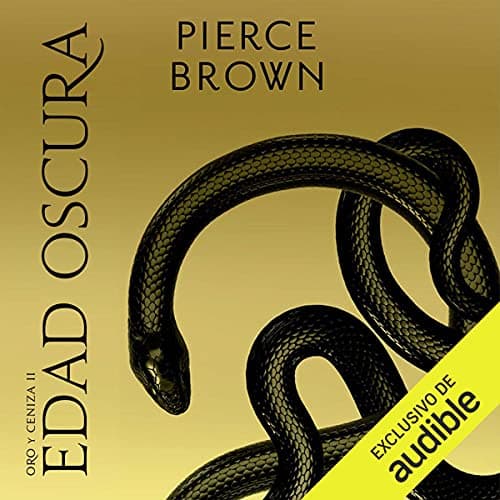

Most people who rate this audiobook seem to land at a near-perfect five stars, and I walked in expecting the usual sequel inflation — fans who'd follow a series off a cliff giving it top marks out of loyalty. I was wrong. Edad Oscura earned those ratings the hard way.
I listened to this across two weeks of late-night sessions, headphones in, lights off. That turned out to be the right call, because this is not a book that lets you half-listen. Edad Oscura is the fifth entry in Pierce Brown's Red Rising saga, and it picks up with Darrow — the revolutionary who tore down an interplanetary caste system — now branded a traitor by the Republic he built. He's fighting a desperate, losing war on Mercury, and the question hanging over every chapter is whether the man who broke the chains has become something worse than what he replaced.
What surprised me, honestly, was how much I cared about the POV characters who aren't Darrow. Brown rotates between five or six perspectives — Lysander, Ephraim, Virginia, Lyria — and each one carries a genuinely different emotional frequency. Lysander's chapters have this cold aristocratic calculation that contrasts sharply with Lyria's raw, ground-level desperation. Ephraim's arc goes places I didn't see coming. The multi-POV structure means this doesn't feel like one story told from different angles; it feels like five separate wars happening on the same chessboard, and when they collide, the impact lands because you've been inside all the competing loyalties. Think of it like a D&D campaign where every player has a different alignment and they're all rolling initiative at the same table.
Luis Torrelles handles this sprawl with the kind of vocal control that makes you forget you're listening to one person. The shift between Darrow's battle-hardened weariness and Lysander's aristocratic precision isn't just a voice change — Torrelles adjusts his entire rhythm. During the Mercury siege sequences, his pacing tightens, sentences clip shorter, and you feel the oxygen leaving the room. Then he'll move into Virginia's political maneuvering on Luna and everything slows down just enough to let the tension recalibrate. Listeners have called his work impeccable, and after forty-one hours I can say: he doesn't slip. Not once. One listener described the combination of Brown's writing and Torrelles' delivery as among the best they've ever encountered in audiobook form, and across this kind of runtime, that consistency is remarkable.
Now, here's the part where I need to be straight with you. This book is relentless. Brown has never been shy about violence, but Edad Oscura pushes past anything in the earlier books. I wrote about Brown's earlier escalation of this in my Hijo Dorado review — even back in book two there were signs he was building toward something that wouldn't let the reader off easy. There are extended battle sequences where the body count becomes almost architectural — it's not just people dying, it's civilizations caving in. Some listeners have flagged this as numbing, and I get it. There were stretches where I needed to pause not because I was bored, but because the brutality was so sustained that I needed a breather before going back in. If you've read the series and thought "I wonder how dark this can get," Brown answers that question and then keeps going.
There's also a translation-specific issue worth mentioning. Several Spanish-language listeners have taken issue with the use of inclusive language in the text, saying it breaks the flow and sounds jarring against the rest of the prose. One listener described it as something that "rompe los oídos y la narrativa" — breaks the ears and the narrative. In a far-future setting, you could read it as deliberate world-building. You could also find it distracting. This is going to be deeply personal depending on how you relate to evolving Spanish usage, but if you're someone who listens closely to prose rhythm, it's something you'll notice.
What makes Edad Oscura work despite — or maybe because of — its darkness is that Brown isn't just wallowing in misery. He's asking what happens when a revolution eats itself. Darrow isn't a fallen hero in the simple sense; he's a man whose methods have always been brutal, and now the story is forcing everyone, including the reader, to stop looking away. The fact that I finished this book genuinely unsure whether Darrow is still someone worth rooting for? That's not a flaw. That's the most interesting thing Brown has done with this series.
Who Should Listen (And Who Should Skip)
If you've followed the Red Rising saga through all four previous books and you're ready for Brown to strip away whatever comfort they left you with, Edad Oscura delivers. Skip it if you haven't read the earlier entries — jumping in here would be narrative suicide — or if sustained, unflinching violence is a hard no for you. Spanish-language listeners sensitive to inclusive language usage should also know what they're walking into.
At forty-one hours, this requires real commitment. My review of Iron Gold — the book that kicks off this second arc — gets into why that entry felt like a riskier structural bet than it gets credit for, which makes landing here feel even more earned. Edad Oscura is punishing, it's sprawling, and Torrelles' performance holds every fractured piece of it together.









![Mañana Azul (Narración en Castellano) [Morning Star (Narration in Castilian)] audiobook cover](/_next/image?url=https%3A%2F%2Fm.media-amazon.com%2Fimages%2FI%2F51D%2BwPWnl0L._SL1200_.jpg&w=1920&q=75)
![Hijo Dorado [Golden Son] audiobook cover](/_next/image?url=https%3A%2F%2Fm.media-amazon.com%2Fimages%2FI%2F51uzJj8M6uL._SL1200_.jpg&w=1920&q=75)
![Oro y Ceniza (Narración en Castellano) [Iron Gold] audiobook cover](/_next/image?url=https%3A%2F%2Fm.media-amazon.com%2Fimages%2FI%2F51RqG42bC8L._SL1200_.jpg&w=1920&q=75)