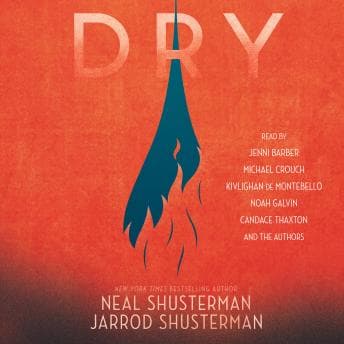

What would you actually do if you turned on the faucet and nothing came out?
Not like a "hmm, the water company is doing maintenance" nothing. I mean nothing-nothing. No warning, no timeline, no plan. Just... dry. I started this book during Sophie's nap on a Tuesday - she'd been fighting it for twenty minutes and I was stress-eating goldfish crackers in the hallway - and by the time she woke up ninety minutes later, I was genuinely considering filling the bathtub "just in case." That's the kind of book this is.
The Suburb That Ate Itself
The Shustermans (father-son writing duo, which is kind of adorable until you remember they wrote something this brutal together) take a normal Southern California neighborhood and strip away the one thing everyone takes for granted. And then they just... watch what happens. Alyssa's street goes from "friendly wave at the mailbox" to "I will hurt you for what's in your garage" in a terrifyingly short amount of time. The pacing is relentless - not in a breathless action-movie way, but in a slow squeeze, like watching your phone battery drain with no charger in sight. Every chapter ratchets tighter.
What got me was how logical it all felt. The Shustermans don't rely on some zombie-apocalypse leap of faith. It's just water. Just the lack of it. And the way neighbors turn on each other, the way suburban politeness curdles into something predatory - it hit different when you're a person who actually lives on a cul-de-sac and waves at people over the recycling bins. I kept looking out my window at our neighbor Dave's house thinking "Dave would definitely be the first one to hoard."
The teen characters - Alyssa, Kelton the survivalist neighbor kid, Jacqui who's got a harder edge, Henry who's younger and vulnerable - they each carry their own moral weight. Kelton's family has been prepping for this exact scenario and the book does something smart with that: it doesn't mock preppers OR glorify them. It just shows what happens when the weird paranoid family might've been right all along, and how complicated that is for everyone.
Six Narrators and It Actually Works
Okay, here's where I need to talk about the audio production because this is a SIX-narrator audiobook and I went in skeptical. Six narrators for an 11-hour book? That's a lot of voices to track when you're also trying to prevent a toddler from eating a crayon.
But it works. Each narrator owns a character, so when perspective shifts, you don't have to reorient - your brain just clicks into the new voice. Michael Crouch and Kivlighan de Montebello (both award-winning narrators, apparently, and yeah, you can tell) carry a lot of the heavy lifting. Crouch gives Kelton this earnest, slightly wound-tight energy that's perfect for a kid who grew up with a bug-out bag. De Montebello's Jacqui is hard and wary and just vulnerable enough underneath. Jenni Barber's Alyssa is the emotional anchor - steady but fraying.
And then there are these little interstitial "snapshot" sections narrated by the Shustermans themselves - brief glimpses of other people affected by the crisis. These could've felt gimmicky but they actually widen the scope in a way that made the whole thing feel bigger and more suffocating. Like you're not just following one family's crisis, you're feeling an entire region unraveling.
The Part Where I Sat in My Car Too Long
I'll be honest - this book is dark for a YA novel. Darker than the Scythe series, I think, because it feels so possible. There's violence. There are choices these kids have to make that no kid should have to make. I finished the last two hours during my sacred car-in-the-garage time and I sat there for an extra ten minutes afterward just... processing. Not ugly-crying exactly, but close. The kind of quiet unsettled feeling where you walk inside and hug your kids a little too tight and they look at you like you've lost it.
It survived 47 pauses and still made sense - the multi-narrator format actually helped with that because re-entry was instant. (Though if you want something on the complete opposite end of the spectrum — gentle, warm, zero apocalypse — Rosa Goes to the City was my palate cleanser after this one.). But I want to flag: this is not a comfort read. This is the opposite of a comfort read. It's fantastic, but it's the kind of fantastic that makes you want to go buy a case of water bottles at Costco immediately after.
Who Needs This (and Who Should Stock Up First)
If your kids are 12+ and you want something to listen to together on a road trip that'll spark actual conversation about resource scarcity and human nature and what we owe each other - this is incredible for that. If you're a mom like me who mostly wants cozy endings and emotional safety, just know what you're signing up for. The ending isn't hopeless, but it's not tied up with a bow either. It's honest. Sometimes that's harder.
My book club would love this (if I ever have time for book club again). Made me check our water filter situation. Twice.









