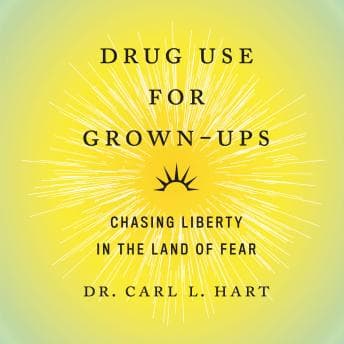

What happens when a Columbia professor with tenure and a reputation to protect tells you he uses heroin recreationally — and then asks you to examine why that sentence made you flinch?
I was chopping onions for a chana masala I had no business attempting on a Tuesday night when Carl Hart dropped that particular bomb. And I just... stopped. Knife in hand, onion half-forgotten, because the psychologist in me was already running through every cognitive bias I could name. The confirmation bias. The availability heuristic. The way we confuse "I was taught this" with "I know this." Hart doesn't just challenge drug policy — he challenges the architecture of how you think about drugs in the first place. Salt Sugar Fat pulled a similar trick on me — Moss dismantling the story I'd told myself about "personal choices" around food until I had to admit how much of it was engineered from the outside. And as someone who studies how narratives shape identity, I found myself genuinely unsettled. In the best way.
The Case Study That Studies You Back
Here's what makes this book fascinating from a psychological standpoint: Hart is simultaneously the researcher and the subject. He grew up in Miami during the crack epidemic, internalized every narrative about drugs destroying Black communities, and then spent decades in federally funded labs trying to prove those narratives true. The protagonist exhibits classic cognitive dissonance resolution — except he resolves it in the direction nobody expected. Instead of doubling down when his data contradicted his beliefs (which, the research actually shows, is what most people do), he followed the evidence. That alone makes him an outlier worth studying.
Hart narrates his own book, and there's something irreplaceable about hearing a man describe his heroin use in the same measured, professorial tone he'd use to discuss his latest paper in Neuropsychopharmacology. No tremor. No confession-booth energy. Just... matter-of-fact. This is a fascinating case study in what happens when someone refuses to perform shame. His voice is warm but direct — you're getting a lecture from someone who genuinely likes you but will not coddle you. The pacing is conversational, almost intimate, like he's explaining this over dinner and really needs you to understand before dessert.
When the Structure Can't Contain the Argument
Now. Some listeners have complained the book feels organizationally scattered — bouncing between personal memoir, policy analysis, neuroscience, and what amounts to a civil rights argument. And honestly? They're not entirely wrong. The chapters don't always build on each other in a linear way. Hart will be deep into pharmacological mechanisms and then pivot to the racist origins of drug scheduling, then circle back to a personal anecdote about using MDMA with his wife. Psychologically, this doesn't track as a traditional academic argument. It tracks more like how someone actually thinks about this stuff — associatively, passionately, with the personal and political tangled together because they ARE tangled together.
But here's the thing some critics miss: the racial discrimination content isn't a digression. Hart's central thesis is that drug prohibition IS racial policy. You can't separate the drug war from mass incarceration of Black and brown people any more than you can separate a symptom from a diagnosis. Some listeners wanted a clean, apolitical book about responsible drug use, and I found myself asking: why does that desire itself reveal something? Who gets to use drugs "responsibly" without police intervention? Hart makes you sit with that question, and it's uncomfortable. Good.
The weakest stretch, for me, was when Hart catalogues drug after drug — heroin, cocaine, methamphetamine, cannabis — with similar structural arguments for each. Around hour six, the pattern becomes predictable: here's the drug, here's the myth, here's the data, here's the policy failure. At 1.0x speed during my jog through Cambridge the next morning, I felt the repetition. I'd recommend bumping to 1.25x through those middle chapters. The argument doesn't lose anything at a faster clip.
Who This Is Actually For (And Who Should Probably Skip)
If you want your worldview confirmed — in either direction — this isn't your book. Hart will frustrate libertarians who don't want to talk about race, and he'll frustrate progressives who are fine with weed but draw the line at heroin. He's arguing for something more radical than legalization: he's arguing for the right of adults to pursue pleasure through substances without moral judgment. The research actually shows that most people who use drugs — even "hard" drugs — don't become addicted. Hart hammers this point with data, and it's the kind of data that makes you realize how thoroughly the war-on-drugs narrative has colonized your thinking.
My therapist would have thoughts about this book. Specifically about how Hart uses his professional authority to grant himself permission to live authentically — something most of us struggle to do without tenure as a safety net. That's not a criticism. It's an observation about who gets to tell this story.
This book requires your full attention. Don't put it on while doing dishes. The science is real, the stakes are high, and Hart is asking you to do genuine cognitive work. Sit with it.
The Diagnosis I Didn't Expect to Write
I went in expecting a policy book. What I got was a book about epistemology — about how we know what we think we know, and what happens when the data says we're wrong. Hart isn't just chasing liberty. He's chasing intellectual honesty, which might be harder to find. Pretty much essential listening for anyone who's ever said "drugs are bad" without examining where that sentence came from.









