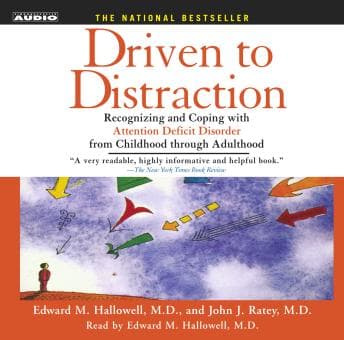

I was halfway through prepping a chana masala — onions caramelizing, whole spices blooming in oil, the kitchen smelling like my mother's house in Edison — when Hallowell started describing a patient who couldn't finish cooking a single meal without wandering off to check email, reorganize a drawer, and then forgetting the stove was on. I literally turned the heat down. Not because I have ADD. But because the behavioral pattern he described was so recognizable, so precisely observed, that I found myself doing a quiet inventory of my own executive function quirks. That's what good psychology writing does. It makes you look inward whether you meant to or not. The last time a book made me do that kind of unsolicited self-audit was reading The Intention Experiment — different subject entirely, but that same uncanny quality of making you feel like the author somehow already knew what you were going to resist.
When the Clinician IS the Case Study
What makes this book psychologically interesting — and what separates it from a dozen other pop-psych ADD primers — is that Hallowell and Ratey aren't just diagnosing from behind a desk. They both have ADD. So the clinical vignettes carry a double weight: here's a patient exhibiting classic attention-regulation deficits, and by the way, your narrator knows exactly what that internal chaos feels like from the inside. Hallowell narrates with this calm, conversational warmth that almost tricks you into thinking you're chatting with a friend over coffee rather than absorbing diagnostic criteria. His tone is gentle, unhurried, occasionally self-deprecating in a way that disarms the stigma around the diagnosis.
But here's where I found myself asking: why does this book pull its punches? The patient stories are vivid — there's a surgeon who hyperfocuses beautifully in the operating room but can't manage to pay his bills on time, and a woman whose relationships keep imploding because her partners read her distractibility as indifference. These are genuinely useful case studies. The research actually shows that ADD presents so differently across contexts that a lot of adults go undiagnosed precisely because they're high-functioning in one domain and falling apart in another. Hallowell gets this. He understands the shape of the disorder.
What he doesn't do — and this is where I got frustrated stirring my chana masala with increasing vigor — is go deep enough. The book was groundbreaking when it first came out. It reframed ADD as neurological rather than a character flaw, which mattered enormously. But this abridged audiobook clocks in at under two hours, and you can feel the compression. Complex ideas get summarized when they should be explored. The neuroscience is gestured at rather than explained. If you already know the basics of executive function, attention regulation, and dopamine pathways, you're going to be hungry for more substance than this version delivers.
Two Hours Is Not Enough Time for This Brain
Let's talk about the elephant in the room: this is an abridged version. Under two hours. For a book that covers ADD from childhood through adulthood, across work, relationships, parenting, and self-image. That's... ambitious. And it shows. Some sections feel rushed in a way that's almost ironic given the subject matter — like the book itself has attention issues, jumping from topic to topic before fully landing anywhere.
Hallowell's narration partially compensates. He reads with a calm, measured pace that gives weight to the patient stories, and his voice has this quality — slightly professorial but never condescending — that works well for the material. He's not performing the audiobook so much as sharing it with you. Which is the right choice for self-help, honestly. You don't want vocal pyrotechnics when someone's describing their lifelong struggle with organization and self-worth. You want warmth and authority. He delivers both.
That said, there are moments where his regional accent pulls slightly against the clinical content — nothing severe, but noticeable if you're the kind of listener who tracks vocal patterns (I am, obviously). And because this is a single-narrator abridged format, you lose the richness of the original text. Patient dialogues that probably read with distinct voices on the page get flattened into Hallowell's singular delivery.
Who This Is Really For (And Who Should Keep Looking)
If you've never encountered the ADD framework before — if you're the person who's spent years thinking "why can't I just focus like everyone else" — this audiobook might genuinely shift something for you. The protagonist of this book, if we can call it that, is the undiagnosed adult. And the authors exhibit classic empathy-driven clinical writing: normalizing the experience before pathologizing it. Psychologically, that tracks. You have to make people feel seen before they'll accept a label.
But if you're looking for a deep clinical resource, a comprehensive guide with treatment protocols and current research? This abridged version won't satisfy. It's a starting point, not a destination. Pick up the unabridged edition or the sequel, Delivered from Distraction, which apparently goes further into treatment and coping strategies.
For me, standing in my kitchen with perfectly spiced chana masala and a brain full of questions about attentional networks, this was a useful refresher but not a revelation. The case studies are the strongest element — real humans behaving in recognizably human ways, which is all I ever ask from psychology writing.
My Therapist Would Say I'm Projecting, But Still
Worth your time if you need an accessible, compassionate entry point into understanding ADD. Not worth a full credit at under two hours, though. Stream it on a weeknight when you need something smart but low-commitment. And maybe check your stove when it's done.