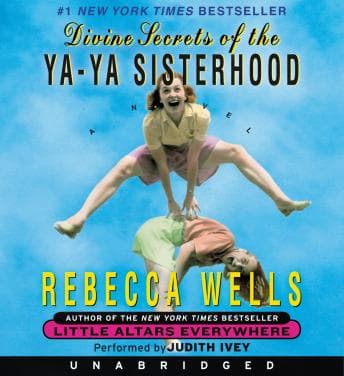
"I'm your mother. You were my first. My wild, beautiful first."
Somewhere around hour six, Judith Ivey delivered that line with this ragged, bourbon-soaked tenderness that hit me right in the sternum. I was sitting in my driveway at 7:45 AM, engine still running, and I just... sat there. Carlos texted asking if I was okay because he could see the car from the kitchen window. I blamed allergies.
Look. I picked this up because my youngest sister recommended it - she's on a Southern fiction kick - and I figured nearly fifteen hours of bayou women being dramatic would be good company across a week of night shifts. What I didn't expect was for Vivi Walker to gut me like that.
Vivi Walker Is Every Filipina Mother I've Ever Met (Fight Me)
Here's the thing nobody told me about this book: it's not really about friendship. I mean, the Ya-Ya Sisterhood stuff is there, and it's fun - four Louisiana women with their rituals and their secrets and their cigarettes and their absolute refusal to apologize for anything. But the real engine of this story is the wreckage between Vivi and her daughter Siddalee. The love that's so big it becomes suffocating. The mother who gave everything and resents you for it. The daughter who adores her mother and is terrified of becoming her. There's a different kind of suffocating devotion threaded through Brush of Wings too, though it comes wrapped in something more celestial than bourbon and magnolias.
My mom would love this. (She still thinks I should've been a doctor.) Because Vivi is that specific kind of mother - the one who shows up in a turban and full makeup to your school play and somehow makes it about herself, but also would literally fight God for you. I've met this woman. I've been raised by a version of this woman. When Siddalee talks about her mother's moods swinging from lavish affection to cold withdrawal, I felt that in my bones.
What Wells does well is refuse to make it simple. Vivi isn't a villain. She's not a saint. She's a woman who was broken by her own mother, by the Church, by the expectations of 1940s Louisiana womanhood, and she passed that brokenness down like an heirloom nobody asked for. The scenes from Vivi's girlhood - the Ya-Yas as young women, wild and fearless and doomed in the way only Southern girls in the pre-Civil Rights era could be - those sections have real weight to them.
Judith Ivey's Voice Could Cure or Kill You
Okay, the narrator. This is where it gets polarizing and I get it.
Judith Ivey commits. She COMMITS. Her Vivi is all honeyed New Orleans French one minute and cigarette-and-bourbon hoarse the next - this woman sounds like she's been smoking Parliaments since 1952 and flirting with the priest at confession. Her Teensy is lighter, faster, more mischievous. You can hear the difference between the Ya-Yas immediately, which matters when you're switching between timelines and the only thing anchoring you is voice.
But here's my honest take: if thick Southern accents grate on you, this will be rough. I mean ROUGH. Ivey doesn't code-switch to neutral for the narration - she stays planted in Louisiana the entire fourteen-plus hours. For me, it worked. I grew up around accents (my titas all have different levels of Filipino-accented English and I can tell them apart in my sleep), so a performer who leans into regional voice feels authentic to me. But I can absolutely see someone bouncing off this by chapter three.
The emotional delivery, though? That's where Ivey earns her Tony. The scenes of mother-daughter confrontation - when Siddalee finally reads the scrapbook of secrets - Ivey shifts from defensive to devastated in the span of a sentence. As someone who's actually worked a code, I know what real grief sounds like. Ivey knows too.
The Parts That Made Me Yell at My Dashboard (Affectionately)
Is this a perfect book? No. It meanders. There are stretches in the middle where Wells indulges in Ya-Ya backstory that feels more like a greatest-hits montage than storytelling - another party, another wild escapade, another time Vivi did something outrageous. Around hours eight through ten, I'll be honest, my attention drifted. The structure is loose, almost scrapbook-like, and that's intentional but it means there's no real plot tension pulling you forward. You're just... hanging out with these women.
And you know what? Sometimes that's enough. Sometimes at 4 AM when the unit is quiet (knock on wood) and you're caught up on charting, you just want to be in a room with women who've known each other sixty years and still have secrets. The Ya-Yas feel lived-in. Messy and real.
The ending doesn't tie things up neatly, which I respect. Mothers and daughters don't get neat endings. You just keep showing up.
Who Needs This in Their Ears
If you've ever had a complicated mother - and buddy, who hasn't - this book will find the bruise and press on it. Gently, but it'll press. If you need tight plotting and fast pacing, skip it; this is a 14-hour meander through memory and magnolias. If Southern accents make you want to drive into oncoming traffic, maybe grab the print version instead.
Perfect for that post-shift decompression. Or a long road trip. Or honestly, any time you need to feel like someone understands the specific madness of loving a difficult woman who loved you the only way she knew how.
Carlos asked why I was crying in the car. I blamed allergies. Again.