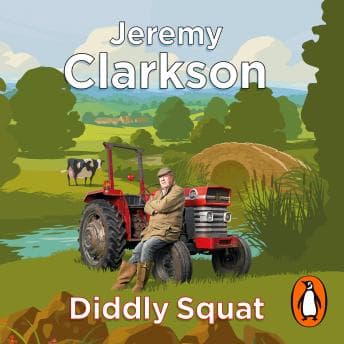

Everyone told me I'd hate this. My colleague Sarah literally said, "Priya, you will be annoyed within ten minutes." And look - I get it. Jeremy Clarkson is not exactly the poster child for self-awareness. The man built an empire on performative bluster and punching producers. So when I queued this up while making chana masala on a Saturday night (the good kind, with whole spices toasted properly, the kind my mother would approve of), I was fully prepared to be irritated.
I was not prepared to find a genuinely interesting psychological portrait hiding inside a comedy about sheep.
The Ego Meets the Soil
Here's what fascinated me. The protagonist exhibits classic narcissistic confidence - "How hard could it be?" is basically Clarkson's entire worldview distilled into five words - but the book is structured around the systematic demolition of that confidence. Biblical weather destroys his crops. His wasabi experiment goes nowhere. Kaleb, his twenty-something tractor driver, repeatedly makes him look foolish in the most matter-of-fact way possible. And Clarkson... lets it happen. On the page. In his own voice.
The research actually shows that identity disruption in midlife - when someone moves from a domain of mastery to one of total incompetence - can be profoundly destabilizing. I kept thinking of God's Smuggler, where the protagonist's leap into unknown danger is far less cushioned by privilege, and the interior cost is ultimately what makes the story resonate. What makes Clarkson's account interesting (psychologically, not literarily, let's be clear) is that he uses humor as a defense mechanism while simultaneously letting real vulnerability leak through. He won't say "I was scared the farm would fail and I'd look like a fraud." He'll say something cutting about bureaucracy or his own stupidity. But the anxiety is right there, just underneath the jokes about his massive Lamborghini tractor.
This is a fascinating case study in how someone processes the gap between their constructed public identity and their actual competence. Clarkson the TV personality is in control. Clarkson the farmer is absolutely not. And at two and a half hours, you get just enough of that tension to stay interested without the joke wearing thin.
Clarkson Reading Clarkson Is the Only Way This Works
Let me be direct: this audiobook would not work with anyone else narrating. A professional voice actor would smooth out the edges, find the rhythm, make it polished. And it would lose everything. Clarkson's delivery is half the content - the exasperated pauses when he's describing some new farming regulation, the genuine bewilderment when his spring water bottling scheme hits a wall, the way his voice gets slightly quieter (not softer, quieter, there's a difference) when he talks about what the land actually means to him.
Some listeners call his voice "soothing," which - my therapist would have thoughts about finding Jeremy Clarkson soothing, but I understand the appeal. There's a confidence to the cadence even when he's describing complete disaster. It's the audio equivalent of someone who's very good at telling stories at a dinner party. You don't need character voices or sound effects. You just need him, talking, being alternately infuriated and charmed by his own farm.
The comedic timing is genuinely strong. He knows exactly when to land a punchline and when to let a beat breathe. This is someone who has spent decades performing, and it shows in ways that benefit the listener even if you'd never want to sit next to him at said dinner party.
Where Psychologically This Doesn't Quite Track
Here's my issue. Clarkson presents his farming journey as mostly accidental - he had this land, the previous farmer left, he thought why not. But I found myself asking: why does a man with essentially unlimited options choose the hardest possible version of reinvention? There's something he's not saying about what he's running toward (or from), and the book never goes there. It gestures at meaning in the final chapters - the land being worth more than money, connection to something ancient - but it pulls back before it gets truly honest.
I wanted about 30% more interiority and got another joke about Gerald the dry stone waller instead. Which is fine. It's Clarkson. But the book is at its best when the mask slips, and it doesn't slip quite enough.
Also - and this is a minor gripe - at 2 hours 32 minutes, this is barely an audiobook. It's more like a long podcast episode. I finished it before the chana masala was done. For a full Audible credit, that's a hard sell.
Who Gets the Most Out of This
If you watched Clarkson's Farm on Amazon and want the companion piece, this is perfect background listening for a drive or a quick chore session. If you're interested in how public personas navigate private incompetence - actually interesting stuff - there's enough here to chew on. Marketing Artificial Intelligence tackles a similar gap between public image and internal reality, but through the lens of brands rather than a blustery TV host. If you need deep self-reflection or anything resembling a structured memoir, look elsewhere. Clarkson wouldn't know what to do with a three-act emotional arc if Kaleb drove it up to him on a tractor.
The Case File, Closed (For Now)
I didn't expect to like this. I liked it more than I should have. It's slight, it's funny, and buried under the bluster is a man quietly terrified that he might care about something real. That's not nothing. But it's not quite enough to be essential, either. Stream it on a lazy afternoon. Don't spend a credit.