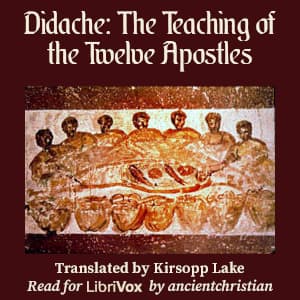

What does a twenty-two-minute audiobook teach you about the entire first century of Christianity? More than you'd think. And less than you'd want. That's the beautiful frustration of the Didache.
I listened to this at my kitchen table on a Saturday morning, coffee going cold, while Denise was still asleep. It felt right - something this old, this compressed, deserves quiet. No lakefront wind, no faculty meeting white noise. Just me and a text that's roughly nineteen centuries old, spoken aloud the way it probably should have been all along.
A Document That Almost Disappeared Forever
Here's what gets me about the Didache: it was lost for over a thousand years. Just - gone. Then in 1873, a Greek Orthodox metropolitan in Constantinople finds it tucked inside a codex, and suddenly we have this first-century manual for early Christian communities sitting in our hands again. The church fathers argued about its status - Eusebius listed it among the "spuria," Athanasius gave it a warmer reception - and here I am listening to it on my phone in 2024. The layers of transmission are dizzying if you stop to think about them.
The text itself is divided into three clean sections. The "Two Ways" - the Way of Life and the Way of Death - reads like a moral catechism stripped to its bones. No theology. No argument. Just: do this, don't do that. It's startlingly direct. "You shall not murder. You shall not commit adultery. You shall not corrupt boys." The prose deserves to be savored, not because it's beautiful in any literary sense, but because its plainness IS the point. This wasn't written for scholars debating in Alexandria. This was written for communities figuring out how to be Christian before that word meant what it means now.
The second section - the rituale on baptism, fasting, and communion - is where historians lose their minds, and rightly so. The instructions for baptism are specific: prefer running water, use cold if possible, pour water on the head three times if immersion isn't available. These are practical instructions for real people in real situations. It reads like a faculty handbook, honestly. (My students would hate this. I love it.)
The third section on ministry - how to treat traveling prophets, how to distinguish true teachers from frauds - that's where it gets genuinely fascinating. The Didache tells communities to test prophets: if a prophet asks for money, he's false. If he stays more than three days, he's false. There's something almost funny about it, this early church already dealing with grifters.
Twenty-Two Minutes That Need Your Full Attention
Let's talk about what the narrator - credited simply as "Ancientchristian" - is working with here. This is a LibriVox recording, which means volunteer production, no studio polish, no sound design. The reading is straightforward and measured. No dramatic interpretation, no vocal characterization - but then again, this isn't a novel. It's a manual. A plain reading is arguably the most honest approach to a text like this.
The audio quality is what you'd expect from a volunteer recording project: functional, clean enough, but not the kind of production you'd get from a professional studio. There's no music, no ambient layering. Just voice and text. For twenty-two minutes, that's fine. This isn't something you need to sustain over twelve hours.
But here's the thing - at twenty-two minutes, you can listen to this twice and still have time left in your lunch break. And you probably should listen twice, because the density of what's packed in here is easy to miss at first pass. The Kirsopp Lake translation is academic but readable, and hearing it spoken rather than reading it off a page gave me a sense of communal instruction that silent reading never quite captures. These words were meant to be heard aloud in gatherings. Audio is actually the more authentic medium here.
Who Gets the Most Out of This
If you loved reading the Desert Fathers or the Apostolic Fathers collection, the Didache is essential context - this is their spiritual predecessor, the DNA of early church practice before the creeds formalized everything. I spent time with Jesus on Trial: A Lawyer Affirms the Truth of the Gospel earlier this year and kept thinking about it here - that book approaches the historical foundations of Christianity from a very different angle, but both are ultimately asking the same question: what do we actually know, and how do we know it? If you're a student of early Christianity, church history, or even just interested in how communities organize themselves around shared belief, this twenty-two minutes is more valuable than some entire courses I took in grad school.
If you're looking for narrative, spiritual warmth, or devotional listening - this isn't that. The Didache presupposes doctrine; it doesn't deliver it. It's a handbook, not a homily.
Worth Pausing the Faculty Meeting For
Twenty-two minutes. A text that shaped centuries of Christian practice, nearly vanished from history, and now exists as a free audiobook you can listen to while your coffee gets cold. The prose is spare, the instruction is blunt, and the window it opens into the first-century church is irreplaceable. It won't change your life, but it might change how you think about the distance between then and now. And that distance is shorter than you'd expect.