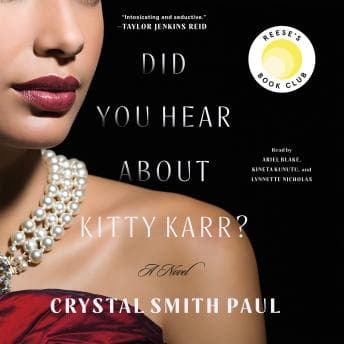

Everyone kept telling me this was a beach read. A fun, gossipy Hollywood book. And sure, there's glamour and old Hollywood and a dead starlet's will - but nobody warned me I'd be sitting in my minivan in the school parking lot, fifteen minutes early for pickup, genuinely shook by what this book does with race, identity, and the lies families build their entire lives on.
So let me recalibrate your expectations.
The Past Timeline Will Wreck You (In the Best Way)
Here's the setup: Kitty Karr Tate, legendary White Hollywood actress, dies and leaves her fortune to three Black women - the St. John sisters. The present-day storyline follows Elise, the eldest sister, as she untangles Kitty's secrets while her own life is imploding (cheating fiancé, social media disaster, the works). But the REAL magic is in the past timeline - Kitty's origin story in the segregated South, her climb through Hollywood's machinery, and the truth about who she actually was.
I'm not going to spoil it, but if you know anything about racial passing in mid-century America, you might guess where this is heading. And even if you do, Crystal Smith Paul earns every reveal. The past sections have this weight to them, this slow-building dread mixed with tenderness, that had me turning off my car engine and just... sitting there. Sophie was asleep in her carseat. I had maybe twenty minutes. And I used every single one.
The present timeline? It's fine. It's good, even. But I'd be lying if I said I didn't get a little antsy during some of Elise's modern-day drama, waiting to get back to Kitty's story. The cheating fiancé subplot and the social media controversy felt almost small next to what was happening in the 1940s and '50s. That's not a fatal flaw - it's more like ordering the appetizer that's better than your entrée.
Three Narrators, Zero Confusion
This is where the audiobook really earns its format. Ariel Blake, Kineta Kunutu, and Lynnette Nicholas each take their own characters, and the transitions between timelines are clean and immediate. You always know exactly where you are and who's talking. For a book that jumps between decades and has a sprawling family tree, that matters. A LOT.
The tone is - and I love this word for it - elegantly laid back. Nobody's chewing scenery. The narrators trust the material, especially in the heavier scenes about racial violence and the cost of living a double life. There's a restraint that makes the emotional moments hit harder than if someone were performing the grief, you know? When the revelations about Kitty's identity start clicking into place, the narration gets quieter, not louder. That's a choice, and it's the right one.
I will say: at 13 hours, this is on the longer side for my attention span. I listened at 1.25x and it took me about a week and a half. That's longer than my usual, and there were stretches in the middle where I had to remind myself what was happening in the present-day plot after being interrupted by Lucas asking for his forty-seventh snack. But the past timeline? Survived 47 pauses and still made sense. The emotional through-line is strong enough that even fragmented listening couldn't break it.
Who This Is Really For
People keep comparing this to Passing by Nella Larsen and The Personal Librarian, and yeah, I see it. But this is warmer than those. More sprawling. It has the bones of a family saga with the pacing of a mystery - what DID Kitty do, and why does it matter now? If you loved The Vanishing Half by Brit Bennett, this is in that same neighborhood, maybe a slightly different block.
Skip this if you need constant momentum. The present-day sections slow things down, and if you're only here for the mystery of the will, you might get frustrated by the detours into Elise's relationship drama. But if you're okay with a story that breathes, that earns its revelations instead of rushing to them, this is worth your time.
Not for the car-line if you're fragile. There are scenes about what it cost Black women to survive in a world that demanded they be invisible - and those scenes don't pull punches. I will say, though - nothing in my recent listening has come close to hitting that specific emotional register, and I've tried a few; To Sleep in a Sea of Stars is a completely different universe (literally), but it's the only other audiobook this year where I felt the same sense of being genuinely ambushed by my own feelings in a parking lot. I didn't ugly-cry at pickup, but I came close. Twice.
The Mom Verdict: Worth Losing Sleep Over
I stayed up past 11 PM to finish the last hour, which in mom years is basically pulling an all-nighter. The ending gave me what I needed - not neat, not tidy, but satisfying and earned. The kind of ending where you sit with it for a day and then text your friend "you HAVE to read this" with no other context.
My book club will love this (if I ever have time for book club again). It's the kind of book that gives you something real to talk about - not just "did you like it" but "what would YOU have done." And honestly? I'm still thinking about that.