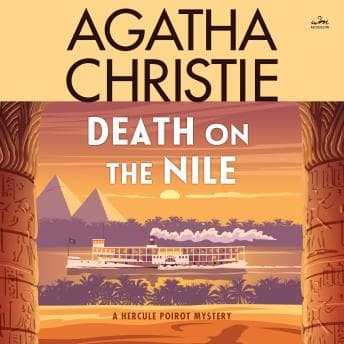

Kenneth Branagh understands Hercule Poirot in a way that's almost unsettling.
I was making dal makhani at midnight—one of those elaborate cooking sessions where I convince myself I'll meal prep for the week but really just want something to do with my hands—when Branagh delivered Poirot's observation about jealousy being "the most dangerous of all emotions." I stopped stirring. Because he didn't just read it. He understood it. The research actually shows that jealousy activates the same neural pathways as physical pain, and somehow Branagh's delivery captured that clinical precision mixed with genuine human sympathy.
This is a fascinating case study in Christie's understanding of obsessive attachment. Jacqueline de Bellefort exhibits classic stalking behavior patterns—the inability to accept rejection, the cognitive distortion that proximity equals connection—and Christie wrote this in 1937. Decades before we had proper terminology for it. What makes this character compelling is that Christie refuses to make her simply villainous. She's wounded. Dangerous, yes. But wounded first.
The Psychology of a Floating Petri Dish
Christie knew something that modern thriller writers often forget: confined spaces don't create tension. They reveal it. The Nile cruise is essentially a floating petri dish of human dysfunction. You've got old money, new money, desperate money. Romantic betrayal simmering alongside professional resentment. Everyone performing their best selves while harboring their worst impulses.
Psychologically, this tracks perfectly. Remove escape routes, add heat (literal Egyptian sun, metaphorical emotional pressure), and watch the masks slip. Linnet Ridgeway isn't just murdered because she's beautiful and wealthy. She's murdered because she represents something—opportunity, threat, mirror—to nearly everyone on that boat.
Branagh navigates this ensemble with varying success. His Poirot is impeccable—that Belgian precision, the way he lingers on certain syllables when Poirot is thinking through a problem. You can hear the little grey cells working. But here's where I found myself asking: why does everyone else sound vaguely... similar? The American heiress, the British aristocrat, the Egyptian guide—they blur together at times. Not enough to derail the experience, but enough that I occasionally lost track of who was speaking during the more crowded scenes.
When the Reveal Lands (And When It Doesn't)
I've read this book three times. I knew the ending. And still, hearing Poirot lay out the solution made me set down my phone and just... listen. The construction is so elegant. Every piece fits. Christie plants clues the way a surgeon places sutures—precise, deliberate, invisible until you know where to look. That same methodical precision shows up in Terminal List, though the stakes there are considerably more visceral.
But here's my honest assessment: the pacing drags in the middle third. There's a stretch of about ninety minutes where Poirot interviews passengers and the narrative momentum stalls. Some listeners have called the reveal underwhelming, and I understand why—if you're expecting explosive drama, Christie delivers something colder. More clinical. The solution is intellectually satisfying rather than emotionally cathartic. My therapist would have thoughts about this character—specifically about how Christie constructs murderers who believe their logic is unassailable. The narcissism required to think you can outsmart Poirot is itself a psychological profile.
Branagh's emotional delivery during the final confrontation partially compensates for the slower sections. He gives Poirot genuine sadness, not just triumph. This isn't a detective who enjoys catching killers. He's a man who wishes people would simply stop killing each other.
Who Will Love This (And Who Should Bail)
If you need action every ten minutes, this isn't your book. Christie wrote puzzles, not thrillers. The pleasure is in watching pieces connect, not in car chases or fight scenes. Dedicated listening recommended—too many characters to track while distracted. If similar-sounding character voices frustrate you, be warned. It's not a dealbreaker, but it's noticeable.
If you're a mystery purist who wants fair-play clues and logical solutions, this is essential. If you're curious about Branagh's Poirot before (or after) watching his films, the audiobook actually showcases his interpretation better than the movies do. Less visual spectacle, more character work.
Diagnosis: Worth the Cruise
Eight hours on the Nile with Branagh is time well spent. Not flawless—that middle section tests patience, and the character differentiation could be sharper. But Christie's psychology holds up remarkably well, and Branagh's Poirot is the kind of performance that makes you understand why this detective has endured for nearly a century.
He's not solving crimes. He's solving people. And that's considerably more interesting.