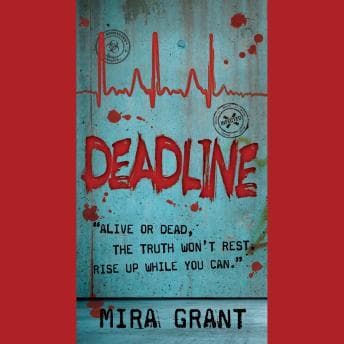

So here's the thing everyone warned me about with Deadline: "It's not as good as Feed." I'd heard this from at least four people, two subreddits, and Kevin (who DNF'd it, the coward). And for about the first three hours, commuting through the dark at 6:15 AM with rain streaking down the Caltrain windows, I thought they were right.
They were wrong.
Shaun Mason Is Basically an Unreliable Narrator Running on Grief and Adrenaline
TL;DR: Worth your commute, but this one demands your attention more than Feed did.
Let me back up. Deadline switches POV from Georgia Mason (Feed's blogger-journalist protagonist) to her brother Shaun, and the shift is... jarring. Intentionally so. Shaun is not okay. He talks to his dead sister. Out loud. Constantly. And Chris Patton's narration leans INTO this instability in a way that genuinely unsettled me during a late-night debugging session last Tuesday - I was tracing a race condition in our messaging service at like 11 PM, headphones in, and Patton shifted from Shaun's manic bravado to this quiet, fractured internal monologue so smoothly that I actually stopped typing mid-line. His voice has this raw, slightly frayed quality that IS Shaun - a guy holding himself together with conspiracy theories and spite.
The dual narrator setup is interesting but asymmetric. Nell Geislinger handles blog posts and emails - the in-universe media fragments that Mira Grant uses to worldbuild. She's fine? Serviceable? It's a smart structural choice because it preserves the newsroom-media texture from Feed without forcing Patton to break character. But Geislinger doesn't really get character work, so it's basically Patton's show.
And Patton carries it. His differentiation between characters is solid - you can tell Becks from Maggie from Alaric without mental overhead, which matters when you're following this at 1.5x on a packed train. The road trip sections through abandoned zones have this eerie, desolate quality in his delivery that reminded me of driving through eastern Washington at night. Empty. Haunted. Wrong.
The Conspiracy Goes Deeper (And the Science Still Holds Up)
Grant's virology background shows. Feed laid the groundwork with Kellis-Amberlee - the zombie virus that's actually two viruses that combined - and Deadline digs into the immunology and epidemiology of it in ways that feel plausible. When the CDC researcher shows up and starts explaining what's actually going on with reservoir conditions and viral amplification, it doesn't read like someone Googled "how viruses work" for twenty minutes. It reads like someone who understands gain-of-function research and decided to write a thriller about it. The political intrigue layered over that hard science reminded me of the faction scheming in Dance of Cloaks — different genre entirely, but that same feeling of every institution being compromised and nobody being quite who they claim.
The political conspiracy angle escalates from Feed significantly. This is basically a post-apocalyptic All the President's Men but with bloggers instead of journalists and zombies instead of... well, I guess Nixon was scary enough on his own. The pacing is slower than Feed for the first third - more investigation, more driving, more Shaun arguing with his dead sister - but once the CDC plot kicks into gear around hour 5 or 6, it accelerates hard and doesn't let up.
Here's my one real complaint: there are stretches in the middle where characters explain things to each other that the reader already figured out. Mira Grant trusts her science but doesn't always trust her audience. I bumped those sections to 1.75x and didn't lose anything.
Who Gets a Seat on This Train
Perfect for: Train (long commute), road trip. The pacing matches transit perfectly - you get natural pause points that align with stops, and the tension builds across multi-commute arcs.
Skip if: You haven't read/listened to Feed. Deadline assumes you know everything. Starting here would be like joining a codebase with zero documentation and no README - technically possible but deeply unpleasant.
Also skip if you need neat endings. This book has a cliffhanger that made me almost miss my stop at Mountain View because I was standing there with my mouth open like an idiot. I immediately queued up Blackout. No regrets.
The dual narrator production is clean - no weird transitions, no volume mismatches between Patton and Geislinger. 15 hours is a commitment, but I finished it in about 6 commutes plus that one late-night debug session.
The ROI Calculation
The ROI on this audiobook is high if you're already invested in the Newsflesh series. Patton's Shaun is the kind of narrator performance where you forget you're listening to someone read - his instability feels real, his grief feels earned, and his slow-burn rage at the conspiracy carries you through the slower investigative sections. It's not Ray Porter (nobody is Ray Porter), but it's close to that tier of "narrator becomes the character."
Is it as tight as Feed? No. Feed was a sprint disguised as a marathon. Deadline is a marathon that knows it's a marathon, and it's okay with that. But the payoff in the last three hours hits harder than I expected, and the science is genuinely smarter.
I'm six hours into Blackout now. Kevin still hasn't finished Deadline. I'm not waiting for him.