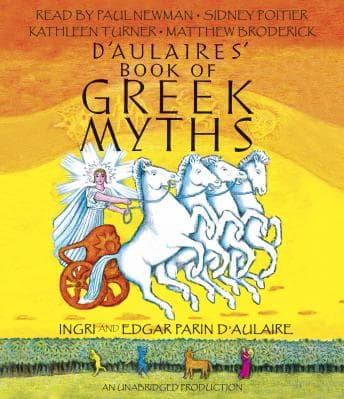

This is the audiobook I wish existed when I was teaching The Odyssey to disinterested sophomores.
I finished grading a stack of essays on symbolism in Lord of the Flies—most of them tragically convinced that the conch represents "society" and nothing else—and needed something to cleanse my palate. Four hours later, I'm sitting in my kitchen at 1 AM, coffee gone cold, genuinely moved by how Paul Newman says "Zeus."
Let me explain.
Hollywood Royalty Reading Bedtime Stories (And It Works)
The casting here is audacious. Paul Newman. Sidney Poitier. Kathleen Turner. Matthew Broderick. This is the kind of narrator lineup that sounds like a producer's fever dream, the sort of thing that could easily become a vanity project where famous voices distract from the material.
It doesn't. And I think I know why.
These are performers who understand that reading for children requires more craft, not less. Newman brings this gravitas to the Zeus sections—you believe this man could throw thunderbolts and also cheat on his wife seventeen times in one chapter. There's no winking at the audience, no "aren't these myths silly" condescension. He reads Olympian pettiness like it's Shakespeare. Because, well, it kind of is.
Turner handles the goddess sections with what I can only describe as knowing warmth. When she narrates Athena's birth—springing fully formed from Zeus's head—there's this slight amusement in her voice that suggests she finds the whole thing as absurd and wonderful as we do. Poitier brings dignity to the heroic tales without making them feel like homework.
The rotation between narrators keeps four hours from feeling like a slog. Just when you've settled into one voice, another picks up a different myth. It's almost like sitting around a fire with four very famous, very talented friends taking turns.
The D'Aulaires Understood Something About Violence
Here's what I appreciate about this source material, and what the narration preserves: the D'Aulaires never sanitized these stories into pablum. Cronos eats his children. Prometheus gets his liver pecked out daily. Medusa's head still drips blood after Perseus severs it.
The narrators don't shy away from this. They don't add gore, but they don't soften it either. There's a matter-of-factness to how these gruesome details are delivered that feels authentically Greek. The ancient Greeks didn't consider violence inappropriate for children—they considered it instructive. The gods are petty and jealous and cruel because humans are petty and jealous and cruel. That's the whole point.
My students would probably find this less intense than the video games they play, honestly. But there's something about hearing Sidney Poitier calmly describe Tantalus's eternal punishment that hits different than reading it on a page.
A Survey Course, Not a Deep Dive
At four hours, this covers impressive breadth—the Titans, the Olympians, the major heroes, the underworld. You're not getting the full Iliad or Odyssey here. You're getting the greatest hits, the origin stories, the family tree of dysfunction that makes the Kardashians look functional.
For kids, this is perfect. For adults who slept through their mythology unit in high school, this is a surprisingly painless refresher. For English teachers who need to remember why they fell in love with these stories before standardized testing crushed their souls—well, that's oddly specific, but yes, this works for that too.
The production is clean but minimal. No dramatic music swells, no sound effects of thunderbolts or crashing waves. Just voices. I actually prefer this. Let the words do the work.
Who This Is For (And Who Should Skip It)
Kids discovering mythology for the first time will find this riveting—it's the real thing, not a sanitized retelling. Adults wanting a refresher without committing to Edith Hamilton will appreciate the four-hour runtime. Skip it if you're looking for scholarly depth or dramatic production values; this is storytelling, not theater.
Denise and I don't have kids, but my sister does. Her eight-year-old just discovered Percy Jackson and won't stop talking about "Posidon" (her pronunciation, not mine). She'd probably also get a kick out of Dragon Orb, though that one skews a bit younger and more fantasy-adventure than foundational mythology. I'm sending her this audiobook because it's the real thing—not a modern adaptation, but the myths themselves, presented with respect and performed by people who take the material seriously.
Why We Still Teach the Classics
Not because they're old, but because they're true. These stories about jealousy and ambition and love and revenge haven't aged because humans haven't changed. Zeus is still out there, metaphorically speaking. So is Hera's wrath. So is Prometheus, chained to his rock, paying forever for giving humanity something beautiful.
The narrators understand that pause is punctuation. They let moments breathe. They trust the stories.
Worth pausing the faculty meeting for. Worth sharing with the next generation. Worth remembering why mythology matters.