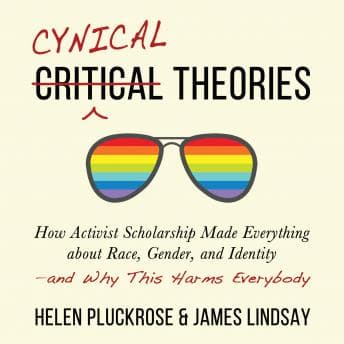

What happens when a psychology researcher who studies how narratives shape identity encounters a book that's basically a 9-hour genealogy of the narratives currently reshaping everyone's identity?
I'll tell you what happens. She stays up until 2 AM making dal tadka she didn't even want, just so she has something to do with her hands while her brain processes the sheer density of what Pluckrose and Lindsay are laying out. My kitchen smelled like cumin and existential crisis.
The Intellectual Family Tree Nobody Asked For (But Everyone Needs)
Here's the thing about Cynical Theories — it does something I genuinely haven't seen done this well in popular nonfiction. It traces the lineage of ideas the way I'd trace the developmental arc of a fictional character. Where did postcolonial theory come from? How did queer theory evolve from its Foucauldian roots into something that would make Foucault himself raise an eyebrow? The book walks you through postmodernism's two "principles" — the postmodern knowledge principle (radical skepticism about objective knowledge) and the postmodern political principle (society is organized by systems of power and privilege) — and then shows how these abstract philosophical positions mutated into applied activist frameworks in disability studies, fat studies, postcolonial theory, critical race theory, gender studies, and queer theory.
The research actually shows that when you understand how ideas evolve, you can engage with them more honestly. And Pluckrose and Lindsay do exactly that — chapter by chapter, discipline by discipline. It's methodical. Almost obsessively so. Which I appreciated, because I'm the person who reads methodology sections for fun. But if you're not that person? Hour five might feel like you're auditing a graduate seminar you didn't sign up for.
Compared to something like Jonathan Haidt's The Righteous Mind, which also diagnoses ideological dysfunction but through moral psychology experiments and personal stories, Cynical Theories is much more of a literature review. It's taxonomic. Haidt gives you the "why people believe what they believe" through evolutionary psychology and data; Pluckrose and Lindsay give you the "what exactly do they believe and where did it come from" through close reading of academic texts. Both are valuable. But one is significantly easier to listen to while jogging.
Helen Pluckrose Reading Her Own Argument
Pluckrose narrates solo — which means you're getting one of the two co-authors delivering the entire thesis in her own voice. There's something psychologically interesting about that. She has a measured, British delivery that suits the academic register perfectly. Clear enunciation, steady pace, no dramatic vocal performances. This isn't a thriller narration, and it shouldn't be.
But — and this is where I have to be honest — the narration is functional rather than electric. At 9.5 hours of dense theoretical material, there are stretches where the tone stays so even that my attention drifted during the fat studies and disability studies chapters. Not because the content isn't important, but because the vocal texture doesn't shift enough to signal "pay attention, this part matters more." I found myself rewinding a few times during my morning run through Cambridge, which is annoying when your hands are cold and your phone is buried in three layers.
I'd genuinely recommend 1.25x speed. It tightens the delivery without losing comprehension, and it helps the denser chapters feel less like they're settling in for a long winter.
Where the Psychology Doesn't Quite Track
Here's where I put on my researcher hat and get a little critical. The book's thesis is essentially: postmodernism started as radical skepticism, then "applied postmodernism" made it politically actionable, and now we have Social Justice (capital S, capital J) as a quasi-religious orthodoxy. Fine. That's a legitimate intellectual genealogy. But I found myself asking: why does this framework assume such a clean, linear transmission of ideas from Derrida and Foucault to a 22-year-old on Twitter?
The protagonist of this book — and yes, I'm treating the ideological movement as a character, because that's what I do — exhibits classic traits of what psychologists call idea diffusion, but Pluckrose and Lindsay sometimes flatten the mechanism. They're excellent at describing what the ideas are. They're less interested in why these ideas have such psychological stickiness for individuals. As someone who studies how narratives shape identity formation, I wanted more about the human pull — the identity needs these frameworks satisfy. Why does a person adopt an ideology that tells them knowledge is a social construct? What psychological gap does that fill? The book gestures at this but never quite sits with it.
That said — their chapter on how these theories often harm the very marginalized groups they claim to serve is genuinely sharp. The argument that reducing individuals to their group identity categories replicates the same essentialist thinking that civil rights movements fought against? That's the kind of structural critique that sticks with you.
Who This Is For (And Who Will Throw Their Phone)
If you've ever been in an argument about social justice and felt like the other person was speaking a completely different intellectual language — this book hands you the Rosetta Stone. It's genuinely useful for understanding the academic origins of ideas that now dominate public discourse.
If you already agree with everything Pluckrose and Lindsay say? You might find this validating but not challenging enough. If you disagree with their premises entirely? You'll probably rage-quit by chapter three. The book positions itself as liberal centrist critique, which means it manages to irritate people on both ends of the spectrum. My therapist would have thoughts about a book that's this committed to being reasonable. The psychological mechanics of belief and self-justification are something I kept circling back to — I explored similar territory in my review of Secret of Dreams, which takes a very different angle on how the stories we tell ourselves calcify into identity.
My Annotated Prescription
This is a fascinating case study in intellectual genealogy — the kind of book that gives you vocabulary for arguments you've been having but couldn't quite articulate. It's dense, it's dry in places, and it assumes you care about the difference between Derrida's deconstruction and how it got applied in postcolonial theory. I do care. If you do too, it's worth the investment. If you want something you can half-listen to while doing dishes — pick literally anything else.