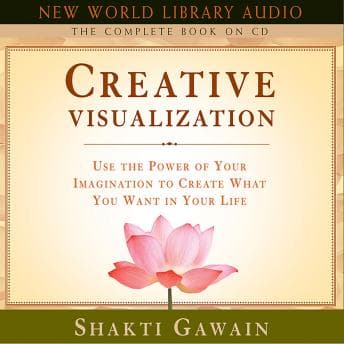

"Using creative visualization, you can begin to create your life as you want it to be."
That line hit me about 20 minutes into my morning commute, somewhere around Millbrae, and I remember thinking: okay, this is either going to be life-changing or complete woo-woo nonsense. Spoiler alert—it landed somewhere in between, and I'm honestly fine with that.
The Engineer's Dilemma With Metaphysics
Look, here's the thing. I debug distributed systems for a living. I think in terms of reproducible outcomes, root cause analysis, and metrics. So when Shakti Gawain starts talking about "the universe" responding to your mental imagery, my inner skeptic immediately starts raising flags. But—and this is a big but—I kept listening. Three commutes later, I'd finished the whole thing.
Why? Because underneath the new age framing, there's actually some practical cognitive psychology happening here. The visualization techniques she describes? Basically mental rehearsal, which has legit research behind it. Athletes use it. Surgeons use it. The affirmations? Reframing negative self-talk, which any decent therapist would recommend. Healing the Shame That Binds You takes a similar approach to cognitive reframing, though Bradshaw comes at it from a therapeutic angle rather than a metaphysical one. Gawain just wraps it in different language.
The book is structured around exercises and meditations, which works surprisingly well in audio format. She'll explain a concept, then walk you through a visualization. It's not passive listening—you're supposed to actually do the exercises. (I did about half of them. The other half happened during the packed 8AM train when closing my eyes felt like an invitation for someone to steal my laptop bag.)
When The Author IS The Narrator
Shakti Gawain narrates her own work, and for once, that's exactly right. Her voice is genuinely soothing—not in that fake spa-music way, but in a calm, clear, grandmother-who-meditates-daily kind of way. For a book that's essentially guided meditation with philosophy breaks, you need that energy.
The meditation guidance sections are where the audio format really earns its keep. Reading "now visualize a peaceful place" on a page is one thing. Having someone with a naturally calming voice actually guide you through it? Way more effective. I found myself doing the relaxation exercise during a particularly stressful on-call week, and honestly, it helped me fall asleep faster than my usual strategy of doomscrolling Twitter.
The pacing is slow by design. This is not a 1.75x speed situation. I tried bumping it up and it completely killed the vibe. You're supposed to breathe with this one, which is not my usual MO but felt appropriate.
The ROI Question
At 3 hours, this is basically one round-trip commute for me. The ROI calculation depends entirely on what you're looking for.
If you want practical techniques for mental rehearsal and positive self-talk, stripped of the metaphysical language? This delivers, but you'll need to mentally translate as you go. Think of it as legacy code—the underlying logic is sound, but the syntax is from a different era.
If you're already into meditation, visualization, or personal development, this is a foundational text for a reason. It's sold 10 million copies because the core techniques actually work for people. The audiobook format makes the exercises more accessible than reading them.
If you're a hardcore skeptic who gets irritated by any mention of "energy" or "the universe," this will annoy you. Fair warning. I found myself eye-rolling at certain passages, but I also kept listening, so make of that what you will.
Queue It or Skip It
Perfect for: bedtime, relaxation, low-key weekend listening. Skip for: the gym, intense focus work, or any situation where you can't actually do the exercises. And if you can't tolerate any new age language without getting twitchy, save yourself the frustration.
The people who will get the most out of this are those willing to engage with the practices, not just passively consume the content. It's interactive in a way most audiobooks aren't. You're supposed to pause, visualize, breathe. If you're just looking for something to fill commute time while you zone out, this isn't it.
I'm not going to pretend this book changed my life or that I now manifest parking spots through sheer willpower. But the relaxation techniques have genuinely helped with my sleep, and the reframing exercises are just good cognitive behavioral therapy in different packaging. Sometimes the woo-woo stuff has practical applications if you're willing to look past the language.
Would I recommend it to Kevin? Probably not—he'd last about ten minutes before making sarcastic comments. Would I recommend it to my sister who's been stressed about her career transition? Actually, yeah. The visualization exercises for goal-setting are legitimately useful, and Gawain's calming narration makes them easy to follow. Open Book has that same quality of needing to be absorbed slowly, though for completely different reasons.
Sometimes Slower Is The Feature, Not The Bug
Not everything needs to be optimized at 1.75x speed. Some things are meant to be slow.