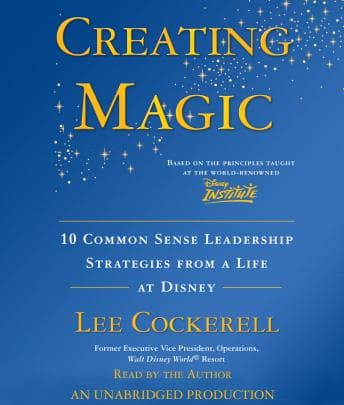

I was halfway through my morning jog along the Charles River when Lee Cockerell said something that made me stop dead on the path. A cyclist nearly hit me. Worth it.
He was talking about how he used to be a terrible boss. Like, genuinely bad. The kind who thought fear was a management strategy. And here's what got me: he didn't frame it as some humble-brag about his "growth journey." He just... owned it. Said he was wrong. Explained exactly how he was wrong. The protagonist exhibits classic defensive attribution patterns early in his career—blaming circumstances, blaming employees—and then something shifts. That shift? That's the whole book.
Why a Psychologist Cares About Disney Management
Look, I'll be honest. When I saw "10 Common Sense Leadership Strategies," my eyes glazed over a little. I've read enough business books that promise revolutionary insights and deliver warmed-over platitudes. (My therapist would have thoughts about why I keep buying them anyway.) But Cockerell does something different here.
He treats leadership as fundamentally a psychological contract. Not in those words—he's not academic about it—but the research actually shows that his instincts align with decades of organizational psychology. When he talks about "burning free fuel" (appreciation, recognition, encouragement), he's describing what we'd call intrinsic motivation theory. When he insists that "everyone is important," he's articulating the core of psychological safety research that Amy Edmondson wouldn't publish until years later.
The way Cockerell unpacks self-assurance through practical action reminded me of The Confidence Code, though his approach is less about internal belief systems and more about external behavioral shifts.
What makes this compelling isn't the strategies themselves. It's watching someone reverse-engineer good psychology through forty years of trial and error. Cockerell figured out empirically what academics theorize about. That's fascinating to me.
Cockerell Behind the Mic
So here's the thing about author-narrated audiobooks in the business genre: they're usually either really good or painfully awkward. Cockerell lands in the good category, though not without caveats.
His voice is exactly what you'd expect from a guy who ran Walt Disney World operations. Clear. Steady. The kind of voice that's given a lot of presentations to a lot of stakeholders. He's not performing the book—he's telling you about his life. And when he gets to the stories about his own failures? You can hear something shift. A slight hesitation. Maybe embarrassment that's aged into acceptance.
Cockerell's willingness to share his management mistakes makes him credible in a way that polished narrators can't replicate. When he describes yelling at an employee and then realizing, years later, what that cost him—you believe him. A fascinating case study in how authenticity functions in persuasion. We trust people who admit they were wrong more than people who claim they've always been right.
But—and this is real—some listeners find the audiobook less engaging than reading the book. I get it. The narration is straightforward, maybe too straightforward. There's not a lot of dramatic variation. If you're used to theatrical business narrators who punch every insight, this might feel flat. I found myself asking: why does the measured delivery work for me but not for everyone? Probably because I was listening during exercise, where I wanted information absorption, not entertainment.
The Psychology That Actually Lands
The chapter on giving people purpose instead of jobs? That's where Cockerell really gets it. He tells this story about a housekeeper at Disney who didn't see herself as cleaning rooms—she saw herself as creating the environment where families made memories. That's not corporate spin. That's legitimate meaning-making, and the research on job crafting supports exactly this kind of reframing.
What I found myself noting (yes, I take notes during runs, don't ask how) is that Cockerell intuitively understands something most leadership books miss: behavior change requires identity change. You don't just tell people what to do differently. You help them see themselves differently. He understands human nature in ways that feel earned rather than studied.
Now, psychologically, some things don't quite track. He occasionally slips into that corporate optimism where every problem has a solution if you just care enough. Real organizations have structural constraints that individual leadership can't always overcome. But honestly? For a practical book aimed at working managers, that's a minor complaint.
Who Should Queue This Up (And Who Shouldn't)
If you're managing people and feeling like something's off—like you're doing the mechanics but missing the connection—this is worth seven hours of your time. Cockerell isn't going to give you a revolutionary framework. He's going to remind you that leadership is fundamentally about how you make people feel. Common sense, sure. But common sense that most of us forget under pressure.
Skip it if you want drama, theatrical narration, or stories about Walt Disney himself. This is a book about operations, about the unsexy daily work of treating people well. It's not flashy. It's just... useful.
The Behavioral Residue
I finished the audiobook three days ago. Yesterday, I caught myself about to send a curt email to a research assistant and stopped. Rewrote it. Added a genuine thank you for something she'd done well.
That moment of self-awareness—catching yourself mid-pattern—is something I've been thinking about since reading Story of My Life, where similar moments of recognition become turning points.
Small thing. But that's kind of the point.