
"You build your own power through knowledge, hard work, excellence, creativity and good will."
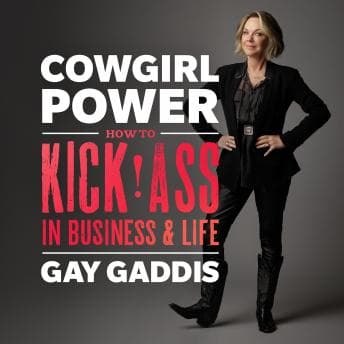
I was halfway through chopping onions for a chana masala — eyes already watering, hands smelling like cumin — when Gay Gaddis dropped that line, and I actually put the knife down. Not because it was some earth-shattering revelation. Honestly, it's advice you've heard before. But something about hearing it in her voice, this Texas CEO who also runs a cattle ranch, made me pause and think about the psychology of why some self-help mantras land and others bounce right off.
The Cowgirl as Archetype (And Why It Almost Works)
Here's what I found myself asking: why does the cowgirl metaphor work as well as it does? Psychologically, it taps into something specific — the frontier woman archetype, someone who operates outside traditional power structures not by rebellion but by sheer competence and grit. It's not the "lean in" corporate feminism that assumes you're already in the boardroom. It's more primal than that. Gay Gaddis positions the cowgirl as someone who earns respect through action, not permission. And that's a genuinely different framework than most women-in-business books offer.
But — and this is where my researcher brain kicks in — the metaphor also has limits. By about hour three, I started noticing that "cowgirl" was doing a LOT of heavy lifting. Confidence? Cowgirl power. Networking? Think like a cowgirl. Risk-taking? Saddle up. The research actually shows that when a central metaphor gets stretched too thin, it loses its psychological anchoring power. It becomes wallpaper. And there were moments where I wished Gaddis had let the stories breathe without lassoing them back (sorry, couldn't resist) to the cowgirl framework.
What saves the book from becoming a one-note gimmick is Gaddis herself. Her stories about building T3, her advertising agency, from scratch are genuinely interesting case studies in entrepreneurial psychology. The way she describes navigating male-dominated boardrooms in the '90s, or the specific moment she decided to buy a cattle ranch while running a major agency — these are the moments where the book earns its keep. She's not theorizing about risk. She's someone who bet her own money, repeatedly, and has the scar tissue to prove it. Phil Knight does the same thing in Shoe Dog — and reading both back to back, what strikes me is how founders who've actually bled for something describe risk completely differently than people who've only studied it.
Author-Read: The Double-Edged Sword
Gaddis narrates this herself, and it's... complicated. On one hand, there's an authenticity you can't fake. When she talks about her ranch or her early career struggles, you hear the warmth of someone telling stories she's told at dinner tables for years. She's a natural storyteller in the oral tradition sense — good pacing on anecdotes, genuine humor that doesn't feel scripted.
On the other hand, she's not a trained narrator. The energy stays pretty level throughout the nearly eight hours. When she shifts from personal anecdote to "here's your action plan" mode, the delivery doesn't really shift with it. The Cowgirl Tool Kit sections (practical advice chapters) sound the same as the memoir sections, which makes it hard to mentally toggle between "I'm being inspired" and "I should be taking notes." At 1.25x speed, the practical sections hit better — they feel more purposeful, less meandering.
No sound effects, no music, no production flourishes. Just Gay talking. Which is fine. It fits the no-nonsense ethos of the book.
Who This Is Really For (Honest Assessment)
The protagonist of this book — and yes, I'm calling Gaddis a protagonist because she narrates her own hero's journey — exhibits classic internal locus of control. She genuinely believes that outcomes are determined by effort and strategy, not luck or systemic forces. If that worldview energizes you, you'll love this. If it makes you want to throw your phone into the Charles River because systemic barriers are real and complex, you might find yourself arguing with your earbuds.
This is a fascinating case study in aspirational identity construction. Gaddis isn't just giving advice — she's offering you a persona to try on. The cowgirl. And for women in their 20s-30s who are entrepreneurially minded, especially outside the coastal tech bubble, I can see this landing hard. It's grounded in a specific American cultural identity that feels different from the usual Silicon Valley hustle-culture playbook.
But if you're looking for data-driven self-help, or psychological depth about WHY women face specific barriers, this isn't that book. It's motivational, not analytical. My therapist would have thoughts about a book that treats confidence as something you simply choose to have — the psychology of self-efficacy is way more complex than that — but Gaddis isn't writing for academics. She's writing for doers.
My Clinical Notes
Three and a half stars. It's a solid listen for the right person — someone who wants energy and practical encouragement from a woman who's actually done the thing, not just theorized about it. Gaddis is likable, her stories are specific enough to be credible, and the cowgirl framework is genuinely more interesting than most self-help gimmicks. But it doesn't push hard enough on its own ideas, and the narration needed more dynamic range to carry eight hours. Worth catching on sale or through your library app. Not quite worth a full credit when there are stronger options in this space.