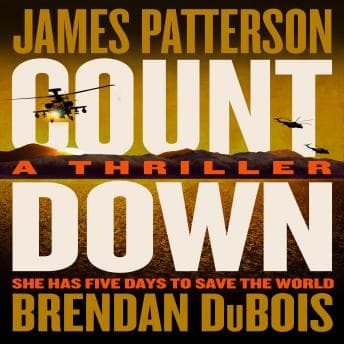

When's the last time a Patterson book made you genuinely nervous about a character's survival? Because I'll be honest - I went into Countdown expecting the literary equivalent of a Marvel movie: fun, loud, forgettable by Tuesday. And for most of its 11-and-a-half-hour runtime, it's exactly that. But Amy Cornwall caught me off guard.
I was deep into a late-night coding session, trying to debug a procedural dungeon generator that kept spawning rooms inside other rooms (my thesis, theoretically, but really just an excuse to not write actual thesis prose). I needed something to keep my brain's idle cores occupied, and Countdown turned out to be almost perfect background-to-foreground listening - the kind of book that starts as wallpaper and then suddenly you realize you've stopped typing and you're just... listening.
Amy Cornwall Plays on Hard Mode
Here's what works: Amy Cornwall isn't a superhero. She's a CIA officer whose cover gets blown because her own people are dirty, and the book leans hard into the paranoia of not knowing who's compromised. She's running dark - no agency support, no safe houses, no backup - while simultaneously trying to keep her husband and daughter alive. It's basically a solo campaign where the DM took away all your magic items and said "good luck."
Patterson and DuBois (because let's be real, DuBois is doing the heavy lifting here - three Shamus Awards don't lie) set up a ticking-clock structure that works well in audio. Seven days. Each section ratchets the pressure. Amy has to operate against people who literally have her entire file - her training, her habits, her family's locations. It's the spy thriller equivalent of fighting a boss who's read your character sheet.
The problem is that the book runs on Patterson Logic™, which means convenient coincidences, villains who monologue when they should shoot, and action sequences that feel more choreographed than chaotic. The "terrorist genius" antagonist is... fine? He exists to be threatening, and he is, but he's not going to keep anyone up at night. He's a plot device with a backstory.
Ellen Archer Earns Her Audie
Ellen Archer narrates, and she's got serious chops - opera-trained voice, Audie Award winner, multiple AudioFile Earphones Awards. You can hear the training in how she handles Amy's controlled-panic moments. There's this quality she brings to Amy's internal monologue that sits right between professional detachment and maternal terror, and it sells the character way harder than the prose alone would. When Amy's thinking about her daughter while planning an op, Archer shifts into something quieter, almost private, and it's effective.
That said - and this might just be me - the male voices blend together a bit. The CIA handlers, the military contacts, the antagonist's people... they live in the same register. It's not a dealbreaker, but when you're spoiled by narrators like Steven Pacey (who walked so other narrators could run), you notice when characters don't have truly distinct vocal identities. Archer's Amy Cornwall voice is the star, and everything else orbits around it.
The Ending Problem
Okay, so. The ending. Multiple listeners have flagged this and I'm joining the chorus: the book builds to this intense, satisfying climax and then... doesn't quite stick the landing. Without spoiling it, there's a resolution that feels like it was written to set up the next book rather than to reward the listener for this one. It's the cliffhanger problem. If you've ever had a DM end a session right before the boss fight and say "we'll pick this up next week," you know the feeling. Ballad of Songbirds and Snakes pulled the same move on me - big investment, ending that feels more like a handoff than a landing - and I had the same complicated feelings about it afterward. It's not bad, exactly, but it leaves you feeling like you paid for a full campaign and got 80% of one.
This knocked it down for me. I was tracking at a solid 4 for most of the listen, and the ending pulled it back. Frustrating, because the ride there is genuinely fun.
Who's Rolling Initiative on This One?
If you want a tight, propulsive spy thriller that doesn't require you to track seventeen subplots and a magic system - this is your book. Great for commutes, great for workouts, great for late-night coding sessions where your thesis isn't writing itself. If you need your thrillers to have airtight endings, maybe wait until book two drops so you can listen back-to-back.
My D&D group would love this as inspiration for a modern espionage one-shot, honestly. Amy Cornwall is basically a rogue who dumped Charisma for Wisdom and it's working out.
Save Your Spell Slot or Burn It Now?
I read this instead of writing my thesis, and I don't regret it - but I also wouldn't burn my last Audible credit on it. It's a solid 11-hour ride with a narrator who elevates the material, hamstrung by an ending that feels like a setup rather than a payoff. Worth your time, maybe not worth full price until you know whether the sequel delivers.