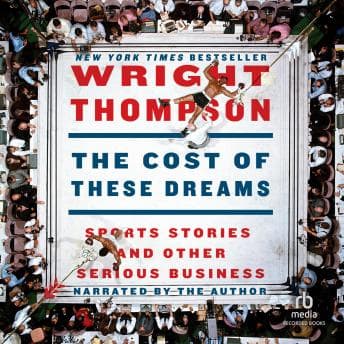

I was three hours into a logo redesign at 2 AM, Frida curled on my keyboard demanding attention, when Wright Thompson's voice broke something open in me. He was talking about Pat Riley—not the slicked-back hair and Armani suits Pat Riley, but the kid whose father never quite saw him. And I just... stopped designing. Sat there in the blue glow of my monitor, tears streaming, thinking about my own dad and the things we never say to each other.
This book wrecked me. Let's talk about why.
These Aren't Sports Stories, They're Ghost Stories
Here's the thing nobody tells you about Cost of These Dreams: Wright Thompson isn't writing about touchdowns or championships. He's writing about hauntings. Every single essay circles back to the same wound—fathers and sons, the things we inherit without choosing to, the way greatness often grows from the soil of something broken.
Michael Jordan's piece? It's not about the six rings. It's about a man who can't stop competing because stopping means facing the silence his father left behind. Tiger Woods? Same frequency, different pain. Urban Meyer literally destroying his own body because rest feels like failure. These men are running from something, and Thompson has this almost supernatural ability to name it without judgment. That same unflinching examination of what drives people to extremes—the kind that makes you uncomfortable because it's so true—reminded me of Thirty Years A Slave, though the context couldn't be more different.
I kept pausing to text my best friend quotes. "The cost of being great is being alone." That one hit different at 3 AM.
Wright Reading Wright
So here's where author-narrated audiobooks usually lose me—writers aren't performers, and I've suffered through enough monotone readings to be skeptical. But Thompson reading his own work? It's like the difference between someone describing a meal and actually tasting it.
His Mississippi accent softens the harder truths. There's this gentleness in his delivery, even when he's describing something devastating. When he reads about his own father (because yes, he turns that investigative lens on himself too), you can hear the catch in his voice. It's not polished. It's not perfect. But it's real in a way that a professional narrator couldn't fake.
I listened at my usual 1.0x because rushing through this felt wrong. Like eating abuela's mole in three bites instead of savoring every layer.
The Essay That Made Me Call My Dad
There's a piece about the children of famous athletes—what happens when your father is a legend and you're just... you. Thompson interviews these grown men who still sound like little boys waiting for approval that never came. One guy talks about finding his father's championship ring in a drawer, and how it felt heavier than anything he'd ever held.
I ugly-cried. Full-on mascara-ruining, cats-looking-at-me-concerned crying. Then I called my dad at 7 AM his time. We talked for an hour about nothing and everything. He was confused but happy. Abuela would have loved that—she always said I didn't call enough.
This is what great writing does. It makes you feel your own life more sharply.
Who Needs This (And Who Should Skip)
Look, if you want stats and game recaps, this isn't your book. If you think sports journalism means hot takes and highlight reels, you'll be bored—skip it.
But if you've ever wondered what drives someone to sacrifice everything for excellence—their health, their relationships, their peace—this collection will answer that question in ways that hurt. If you have complicated feelings about your own father (and honestly, who doesn't?), prepare to process some things. Non-sports fans, don't skip this. I couldn't tell you the rules of football if my life depended on it, but I understood every word because Thompson writes about people, not plays. The sports are just the backdrop. The real story is always the human one.
My Heart Needed This Ache
I finished the last essay during a thunderstorm, Diego pressed against my leg like he knew I needed grounding. Twelve and a half hours of listening, and I felt like I'd been through therapy. The good kind, where you cry a lot but come out understanding yourself better.
Wright Thompson writes like he's trying to save his own life by understanding others. And somehow, in the process, he helps you understand yours too. That's rare. That's worth protecting.
Abuela would have loved this one. She always said the best stories make you feel less alone in your own pain. She was right. She usually was.






![Steve Jobs [unabridged audiobook] audiobook cover](/_next/image?url=https%3A%2F%2Fcovers.audiobooks.com%2Fimages%2Fcovers%2Ffull%2F9788499923406.jpg&w=1920&q=75)