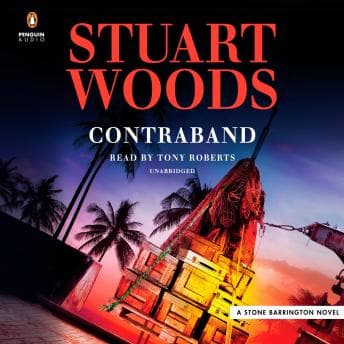

I was grading Gatsby essays at 11 PM—the ones where students insist the green light represents money and nothing else—when I needed something to keep me awake that wouldn't require the analytical attention I'd already exhausted. Contraband seemed perfect. Light thriller, familiar character, Tony Roberts doing his reliable Stone Barrington thing. What I got was... well, let me explain.
The Fiftieth Stone and What That Actually Means
Here's something my students don't understand about serialized fiction: by book fifty, you're not reading a novel anymore. You're attending a reunion. Stuart Woods wrote over ninety books before he passed, and this particular entry in the Stone Barrington saga carries all the weight and weightlessness that implies. The man was a craftsman of a very specific product—airport thrillers that move fast, feature a protagonist who beds beautiful women and solves crimes with suspicious ease, and never ask too much of their audience.
The premise involves something literally falling from the sky in Key West—contraband, naturally—and Stone teaming up with a local detective who is, predictably, both sharp-witted and attractive. Evidence keeps vanishing. Stone bounces between Florida sunshine and Manhattan streets. Old acquaintances resurface with suspicious timing.
If you've read any Stone Barrington, you know exactly what you're getting. That's either a comfort or a complaint, depending on your expectations.
Tony Roberts and the Art of Showing Up
Roberts has been voicing Stone for years now, and his performance here is... professional. Competent. He knows this character the way I know which students are actually doing the reading versus which ones are summarizing SparkNotes. There's an ease to it that works for this kind of material.
But here's my honest assessment: at seven hours and change, this is a breezy listen, and Roberts delivers it at exactly that tempo. The dialogue snaps along—Woods always had an ear for snappy exchanges—and Roberts handles the rhythm well. He's not doing anything surprising, but he's also not getting in the way.
I found myself wishing for more texture in the supporting cast. The "alluring local detective" sounds pretty much like every other alluring woman Stone encounters, which is to say, slightly breathier than the men but otherwise interchangeable. This isn't a performance that demands your full attention, which might actually be the point.
The Elephant in the Beach House
Let me be honest about something the longtime fans are saying: this isn't Woods at his best. Multiple readers who've followed all fifty Stone novels have noted that Contraband feels thin compared to earlier entries. The bed-hopping has apparently reached what one frustrated listener called "way past ridiculous" territory. The mystery itself—evidence disappearing, connections between old and new characters—feels more like a sketch than a fully realized plot.
And yet.
I finished it. I wasn't bored. At 11 PM with a stack of essays about symbolism in the Jazz Age, I didn't need Faulkner. I needed something that moved, that entertained, that didn't require me to underline passages for later analysis. Woods delivered exactly that, even if it wasn't his strongest work.
This reminds me of what Hemingway said about writing—that the first draft of anything is garbage. Woods wrote so many books that some of them were inevitably going to be first-draft quality, even after editing. That kind of relentless output reminds me of the sheer volume in Passionate Friends, though that one at least felt like it had something to say. Contraband feels like a book that exists because the machine needed feeding, not because the author had a burning story to tell.
Who Gets a Hall Pass for This One
Stone Barrington completists and fans of breezy, no-stakes thrillers will find exactly what they're looking for. If you need background listening for commutes, chores, or faculty meetings about budget allocations—this delivers. Skip it if you're new to the series (start earlier) or if formulaic plotting makes you itch. This is book fifty, and it reads like book fifty.
Mr. Williams's Final Grade
This is background listening. The literary equivalent of a CBS procedural—you know the formula, you know the outcome, and there's genuine pleasure in watching competent professionals execute a familiar pattern. Stone will solve the case. Stone will sleep with attractive women. Stone will make dry observations about the criminal element.
My students would hate this. They'd call it formulaic, predictable, empty calories. And they wouldn't be wrong. But sometimes empty calories are exactly what you need. Sometimes you don't want to analyze the green light. Sometimes you just want to watch a rich lawyer shoot bad guys in Key West.
Just don't come to it expecting the series at its peak. Come to it expecting exactly what it is: book fifty of a long-running series, written by a prolific author who knew his audience and delivered accordingly. The prose doesn't demand to be savored—it demands to be consumed, quickly and without much thought, like a beach read that happens to involve smuggling and gunfire.
Denise asked me what I was listening to during our lakefront walk last weekend. "Junk food," I told her. She nodded. She understands.