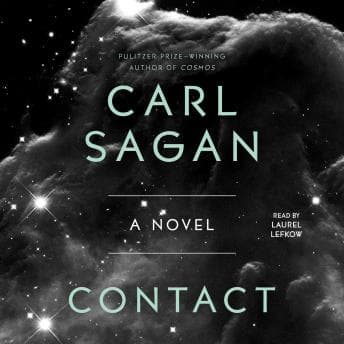

I was walking the lakefront with Denise last Tuesday - one of those gray Chicago mornings where the lake looks like hammered steel - when Ellie Arroway first heard the signal. And I stopped walking. Just stood there on the path while joggers went around me, because Sagan had done something I hadn't felt in years of teaching literature: he'd made me feel genuinely small.
This is why we still read the classics. Or listen to them, in my case, at 1.0x because Carl Sagan chose those words and I choose to hear them properly.
The Scientist Who Could Write
Look, here's the thing about Contact that my students would hate and I love: it's slow. Deliberately, philosophically, beautifully slow. Sagan wasn't interested in alien invasion tropes or space battles. He wanted to ask what it would actually mean - politically, religiously, personally - if we weren't alone. And he takes nearly fifteen hours to explore that question from every conceivable angle.
The science is dense. There are passages about prime numbers and radio astronomy that feel like sitting in on a graduate seminar. But Sagan was that rare creature: a working scientist who could actually write. The prose deserves to be savored. He moves from hard physics to philosophical inquiry without ever making you feel like you're being lectured to. (Don't tell my students I said that - they'd wonder why my lectures don't work the same way.)
Ellie Arroway is the kind of protagonist literature doesn't give us enough of. A woman defined by her intellect, her loneliness, her fierce commitment to truth. She's not particularly likable in the conventional sense. She's prickly and obsessive and sometimes wrong. She feels real.
Laurel Lefkow Gets It
I'll be honest - I didn't know Lefkow's work before this, and I couldn't find much about her background. But based on these fifteen hours together? She understands that pause is punctuation.
Her voice has this calm, gentle quality that matches Sagan's contemplative style perfectly. When Ellie is processing something enormous - and there's a lot of enormous in this book - Lefkow gives the moment room to breathe. She doesn't rush the science, doesn't dramatize the philosophy. She trusts the material.
The character voices are interesting. She does accents - Russian, French, a Southern drawl for the religious antagonist - and some work better than others. The male antagonist voices can get a little gargled, a little exaggerated. I noticed it, then stopped noticing it, then noticed it again during a particularly tense scene. Not a dealbreaker, but if you're sensitive to that kind of thing, you might find it distracting.
What matters: she nails Ellie. And Ellie is the whole book.
When the Signal Changes Everything
The first half is setup - Ellie's childhood, her career, the politics of radio astronomy funding (somehow riveting, don't ask me how). Then the signal arrives. And the book becomes something else entirely.
Sagan was writing in the mid-80s, and you can feel the Cold War anxiety running through every international negotiation. The multinational cooperation required to respond to an alien message - the petty nationalism, the religious panic, the media circus - it all feels uncomfortably prescient. I was grading papers at 11 PM when the political machinations really kicked in, and I had to put the red pen down. Couldn't focus on comma splices when Sagan was dismantling human tribalism.
The ending is polarizing. I know that. Some people find it anticlimactic. I found it devastating in the best possible way. Hemingway said the dignity of movement of an iceberg is due to only one-eighth of it being above water. Sagan's ending is all iceberg. What's left unsaid matters more than what's said. Lord of the Flies does something similar - Golding trusted his readers to sit with the horror instead of explaining it away.
Who Should Listen (And Who Should Skip)
If you need action, look elsewhere - the pacing will lose you. If accents that occasionally miss bother you more than they should, fair warning. But if you loved Cosmos, this is its spiritual successor in novel form. If you've never read Sagan, this is a hell of an introduction. My students would zone out by chapter three. I love it.
The Red Pen Can Wait
Is this audiobook perfect? No. There are stretches where the science gets technical enough that I had to rewind.
But here's what I kept thinking about, days after finishing: Sagan wrote this as a love letter to scientific inquiry, to the idea that asking questions matters more than finding answers. He was dying when he wrote it, though he didn't know it yet. And you can feel that urgency underneath the careful prose. A man trying to say something important about what it means to be human in an incomprehensibly vast universe.
Listen at 1.0x. Trust me on this one. The author chose those words.