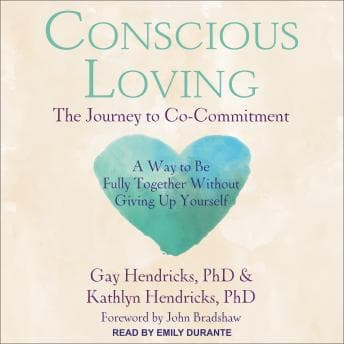

What if the biggest bug in your relationship isn't your partner—it's the code you inherited from your family of origin?
That question hit me somewhere around hour three, stuck on a delayed Caltrain at Millbrae, watching a couple in the seats ahead having one of those whisper-arguments where you can tell they're both losing. I almost wanted to hand them my phone. Almost.
The Framework That Actually Compiles
Bottom Line: This is basically debugging documentation for your relationship operating system. Gay and Kathlyn Hendricks spent 40+ years figuring out why smart, well-intentioned people keep running the same dysfunctional loops in their partnerships. Their answer? Unconscious agreements—these invisible contracts we made as kids that we're still executing as adults without ever reading the source code.
The core concept they introduce is "co-commitment" versus "co-dependence," and honestly, the distinction clicked for me faster than most self-help frameworks. Co-dependence is when you're both optimizing for the relationship at the expense of yourselves. Co-commitment is when you're each responsible for your own growth AND the relationship. It's the difference between a monolith and microservices architecture—one scales, one doesn't.
What I appreciated: they get specific. The "microscopic truth" concept isn't just "be honest with your partner." It's about catching yourself in the micro-lies you tell all day. "I'm fine" when you're annoyed. "It doesn't matter" when it does. They argue these tiny untruths accumulate into massive trust debt. As someone who's watched technical debt take down production systems, this metaphor landed hard.
Where the 1990s Shows (And Where It Doesn't)
Look, this book was originally published in 1990. You can feel it in spots—some of the examples have that Reagan-era relationship energy, and there's a heteronormativity to the case studies that feels dated. But here's the thing: the underlying principles are solid. Power struggles, control issues, the dance between closeness and separateness—these are platform-agnostic problems.
Emily Durante's narration is clean and professional. No vocal fireworks, but she doesn't need them. This isn't fiction requiring character voices—it's a textbook for your emotional life, and Durante reads it like a competent instructor who actually wants you to understand the material. I bumped it to 1.5x after the first hour with zero comprehension loss.
The exercises are where this book either wins or loses you. There are breathing techniques, body awareness practices, communication scripts. If you're the type who actually does the homework (I am not, generally, but Kevin made us try a few), there's real utility here. If you're just looking for insight without action, you'll still get value, but maybe 60% of what's available.
The ROI Calculation
At 10+ hours, this is a commitment. The Hendricks repeat concepts—sometimes it feels like they're writing for people who need the message drilled in, which, fair, most of us do when it comes to relationship patterns. But if you're a quick study, some sections will feel padded.
Perfect for: commute, long walks, Sunday cleaning. Skip for: gym (too much to process while lifting) or anything requiring split attention.
Here's my honest take: if you've read other relationship books and they felt too surface-level, this goes deeper into the mechanics. Firekeeper's Daughter also doesn't hold back on the heavy stuff—different genre entirely, but that same commitment to going deep instead of skimming the surface. If you've never done any relationship work, this might be intense as a starting point. It's not "5 Easy Tips for Better Communication"—it's more like "Here's Why You Keep Sabotaging Intimacy and How to Rewrite Those Patterns."
Kevin and I listened to chunks of this together on a road trip to Tahoe. We had to pause multiple times because something would hit too close to home and we'd end up in an actual conversation about our actual relationship. Which is either the highest recommendation or a warning, depending on your tolerance for emotional processing at 70 mph.
Ship It or Shelve It?
Queue it up if: You're a couple who's basically solid but stuck in frustrating loops—the same argument you've had forty times, the distance that creeps in despite loving each other. The framework is sound, the advice is actionable, and the Hendricks clearly know their stuff from decades of practice. Also useful for individuals working on themselves before or between relationships; a lot of these patterns are things you bring to every connection.
Skip if: You want quick fixes, you're in crisis mode (get a therapist first), or you fundamentally disagree with the premise that you might be contributing to your own relationship problems.
I finished this across maybe eight commutes, and I'm still thinking about the "upper limits problem"—their theory that we unconsciously sabotage good things when they exceed what we believe we deserve. That one's going to take me a while to debug.