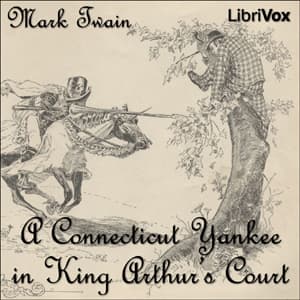

Everyone tells you this is a comedy. A lighthearted romp through Arthurian England with a wisecracking American. And sure, there's humor - Twain's humor, which means it's sharp enough to draw blood while you're still laughing. But nobody warned me that the last few hours of this book would hit like an IED you didn't see coming.
I picked this one up during a long weekend where Linda was visiting her sister and I had the house to myself. Ranger and I were rebuilding a section of fence in the backyard - Texas heat, cold beer, audiobook rolling through the workshop speaker. Seemed like the right vibe for Mark Twain. Light. Classic. Safe.
I was wrong about the safe part.
Hank Morgan Is Every American Who Thinks He Can Fix Everything
Let me cut to the chase - this book is from 1889 and it reads like a commentary on every nation-building exercise I've seen firsthand. Hank Morgan, a factory superintendent from Hartford, gets knocked unconscious and wakes up in sixth-century England. His immediate instinct? Modernize everything. Build factories. Install telephone lines. Train a military. Introduce democracy. Sound familiar?
Twain has Hank set up what he literally calls "Man-Factories" to educate the peasantry, and he establishes a network of secret schools and infrastructure projects - basically running a shadow government while publicly playing court magician. I've seen this scenario play out in real life, and Twain nails the hubris of it. Hank genuinely believes he's the smartest person in any room (and he usually is), but that doesn't mean his project ends well. The author clearly did their homework on human nature, even if the "homework" was just being Mark Twain and having zero illusions about people.
What surprised me was how contradictory Hank is - and how Twain seems fully aware of it. Hank rails against the Catholic Church's monopoly on spiritual life but champions religious freedom. He despises aristocratic power but builds his own technocratic empire that's arguably just as authoritarian. He mocks knights in armor but eventually arms his own followers with Gatling guns and electric fences. There's a passage where Hank casually discusses the economics of wage slavery versus literal slavery that could've been written yesterday. Twain doesn't resolve these contradictions. He just lets them sit there, daring you to pick a side. I ran into that same refusal to tidy things up in Tenth Circle — different century, different stakes, but the same authorial nerve to leave the wound open instead of stitching it shut for your comfort.
Steve Andersen - Steady Hand, Not a Show-Off
Andersen narrates this with what I'd call a clean, unaffected style. He's not doing theatrical voices for every knight and peasant - it's more of a thoughtful reading, like a smart friend telling you a long story over a campfire. His pacing is deliberate, with these measured pauses that actually work well for Twain's satirical timing. When Hank drops a dry observation about the locals, Andersen lets the silence do the work.
Here's the tradeoff though: if you're coming in expecting a full-cast performance or even strong character differentiation, you won't get it. Sandy and King Arthur and Merlin all sound roughly the same. For a 13-hour-45-minute listen, that can flatten some of the dialogue-heavy sections - and there are a LOT of dialogue-heavy sections, especially when Hank goes on extended philosophical tangents about democracy and taxation. I bumped my speed to 1.25x around hour two and never looked back. The early chapters where Twain establishes the setting through period-style narration within the narrative? They drag at normal speed. At 1.25x, it flows.
No sound effects, no music, just clean audio. Which is fine - this book doesn't need production gimmicks. It needs you to pay attention.
The Part Nobody Talks About
This is where it lost me - or rather, where it found me in a way I wasn't prepared for. The final act of this book turns genuinely dark. Without spoiling specifics, Hank's grand modernization project collapses into violence on a scale that's deliberately horrifying. Twain wrote one of the earliest descriptions of industrial-scale killing in fiction, and he did it as a warning dressed up as adventure. After twenty-five years in the Army, the ending didn't read like satire to me. It read like an after-action report.
Ranger put his head on my knee during the last hour. He's good at that.
Who This Is For (And Who Should Bail)
If you only know Twain from Tom Sawyer and Huck Finn, this will recalibrate your understanding of the man. He was angrier and sadder than most people realize. If you want pure action-adventure, you'll get some - jousting, escapes, a few genuinely funny set pieces involving knights on bicycles - but this is really a book of ideas wearing an adventure costume.
Skip it if slow-building satire makes you restless. Skip it if you need distinct character voices from your narrator. But if you've ever tried to bring order to a place that didn't ask for it, and watched the whole thing come apart? Worth your time. Here's the debrief: it's Twain at his most ambitious, Andersen at his most reliable, and a story that's aged better than it has any right to.
Ranger approved this one. Quietly.