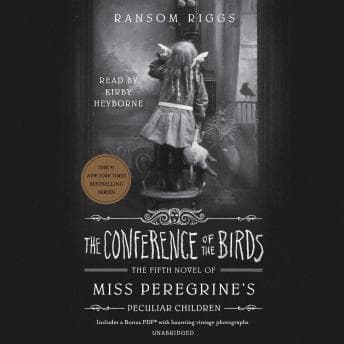

Book 5 of anything is a trust exercise.
Kevin was visiting his parents in Fresno, I had the apartment to myself, and I was halfway through reorganizing my closet when I realized I needed background audio that wouldn't demand too much brain. Conference of the Birds seemed perfect - I'd binged the first four Miss Peregrine books over a few months of commutes last year, figured this would be a comfortable return to a world I already had cached in memory. Turns out the book was counting on exactly that. Maybe too much.
The "No Previously On" Problem
TL;DR: Worth your commute, but only if you've recently finished A Map of Days. Maybe literally the week before.
Here's my biggest gripe: Ransom Riggs drops you back into Jacob Portman's world with zero recap. None. No "last time on Peculiar Children," no convenient exposition dump, no helpful character reintroductions. It's like joining a standup at your new team and everyone's already three sprints deep into a project with no wiki page. I finished book 4 maybe eight months ago, and by chapter two I was genuinely fuzzy on who half these American peculiars were and why we were running from what we were running from.
I should have re-listened to Miss Peregrine's Home for Peculiar Children first—the later books assume you've got the world-building cached, but that one actually does the caching.This is book 5 of 6 in the series, and it plays like it. The story picks up mid-sprint with Jacob stepping into a leadership role, and if you don't remember the political dynamics between ymbrynes and the American peculiar underground, you're going to be reconstructing context from vibes alone. I paused twice to look things up, which - when your hands are full of hangers and sweaters - is annoying.
Jacob Finally Ships His Character Arc
Okay, so the good stuff. The back half of this book genuinely surprised me. Jacob Portman has been kind of a reactive protagonist for most of this series - things happen to him, he responds, rinse and repeat. But somewhere around the midpoint of Conference of the Birds, he starts actually making decisions that carry weight. There's a shift from "boy stumbling through a weird world" to "guy who understands the cost of his choices," and it hits different in audio because Kirby Heyborne adjusts his delivery to match.
Heyborne's Jacob in the early chapters sounds like the same slightly-bewildered teen from the first trilogy. By the dramatic ending sequence - which, without spoiling it, involves some genuinely tense stakes - his voice drops into something steadier, more deliberate. It's subtle. Not a completely different voice, more like watching a variable get reassigned in real-time. The tone shift mirrors the series' own pivot from quirky-British-island-adventure to something darker and more American in scope, and Heyborne handles that transition well.
That said, his character differentiation is... fine? He does tone shifts more than distinct voices. You can tell who's talking from context, but if you zone out for thirty seconds on a crowded train (or while wrestling with a fitted sheet), you might lose track of which peculiar is speaking. It's not a dealbreaker, but it's not Ray Porter-level character work either.
I've heard Heyborne stretch more in Magic of Recluce, so this might have been a deliberate, subdued choice that just didn't click for me.The Pacing Runs Like an Unoptimized Query
At 9 hours and change, this isn't a massive commitment. But the pacing is uneven - the first third feels like setup and travel, the middle section picks up with some genuinely creepy peculiar-world-building, and then the ending accelerates hard. Like, sprint-to-the-finish hard. I finished those last two hours while making dinner because I actually needed to know what happened, which - for a book I'd been half-listening to while folding laundry - says something.
The problem is that the slow early section is where you're most likely to lose casual listeners. If you're not already invested in this world, the first three hours will feel like mandatory reading for a class you didn't sign up for. The characters sometimes feel weirdly British in their mannerisms despite the American setting, which creates this tonal friction that I couldn't quite shake.
But when it clicks - when Jacob's peculiar abilities become central to the plot and the group dynamics start fracturing - it clicks. The dramatic ending left me wanting book 6 immediately, which is exactly what a penultimate series entry should do.
Perfect For: Series Loyalists. Skip For: Everyone Else
Look, this is not a standalone. Don't even try. If you haven't read at least books 1-4, this will make approximately zero sense and you'll hate it. If you HAVE read the series but it's been a while, honestly consider skimming a recap online before pressing play.
For committed fans: this is a solid entry that sets up what I'm hoping is a big payoff in the finale. Jacob's growth is the highlight, Heyborne keeps things moving, and the ending will make you immediately queue up The Desolations of Devil's Acre.
One note: the listing mentions a PDF with vintage found photographs, which are a huge part of the print experience. You obviously lose that on audio. It's not a fatal flaw - the story works without them - but you're missing some context that the physical books provide. Something to know going in.
The ROI on This One
The ROI on this audiobook is decent if you're already deep in the series, minimal if you're not. At 1.5x speed, I got through it in a Saturday of apartment puttering, and while it didn't blow me away, that ending bought enough goodwill to keep me going. Heyborne is a reliable narrator even if he's not doing anything spectacular here, and the story delivers where it counts - just not always when it counts.
Perfect for: light housework, commute (if you're caught up on the series). Skip for: deep work, first-time listeners, anyone who needs a recap.