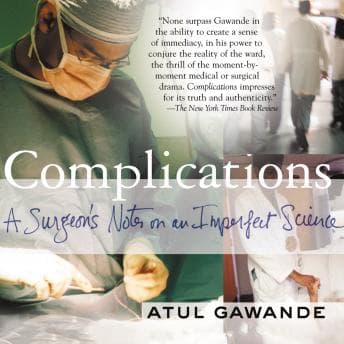

I was wide awake at 3AM last Tuesday - another production incident, another Redis cluster deciding it didn't believe in consistency anymore - and while waiting for replicas to sync, I started this book. Finished it the next morning on the train. And honestly? Atul Gawande did something I didn't expect: he made me feel better about my own job by showing me one that's way more terrifying.
TL;DR: Worth your commute. This is basically a postmortem analysis of the medical profession, except the failed deployments are human bodies and the rollbacks don't exist.
Debugging Humans Without Stack Traces
Gawande structures this book like a series of incident reports from the OR, and if you've ever written or read a blameless postmortem, you'll recognize the format immediately. He walks through cases where surgeons had incomplete information, made judgment calls under pressure, and sometimes got it wrong. There's a section on the learning curve for new procedures - how many times does a resident need to practice inserting a central line before they're competent? - that hit uncomfortably close to home. We talk about junior engineers needing to break things to learn, but at least our broken things don't bleed.
The chapter on how good surgeons go bad is genuinely unsettling. Gawande describes a case where a perfectly competent surgeon's error rate starts climbing, and nobody knows how to intervene because medicine has no good system for it. It's the human equivalent of performance degradation with no clear root cause. No alerting threshold. No runbook. Just colleagues quietly noticing and not knowing what to say.
Then there's the story about a newscaster whose blushing was so severe it destroyed her career. Gawande uses it to explore the boundary between what medicine can explain and what it can't - she ultimately gets surgery to sever the nerves that cause blushing, which works but comes with permanent side effects. The question of whether that trade-off is worth it doesn't have a clean answer, and Gawande doesn't pretend it does.
The Narrator Handles Medical Jargon Like It's His Native Language
William David Griffith is not Ray Porter. (I know, I know, I measure all narrators against Ray Porter. Kevin says this is unhealthy. Kevin is correct.) But Griffith is genuinely good here. The medical terminology flows out of him without any of that awkward pause-before-big-word thing you get with narrators who clearly practiced the pronunciation five minutes before recording. He's got this slightly warm, slightly clinical tone that matches Gawande's writing perfectly - like a really good attending explaining something complicated during rounds.
No character voices needed here since this is nonfiction, but Griffith modulates well between the tense surgical scenes and the more reflective passages. The pacing is steady without being monotonous. Clean production, no audio weirdness.
One thing worth flagging: this is the abridged version. Around 7 hours and 49 minutes, which means some chapters from the print edition are missing. I didn't notice obvious gaps while listening, but if you've read the book before, you might feel like something's been trimmed. For a first-time listener, it works fine as a complete experience, but it bugs me on principle. Give me the unabridged or give me death. (Okay, that's dramatic. But still.)
The Science Actually Holds Up (Mostly)
Gawande was a surgical resident at Brigham and Women's when he wrote this, and you can tell. The medical details feel lived-in, not researched-from-Wikipedia. He's honest about what he didn't know, what he got wrong, and what the profession as a whole gets wrong. The book is from 2002, so some of the specific medical practices have evolved, but his core argument - that medicine is fundamentally uncertain and we should be honest about that rather than pretending doctors are infallible - hasn't aged a day.
If anything, it's more relevant now. Replace "surgeon" with "ML engineer deploying a model that makes decisions about human lives" and half of Gawande's ethical dilemmas map directly.
Perfect For: Train, Gym. Skip For: If You're Squeamish Pre-Coffee
The ROI on this audiobook is solid. Under 8 hours means I finished it in about 3 commutes at 1.5x. It's dense enough to keep your brain engaged at 6AM but structured in discrete case studies so if you zone out for a minute, you can pick back up without being lost. That's the ideal commute format.
Skip this if detailed descriptions of surgery make you queasy - there's a reason I waited until 3AM adrenaline mode to start it. Trident K9 Warriors is another one I'd file under "high-stakes decisions, incomplete information, humans doing their best" - different domain entirely, but that same uncomfortable honesty about what training can and can't prepare you for. Also skip if you want something unabridged. But if you liked The Checklist Manifesto (which, let's be real, could've been a blog post but was still good), this is Gawande's better, darker, more honest predecessor.
If you work in any field where you make high-stakes decisions with incomplete data - so, basically everyone in tech - this book will make you think differently about error rates, learning curves, and the uncomfortable truth that expertise is never as certain as we want it to be.





![Steve Jobs [unabridged audiobook] audiobook cover](/_next/image?url=https%3A%2F%2Fcovers.audiobooks.com%2Fimages%2Fcovers%2Ffull%2F9788499923406.jpg&w=1920&q=75)