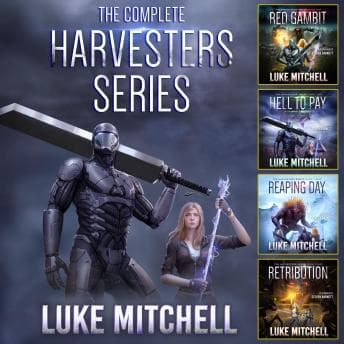

"He just wanted his exosuit back."
That's it. That's the pitch. And honestly? That line alone had me clicking play at 1 AM on a Tuesday when I should've been debugging my procedural terrain generator. (Dr. Patel, if you're reading this — I wasn't. I was definitely working on my thesis.)
Forty hours later, I emerged from the Complete Harvesters Series Collection like someone crawling out of a bunker after the alien invasion actually ended. Bleary-eyed, slightly dehydrated, and genuinely annoyed that it was over.
Exosuits, Snarky AIs, and Aliens That Earn Their Body Count
Luke Mitchell built something here that scratches a very specific itch — the "what if Mass Effect and Fallout had a baby raised on Star Wars dialogue" itch. Jarek is basically what happens when you give a D&D fighter an Iron Man suit and a wisecracking AI companion named Al (yes, like the name, and yes, the banter between them is half the reason to keep listening). Rachel's the arcanist — and before you roll your eyes at "magic in my sci-fi," Mitchell actually earns it. The arcane system here isn't hand-wavy nonsense. There are rules, there are costs, and when Rachel pushes past her limits, you feel the consequences. The magic system is chef's kiss.
The raknoth — the alien invaders — could've been generic big bads, and in Book One they kind of skirt that line. Red Gambit is very much a setup book. You're meeting characters, learning the post-invasion status quo, figuring out who's trustworthy and who's going to betray everyone by Act Three. But Mitchell does something smart: he keeps the personal stakes tight. Jarek wants his exosuit. Rachel wants her brother. These aren't galaxy-brain save-the-world motivations — they're selfish, human, and that's exactly why they work. The world-saving stuff creeps in gradually across Hell to Pay and Reaping Day until by Retribution you're fully locked in on the macro conflict without ever feeling like Mitchell pulled a bait-and-switch.
The progression is satisfying. Jarek and Rachel's power growth across four books feels earned rather than handed to them, and the escalation of threats scales with it. By the back half of the series, the stakes are legitimately apocalyptic, but it never loses that scrappy underdog energy.
Steven Barnett Does the Heavy Lifting at 1.25x
Look, I'll be upfront — I don't have a ton of specific intel on Barnett's voice work here, and he's not someone I'd listened to before this. He's no Steven Pacey (Steven Pacey walked so other narrators could run, and I will die on that hill), but Barnett handles the comedic timing well, which matters enormously for a series that leans this hard into quippy dialogue. Jarek's sarcasm lands. The action sequences have genuine urgency in his delivery — there's a breathlessness to the combat narration that kept me engaged even during my third consecutive hour of listening while "organizing" my board game shelf. (I was not organizing. I was standing in front of it, holding a copy of Gloomhaven, completely zoned out on alien warfare.)
What I can't tell you is whether his character voices are wildly distinct from each other. Honestly, at forty hours, I was deep enough into the story that my brain filled in the gaps regardless. Your mileage may vary if you're someone who needs crystal-clear vocal differentiation between fifteen characters. I bumped it to 1.25x around the middle of Book Two and never looked back — default pace felt just a touch leisurely for the action-heavy sections.
Who's Suiting Up and Who Should Walk Away
If you're into LitRPG-adjacent sci-fi — and yes, I will defend LitRPG with my dying breath — this scratches a similar itch even without literal stat blocks. The power progression, the gear obsession (Jarek and that exosuit, man), the party dynamics between Jarek and Rachel that feel like a two-person adventuring group figuring out how not to TPK. My D&D group would love this.
If you don't like info-dumps, this isn't for you (but you're wrong). Mitchell front-loads world-building, especially in Red Gambit, and you either vibe with that or you don't.
Skip this if you want hard sci-fi. The science here is firmly in the "rule of cool" camp. Skip it if snarky male protagonists make you want to throw your phone. On the opposite end of that spectrum, Revelation Space is the hard sci-fi experience where the science absolutely does not care about your feelings — I bounced off it twice before it finally clicked, and even then I needed a spreadsheet. Jarek is a lot, especially early on.
But if you want 40 hours of rip-roaring post-apocalyptic adventure with genuine heart underneath the wisecracks? Yes, it's 40 hours. Yes, it's worth it.
I Read This Instead of Writing My Thesis (No Regrets)
The Harvesters Collection isn't trying to be Sanderson-level world-building or some literary genre-bender. It's trying to be a blast, and it succeeds. Mitchell writes action and character banter better than he writes quiet introspective moments — the few slower emotional beats in Books Three and Four feel a little undercooked compared to the kinetic stuff — but that's a minor gripe in a series that kept me up past 3 AM on a work night more than once. I came for the exosuit. I stayed for Jarek and Rachel figuring out how to not hate each other while the world burned around them.
Now if you'll excuse me, I have a thesis to pretend to work on.