
This book could've been a blog post. Okay, maybe three blog posts. But definitely not 9 hours and 38 minutes.
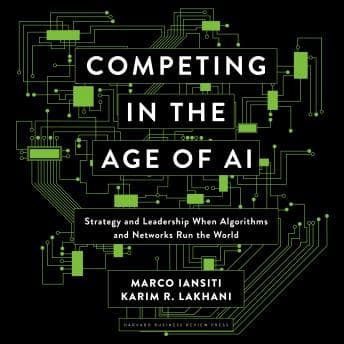
Let me back up. I started this on a Monday morning, 6:12 AM, standing room only on the Caltrain, coffee threatening to spill every time someone's backpack shifted. And honestly? The first couple chapters hit different when you're literally commuting to a company that runs on the exact operating architecture Iansiti and Lakhani are describing. They break down how firms like Amazon, Ant Financial, and Microsoft have rebuilt themselves around data and AI pipelines - not as a feature bolted on, but as the actual operating model. The "AI factory" framework they introduce is genuinely useful. Think of it as: data pipeline in, prediction out, feedback loop back in. If you've ever architected a microservices system, the analogy lands immediately. Your company isn't using AI. Your company is an AI system. Or it's not, and that's the problem.
The Framework That Actually Ships
The strongest section is their breakdown of how AI removes traditional constraints on scale, scope, and learning. They use Ant Financial as the centerpiece example - how it processes loan applications in seconds with virtually zero marginal cost, versus traditional banks that need humans reviewing paperwork. The network effects discussion is solid too. If you've read anything about platform economics, some of this will feel like a refresher, but they tie it together with enough real-world case studies that it doesn't feel entirely redundant. The Peloton analysis, the discussion of how traditional automakers are scrambling to compete with Tesla's software-first model - these land well.
But here's where my frustration kicks in. The book repeats its core thesis roughly every 45 minutes. AI removes constraints on scale. AI enables scope expansion. AI accelerates learning. Got it the first time. Got it the second time. By the fifth time, I was reaching for the 1.75x button. And this is a 9.5-hour book. At 1.5x that's still over 6 hours of listening, and I'd estimate maybe 4-5 hours of actual unique content. The ROI on this audiobook is... middling, because you're paying a time premium for a lot of restatement.
Steven Jay Cohen and the Pause Problem
Okay, the narrator situation. Steven Jay Cohen has a perfectly pleasant voice. Clear, professional, the kind of narrator who sounds like he should be reading business books. But - and this is a real problem for audiobook consumption at speed - he inserts these bizarre pauses in the middle of sentences that completely fracture the meaning. Like, imagine reading "AI removes traditional... constraints on scale" where that pause makes your brain parse it as two separate thoughts before realizing it's one clause. At 1.5x speed, some of these pauses compress into something tolerable, but at normal speed? Multiple listeners have flagged this, and one even speculated the narration itself might be AI-generated. I don't think it's that extreme, but the pacing is genuinely distracting. For a book that demands you track frameworks and case study details, having the narrator's rhythm work against comprehension is a real cost.
I actually had to rewind twice during the Ant Financial section because a weirdly placed pause made me lose the thread of the argument. On a train. At 6 AM. That's not great.
Who This Is Actually For (and Who Should Just Read the HBR Article)
If you're a product manager, strategy consultant, or anyone trying to make the case internally for AI-first transformation, this gives you the vocabulary and framework to do it. The "collision" chapter about AI-native companies disrupting traditional firms is genuinely useful ammo for strategy decks. If you're a software engineer who already lives in this world - you already know most of what's here. You just know it from the implementation side rather than the MBA side. Reading it felt like watching someone explain Kubernetes to a boardroom. Correct, but not exactly new information for the people building the clusters.
Perfect for: people who need the strategic language around AI transformation. Skip for: anyone who's already read two or more books on platform economics or AI strategy. You've heard this song. The Infinite Game gives me the same vibe - big repackaged ideas dressed up in framework language that consultants will love and practitioners will find familiar.
The Commit Message
Solid framework, genuinely useful case studies, but padded beyond what the content warrants and undermined by narration that fights you instead of helping. I'd honestly recommend reading the physical book over the audiobook here - the pause issue is a real degradation of the experience, and business books with repetitive structure don't benefit from the forced-linear nature of audio. If audio is your only option, bump to 1.75x and treat it as background reinforcement rather than deep learning. I finished it in about 4 commutes at 1.5x, but I could've gotten 80% of the value in 2.








![Steve Jobs [unabridged audiobook] audiobook cover](/_next/image?url=https%3A%2F%2Fcovers.audiobooks.com%2Fimages%2Fcovers%2Ffull%2F9788499923406.jpg&w=1920&q=75)