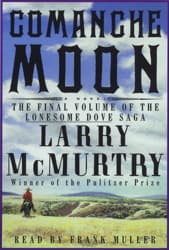

Look, I'll be honest - I didn't expect to spend 24 hours of my life riding across Texas with a bunch of Rangers chasing Comanches. But here we are, and I regret nothing. (Okay, I regret not finishing my thesis proposal, but that's a separate issue.)
Comanche Moon sits right in the middle of McMurtry's Lonesome Dove saga, filling in those twenty years between Dead Man's Walk and the Pulitzer Prize-winning main event. And if you're already invested in Gus McCrae and Woodrow Call? This is basically required reading. Or listening. You know what I mean.
The Slow Burn That Earns Every Minute
McMurtry writes Westerns the way Sanderson writes fantasy - there's a system to everything, a logic to how the world works, and he's going to make sure you understand it. American Gods has that same methodical world-building approach, where understanding the rules matters as much as the action. The pacing is leisurely. And I mean leisurely. This isn't a shoot-em-up action fest. It's a character study wrapped in frontier violence, wrapped in existential dread about what happens when two worlds collide and one of them has to lose.
Gus and Call are in their middle years here, which means they've got enough experience to be dangerous and enough baggage to be interesting. Gus is still pining after Clara Forsythe - the man cannot let go, and honestly, mood - while Call is doing that thing where he refuses to acknowledge his feelings for Maggie Tilton because emotional vulnerability is apparently worse than getting shot at by Comanches.
The villains absolutely steal scenes. Buffalo Hump as the Comanche war chief carries this weight of a dying way of life, and Ahumado the Mexican bandit king is genuinely terrifying in that "I will haunt your nightmares" way. McMurtry doesn't let you forget that everyone in this story thinks they're the hero of their own narrative.
Frank Muller Is a Gift We Didn't Deserve
Okay, so here's where I need to be real with you. Frank Muller's narration is... polarizing. I've seen reviews where people couldn't finish the book because his voice bugged them. His female characters can sound a bit off - there's this quality to how he does women's voices that takes some getting used to.
But once you're in? Once you've given it a few chapters to settle? The man is exceptional. His Captain Innish Scull is unforgettable - this eccentric, Harvard-educated Ranger captain who quotes Latin while tracking raiders. And Ahumado... Muller makes that character crawl under your skin. There's a reason he won the AudioFile Lifetime Achievement Award. Muller brings that same intensity to Dark Tower II: The Drawing of the Three, where his range across multiple characters is just as impressive. The emotional beats land. The quiet moments breathe. The violence hits hard.
I listened to most of this during a coding marathon when I should've been working on my procedural generation algorithms. (Dr. Patel, if you're reading this, I was definitely working on my thesis.) The pacing actually works perfectly for long listening sessions - it's not so intense that you burn out, but it's engaging enough that you don't zone out during the slower stretches.
This Is Not Your Quick Weekend Listen
Let's talk about the 24-hour runtime. That's basically the length of a D&D campaign arc. If you're not ready to commit, this book will punish you. But if you're the type who appreciates slow world-building, who wants to understand why characters make the choices they do, who enjoys watching a frontier civilization clash with indigenous peoples in all its messy, violent, morally complicated glory - this is your jam.
The violence is real, by the way. Content warnings for torture, some pretty graphic stuff with Ahumado's methods, and the general brutality of frontier life. There's also some sexual content and language. This isn't a sanitized Western.
Who's Rolling Initiative and Who Should Sit This Campaign Out
If you're already a Lonesome Dove fan, this is essential. If you're new to McMurtry, maybe start with Lonesome Dove itself and work your way here. Skip this one if you need fast pacing or can't handle graphic frontier violence - Ahumado's scenes especially aren't for the squeamish. And if you're on the fence about Frank Muller's narration style, give it three chapters before you decide. He grows on you.
Honestly? I'd probably listen again. Not immediately - I need to recover from the emotional weight of it - but this is the kind of audiobook that rewards a second listen. You catch things you missed. You appreciate the foreshadowing once you know where it's going.
Now if you'll excuse me, I have a thesis I've been avoiding and a sudden urge to reread the entire tetralogy instead of doing anything productive.